|
Trio gets Nobel accolade for work on cellular aging
(China Daily)
Updated: 2009-10-06 07:10
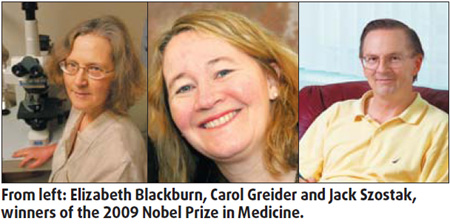
![]() STOCKHOLM: Australian-American researcher Elizabeth Blackburn and Carol Greider and Jack Szostak of the United States won the Nobel Prize in Medicine yesterday for identifying a key molecular switch in cellular aging. The trio were honored for the discovery of how chromosomes are protected by telomeres and the role of an enzyme called telomerase in maintaining or stripping away this vital shield. "The award of the Nobel Prize recognizes the discovery of a fundamental mechanism in the cell, a discovery that has stimulated the development of new therapeutic strategies," the Nobel jury said. The three told Swedish Radio they were overjoyed by the news. Greider said she was "just thrilled". "I just think that the recognition for curiosity-driven basic science is very, very nice," she said, adding that she was up doing laundry in the US when the early morning call came from Sweden. Blackburn said she knew when they made their discovery that they were on to something big. "I felt very excited ... and I thought this is very interesting, this is a very important result, and you don't often feel that about a result," she said. Szostak said meanwhile he expected "to have a big party at some point" to celebrate the prestigious award. Blackburn said she was awakened at 2 am. "Prizes are always a nice thing," she told The AP. "It doesn't change the research per se, of course, but it's lovely to have the recognition and share it with Carol Greider and Jack Szostak." Telomeres are a minute yet vital factor in aging. They are like a nubby, protective cap, fitting on the ends of the strands of DNA - the chemical recipe for life - that are packed into chromosomes. Blackburn and Szostak discovered in 1982 that a unique DNA sequence in the telomeres protects the chromosomes from degradation when the cells divide. With Greider, Blackburn also identified telomerase, the enzyme that makes the telomere DNA. If telomeres become worn, cells age.

But if telomerase levels are high, the telomere length is maintained, and cellular aging is braked. A small number of rare but very destructive diseases, including a form of severe anaemia, are linked to defective telomerase, resulting in damaged cells. Yet there is also a darker and more complex side to this picture. Many experts initially speculated that aging could be pinned to telomere shortening, but the process has emerged as something that encompasses different factors, as well as telomeres. In addition, high telomerase also helps cancer, enabling its cells to replicate endlessly and achieve what scientists call "cellular immortality". Finding ways of blocking this machinery through "telomerase inhibitors" is one of the most eagerly explored areas of cancer research. The trio's work has "added a new dimension to our understanding of the cell, shed light on disease mechanisms and stimulated the development of potential new therapies", the Nobel citation said. The three won the 2006 Lasker Prize, one of the most prestigious US science awards, for the same work. Blackburn has been a professor of biology and physiology at the University of California in San Francisco since 1990, while Greider is a professor in the department of molecular biology and genetics at Johns Hopkins University School of Medicine in Baltimore. Szostak is professor of genetics and Massachusetts General Hospital in Boston and affiliated with the Howard Hughes Medical Institute. He said winning the prize was made sweeter because it also included Blackburn and Greider. Ten women have won the prestigious medicine award since the first Nobel Prizes were handed out in 1901, but this was the first time that two women were honored in the same year. The Medicine Prize is the first award to be announced in this year's Nobel season. The Physics Prize will be announced today followed by the Chemistry Prize tomorrow. The Nobel prizes, founded by Swedish industrialist Alfred Nobel, were first awarded in 1901. Nobel, the inventor of dynamite, died childless in 1896, dedicating his vast fortune to create "prizes to those who, during the preceding year, shall have conferred the greatest benefit on mankind". Laureates receive a gold medal, a diploma and 10 million Swedish kronor ($1.42 million) which can be split between up to three winners per prize. The prizes are awarded in Stockholm and Oslo on Dec 10. AFP-AP (China Daily 10/06/2009 page1) |