> 2008 Lasting Legacy
Ban going up in smoke?
By Shan Juan (China Daily)
Updated: 2009-08-07 07:54

Ban going up in smoke? 

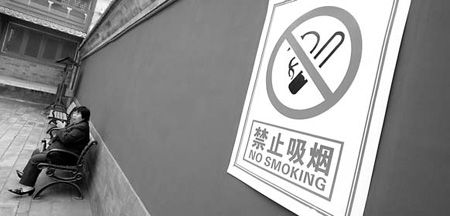
Beijing issued a regulation last year to ban smoking at Olympic-related facilities. Wu Changqing

For someone who puffed through two packs of cigarettes a day for the past seven years, Yuan Jian had a trying time during the Beijing Games.

The chain smoker became wary of lighting up in public last year, after a volunteer caught him with a cigarette at a non-smoking caf and told him to put it out.

Those difficult days are over, said the 31-year-old salesman.

"I never saw those anti-smoking volunteers again after the Games," he said.

With 350 million smokers, China is the world's biggest tobacco consumer.

But the authorities banned smoking in certain areas in the capital to enforce a smoke-free Olympic Games.

Still, officials and residents like Yuan say the health policy appears to be fading out.

"The post-Olympic smoking ban seems to be only on paper," said Yang Jie, deputy director of the anti-smoking office under the Chinese Centers of Disease Control and Prevention (CDC), which is closely connected to the Ministry of Health.

"Enforcement of the smoking ban at many public places is not as strict as before."

"I can see ashtrays on restaurant tables in non-smoking areas, with people smoking there," said Wang Lu, a college teacher in Beijing.

"The owners of such restaurants won't stop people from lighting up unless you ask them to. They don't seem to care much about the smoking ban now," Wang said.

The Beijing local government issued a highly publicized regulation on May 1 last year to completely ban smoking at Olympic-related facilities, including competition sites and designated hotels, as well as public venues such as schools, hospitals and transportation depots.

In restaurants, cafes, pubs and parks, smoking zones had to be marked clearly and could form no more than 30 percent of the establishment's area. The fine for a restaurant flouting the ban could amount to tens of thousands of yuan.

About 60,000 volunteers also fanned out to Olympic-related facilities to help thousands of law-enforcement workers patrolling public venues to enforce the ban before and during the Games.

A smoker like Yuan in a non-smoking area would be asked by a volunteer to put the cigarette out. Fines ranging from 200 to 1,000 yuan would be imposed if the smoker did not heed the request.

Restaurants and pub owners also faced heavy fines if they ignored the ban.

Beijingers said the smoking ban was well observed during the Games. A restaurant owner, surnamed Feng, said the supervision was "tight and the fine heavy".

Feng said his business even dropped at that time.

"Customers like dining, drinking, chatting and smoking at the same time," he said. "It was hard at first for us to stop customers even if they smoked in non-smoking areas."

One significant reason why the ban has not worked since the Games is that the governing body responsible for supervising the ban's enforcement has not been clearly defined, the CDC's Yang said.

The duty of handing out punishments for violators belongs to the Beijing Patriotic Health Movement Committee but without violations being submitted to the poorly staffed committee, the ban becomes futile, he said.

"That's the main reason why anti-smoking achievements made during the Games cannot be sustained," he said.

"When the call from government was strong, volunteerism was high and implementing the ban during the Olympics was forceful. Beijing was largely smoke-free in public places," Yang said.

Anti-smoking volunteers also left the scene gradually when the Beijing Games concluded, he said.

Undaunted, the Ministry of Health continues to take steps to curb smoking. Most recently, it launched an anti-smoking initiative with the China Medical Board and the Bill & Melinda Gates Foundation to build smoke-free campuses and smoke-free hospitals, as well as to improve hospital services for those interesting in kicking the habit.

Similarly, the government raised consumption tax on cigarettes by between 6 and 11 percent to curb smoking and add revenue to State coffers.

Until those measures take full effect, smokers like Yuan can continue to rest easy.

"I feel much more relaxed smoking in restaurants and bars now," he said.

(China Daily 08/07/2009 page14)