> 2008 Lasting Legacy
Clearing the air
By Chen Jia and Brian Liou (China Daily)
Updated: 2009-08-07 07:54

 Clearing the air

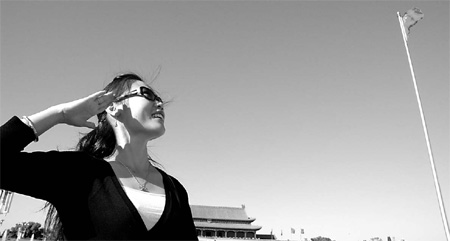
A visitor salutes the national flag in Tian'anmen Square. Liang Baoguo

The yellow, hazy sky was a common sight for Lao Han when he headed to work last year at the Shougang Group, a highly polluting factory in the capital that produces iron and steel.

Dirt was an annoying greeting he wiped from his desk every day.

For nearly two decades, Lao never worried about his health from the poor air quality - not until he heard of the factory's relocation as part of the government's efforts to clean up the air during the Beijing Olympics.

"I didn't care about it because I had my family to feed," the 38-year-old Beijinger told China Daily.

"I didn't want to move out of the capital."

He eventually chose to work for a branch of the group to remain in Beijing, even if it meant a lower salary.

Lao was one of about 60,000 people who faced new job arrangements because of the factory's relocation. About 13,000 workers who were nearing retirement also chose to quit early.

Still, Lao has remained upbeat about the change.

Clearing the air

"I am proud of my sacrifices when I see the blue sky from my office window now," said Lao. "It could be a good decision for our children."

Lao is not alone in his enthusiasm about the improving changes he has seen in Beijing's air quality. Thanks to the government's controversial clean-up measures to move hundreds of dirty factories, close down power plants and force at least 2 million cars off the road, officials and residents that China Daily spoke to agree they are breathing cleaner air these days.

"This year's pollution levels might actually be better than what the year of the Olympics experienced," said Wang Yuming, director of the international cooperation department of the All-China Environment Federation (ACEF), an interest group under the Ministry of Environmental Protection.

To that effect, the capital's air quality has continued to improve, with half of this year's target of a minimum 260 days of blue skies already met, the Beijing administration of environmental protection has said.

Air quality is measured by the air pollution index (API), which monitors the level of five airborne pollutants. A blue-sky day occurs when the API falls below 100, meaning there are no health implications. For the first time in nine years, there was no day with an API more than 150, a level when people with breathing or heart problems should limit outdoor activities.

Vehicular emissions have been another major part of the authorities' efforts to reduce pollution in the city.

In the run-up to the Olympics, the government restricted all motorists from driving at least one weekday depending on the last digit of their license plate numbers. The ban, which is in effect from 7am to 8pm on weekdays, was successful enough for it to be extended until April 10 next year.

But the ban is coming head-on with a booming auto market in Beijing, which has 3.6 million cars and rising: At least 1,400 more cars are introduced to the streets every day.

According to New York-based research company AC Nielsen, more people in China look forward to buying a car than those in any other country.

As such, not every driver is completely happy with the ban.

"It's troublesome remembering which day I can drive and which day I can't," said Beijinger Liu Liang, 26.

"But I guess it's a small price to pay for clean air."

A Cornell University study by Assistant Professor Max Zhang has also backed up claims that the air is clearing because of the ban.

Published in July, the study was based on air quality readings before, during and after the Olympics.

The researchers found that car emissions of black carbon were down 33 percent in 2008, the year the Olympics took place, compared with 2007. Carbon dioxide also dropped 47 percent in 2008 from the previous year's levels.

Encouraged by these figures, Beijing authorities are pushing ahead with efforts to clean up the capital.

Earlier this year, Du Shaozhong, deputy head of the Beijing administration of environmental protection, said the administration would focus on "eliminating high-emission vehicles, controlling dust at construction sites and decreasing the use of coal in the city this year".

 Clearing the air

Datang Gaojing Power Plant in Beijing's Shijingshan district has installed advanced facilities to protect the environment. Zhang Quanyue

(China Daily 08/07/2009 page14)