|
Sizzling revelations
By Chitralekha Basu (China Daily)
Updated: 2009-07-17 08:07
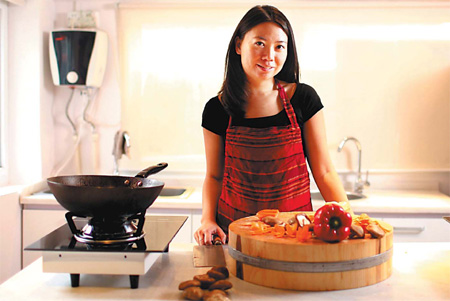
When Jen Lin-Liu arrived in Beijing in 2000 she disliked the local food. As a child of immigrant Chinese professionals, raised in the United States, her palate was already too well set. But by 2005, she had enrolled in a nondescript cooking school in a hutong, training with a bunch of wannabe chefs, trying to get a feel of the traditional ways of Chinese cooking. It was her way of breaking free of the comfortable expat bubble she had been living in, writing for prestigious international publications such as The New York Times and The Wall Street Journal. Lin-Liu's passion for traditional Chinese cuisine took her to many places - a run-down noodle stall catering to migrant workers in southeast Beijing, a dumpling house and finally a chic Shanghai restaurant - before she opened her own outlet, the Black Sesame Kitchen, in Beijing's Nanluoguxiang. She traveled extensively in China, observing the steadily-evolving dietary habits of the Chinese, in its socio-historical context, trying to make sense of the way food has evolved since the deprivation during the "cultural revolution" (1966-76) to the present time, when people were, in fact, mostly, "eating well". "I wanted to explain China through my writing," says Lin-Liu. "Food was a lens to view China with." Her wish is manifest in Serve the People: A Stir-fried Journey through China (Harcourt Inc) launched recently. From southern Chinese rice fields where primitive tools are still used for harvesting, to the lively wet vegetable markets in Beijing's hutong, pulled down to make way for concrete blocks, to jazzed-up Shanghai restaurants sourcing "beef from Australia and lamb from New Zealand yuzu from Japan and truffles from France", the food trail is like a multi-course dinner, laid out in its many-splendored variety. "The book's both a memoir and a cookbook and offers great insight into Chinese culture," says Candice Lee from Massachusetts, who now runs Black Sesame on Lin-Liu's behalf. "Jen makes traditional Chinese recipes easy, for foreigners and even for the Chinese." Among a wealth of Chinese dishes listed in the book, Lin-Liu has recommended her five favorites, including dessert, dumplings and noodles. Candied Apples (Basi Pingguo)

Lin-Liu digs the sticky sweetness of caramel-coated Fuji apples, deep-fried in a batter of flour and baking powder. Desserts are unheard of in Chinese cuisine, but as an American-Chinese growing up in southern California, Lin-Liu loves them, hence her partiality toward this dish. She picked up the recipe from "Chairman" Wang, her first real Chinese cuisine tutor whom she met at the Hualiang cooking school in a hutong in Beijing. The honorific preceding Wang's name had nothing to do with honor. It actually meant Wang was a low-paid girl Friday, who filled in as registrar, assistant to the school's president, assistant teacher, food purveyor, and de facto janitor - "all the tasks that no one else wanted to do". Lamb-and-Pumpkin Dumpling (Yangrou Nangua Jiaozi)
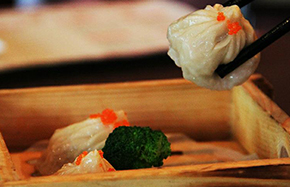
Dickinson pumpkins, oblong and yellowish, writes Lin-Liu in her book, are ideal for making this dish, blending seamlessly with ground lamb, while Butternut squash makes a good substitute. She warns against using the round, orange Halloween variety of pumpkin, "lacking in proper flavor and texture". Making the dish is a labor-intensive process. The ground lamb and water mix needs to be stirred vigorously with chopsticks 50 times in one direction, and after adding the soy sauce, another 50 times in the opposite. A further 10 strokes are required after the grated pumpkin is added. But the toil is less taxing when shared. "Making dumplings," says Lin-Liu, "is a group activity, through which one might get a real sense of bonding with the family." Knife-grated Noodles (Daoxiao Mian)
Lin-Liu was taken by "the performance aspect and the use of special blades" to make knife-grated noodles. She is also a huge fan of the savory pork and eggplant sauce that these are served with. But the intricate art of chipping off thin strands of dough from a potentially-lethal block of kneaded flour, 20 cm long, 10 cm wide, and 8 cm thick, was an acquired skill. And Chef Zang, with whom she interned in a non-descript noodle shop stashed away in a southeast corner of Beijing, taught her only after days of agonizing waiting. Lin-Liu was made to hold a board, containing the dough, as if it were a violin and act on it with a boxy, handle-less knife. It took her a while before she could figure out the exact angle at which the grating would be smooth and less labored, but not before she had got herself a "noodle elbow", stiff and aching. "My noodles lacked a consistent texture," she writes. "Fat strands of raw and gummy dough were interspersed with stringy pieces that tasted limp and overcooked. Eating a bowl of my noodles was like tucking into a half-burnt, half-undercooked pizza." But soon Lin-Liu, somewhat perversely, began to actually like "sweating over the wok with a hunk of dough in hand". Sichuan-style Green Beans (Ganshao Biandou)
"The mix of pork, pickled vegetables, soy sauce and sugar make this dish an amazing combo," says Lin-Liu. The sound of stringy green beans crackling in hot oil, forming white bubbles on the surface, could be extremely enticing. The addition of leek, ginger, preserved vegetable, rice wine and soy sauce help add more color to a dish that's already a sizzler. This was one of the dishes Lin-Liu was asked to rustle up at the Labor-Ministry-conducted exams she took to be a certified chef. Chairman Wang did half the cooking for her, presiding over the ceremony like a mother hen, taking care to see that MSG was added and the red oil dripped from the vegetables so that the judges would be completely satisfied. Lin-Liu patiently put up with the interventions. She did not have a choice. Mapo Tofu This one makes the cut because "Craig loves it".
It was the first Oriental dish Lin-Liu cooked for the six-footer hunk with "cornflour-blue eyes", whom she was then dating. Apprehensive not to slip on her cooking, nor send out a message of "kitchen intimacy" that might put pressure on the man she obviously valued, Lin-Liu had been putting off cooking for him. But one day she gingerly offered Craig some mapo tofu, leftover from the previous night. Basically a stir-fry, in which 0.6 cm cubes of tofu are cooked with beef, leek, ginger, broadbean paste, soy sauce and Shaoxing rice wine, and sprinkled with ground Sichuan peppercorns, the dish turned out to be a clincher. Craig certified the item as "The best mapo tofu I've ever had". The couple was married recently. (China Daily 07/17/2009 page19) |