|
Spike in flu cases triggers WHO declaration
(China Daily)
Updated: 2009-06-12 07:51
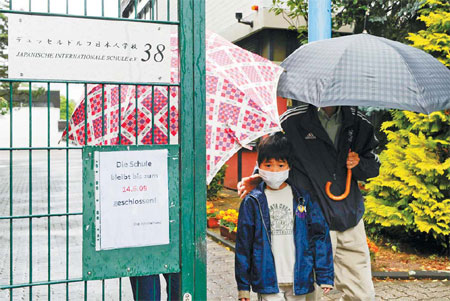
SYDNEY/BERLIN/BANGKOK: The spike in H1N1 cases in Australia, where five people have been admitted to intensive care and 1,263 cases of H1N1 flu recorded, has prompted the World Health Organization (WHO) to declare a first flu pandemic in 40 years. Australian authorities yesterday defended their handling of the flu virus, saying the high number of cases was a result of widespread testing. "We have tested 5,500 people in the last two weeks, that is more people than we test in our whole (normal) influenza season," said Victorian state premier John Brumby. "Elsewhere around the world, in the United States and Canada, they are only testing the most serious cases," said Brumby. There have been 27,737 cases reported in 74 countries to date, including 141 deaths, according to the WHO's latest tally. Australia has the fifth-highest number of H1N1 flu cases worldwide, after the United States, Mexico, Canada and Chile. Its first H1N1 case was announced on May 9, with a woman in the tropical northern state of Queensland testing positive after returning from Los Angeles. Australia's government has ordered 10 million doses of H1N1 flu vaccine being developed by pharmaceutical company CSL Ltd. The country has implemented standard health procedures to stop the spread of H1N1, such as thermal scanning at airports, quarantining those diagnosed and issuing hygiene warnings. But some health experts say Australian authorities have failed to control the spread of H1N1 due to a lack of co-ordination between national and state health officials. "The message given to people was that this was not a serious disease and people have not complied with quarantine guidelines. People have gone to work sick. People have not taken it seriously," said James Schluter, a biochemist with law firm Holding Redlich. 30 cases at Japan school German authorities have confirmed 30 cases of the H1N1 flu at a school in the western city of Duesseldorf, the most concentrated outbreak of the virus so far in Europe's largest economy. The health ministry in the state of North Rhine-Westphalia said yesterday the majority of the cases at a Japanese school in the city were detected on Wednesday evening. Additional confirmed infections were likely to emerge, said Kathrin Rebbe, a spokeswoman for the ministry. Parents of the infected children and people who had been in contact with them would be tested, said Heiko Schneitler, head of the city health's authority. Most of the children affected were Japanese, he said. One of the children was confirmed with H1N1 last week, and had recently been to Malta, a spokesman for the health authority said. The children are now in quarantine, he added. The school has been closed until the end of next week, said Hiromi Kida, a senior official at the school. Duesseldorf is home to a large Japanese community. Rebbe at the NRW health ministry said four additional cases of H1N1 had been detected at a school in nearby Cologne. Germany had 86 confirmed cases of H1N1 prior to the school infections, according to the Robert Koch Institute, the country's federal agency for infectious diseases. Jump in Thailand cases Thailand reported a sharp jump in confirmed H1N1 cases yesterday, with most of the new infections found in the seaside tourist town of Pattaya. "We found 30 cases today, 21 of which were found in Pattaya," Health Minister Witthaya Kaewparadai said in a statement. The latest infections bring the total number of cases to 46, none of which have been fatal. All but one case, a British man who was detected at Bangkok's international airport, are Thais. Authorities began testing suspect cases in Pattaya, 150 km east of Bangkok, after three students from Taiwan tested positive for H1N1 on their return from a holiday in the resort town, the ministry said. In Bangkok, officials closed a school yesterday for at least six days after five students contracted the virus, the ministry said. "Thai people should not panic because the information we have suggests this flu is not lethal if they seek medical help," Witthaya said. The impact of H1N1 on global travel has added to the gloom in Thailand's travel industry, which has suffered a major drop in arrivals due to the global economic crisis and political unrest. Reuters (China Daily 06/12/2009 page12) |