|
Walking tall
By Mark Hughes (China Daily)
Updated: 2009-06-01 07:49
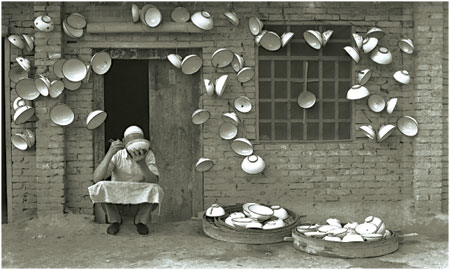
A young boy stares in rapt concentration as an electrician installs his rural family's first electric light bulb just 100 km from the heart of Beijing. The poignant photograph was taken by Han Xuezhang in 1956 in what is now the Fangshan district of the capital. The scene marked the first visible benefits of the construction of a small hydro-electric station nearby that heralded the end of a long era during which the hours of darkness were lit up with oil lamps. Now the area is ablaze with neon lights and the countryside has been largely concreted over. The picture is one of hundreds assembled by China Daily in a book commemorating the 60th anniversary of the People's Republic of China.
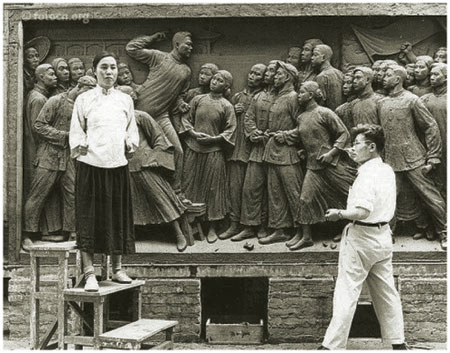
Since the memorable date of Oct 1, 1949, extraordinary changes have been wrought in this, the most populous and diverse nation on planet Earth. Many historic events recorded on celluloid throughout the country present a visual and vivid history of a dynamic people pulling together, often in adversity but also often with an optimistic or celebratory smile, to make life better for the next generation. If some of the most treasured items in a household are the photographs of key moments - a newborn baby, a son or daughter graduating from college or a day out at the fair - then this beautifully-bound volume is China's family album, capturing the highs and lows, the industry and the celebrations, the challenges and the achievements. Its aim is to help one understand China - and to do that it shows where the China we know today came from. And, perhaps, hint at where it's going. As Zhu Ling, China Daily's Editor-in-Chief, reiterates in his foreword, a picture is worth a thousand words. What we have here, then, in 362 images, is a history to which not even hundreds of thousands of words could ever do justice. There will be some still alive who remember the events recorded either first hand or through contemporaneous reports. For the younger ones, it is an opportunity to bring to life what they may only have read about in books. For everyone, it is a chance to marvel at what has grown from such humble beginnings in such a short time and to ponder upon what may happen over the next 60 years. Many families have matured from a subsistence existence to a life of comfort. Journeys once undertaken by foot over many days now pass in the neon-lit, electrically-charged twinkle of an eye. Roads replace tracks, skyscrapers replace wattle and daub huts, air conditioning relieves the lassitude of extreme heat and e-mail challenges the most nimble of postmen.
Although still developing (and at what a rate) China's cities are now high-tech, modern metropolises with every conceivable service known to man. Rural areas have also borne witness to remarkable change. As Zhu says, "Certainly, 60 years may represent a drop of water in the long river that is history. But this drop captures the vicissitudes of a great epoch, just as our collection of photographs is a testament to the various facets of Chinese people's rich life." Wang Yong, vice-president of Beijing Shengshixing Foundation, also contributes to the book. He comments that some observers cannot help but wonder how a nation that had been asleep for hundreds of years could, once it started to change, become so fond of revolutionary changes - with virtually endless new plans, new goals and new actions that defy their imagination. He notes that it is neither possible nor preferable for the Chinese people to solve their problems by copying other countries' models - they have to carve their own destiny. "Such a spirit of independent innovation is also the driving force for China's economic take-off," he concludes. Look out for a photograph of the first tractor to arrive at a rural village where back-breaking manual labor had been the only means by which to put food into the mouths of hungry families. Relish the joy of harvest time. Experience the thrill of a people, once subjugated to serfdom and now emancipated to choose their own paths through life. Feel the accomplishment that technological breakthrough bestows. And let your heart be touched by this year's photograph, acclaimed by veteran photographer Jiang Duo as his best in a long and successful career, of an attractive young couple visiting Tian'anmen Square. Their sense of patriotism sings out loud and long. It is a fitting testament to what has been achieved. And the optimism on their faces indicates that the best is yet to come. Mao Zedong was indeed prophetic when, in the autumn of 1949, he told the Chinese People's Political Consultative Conference: "We are all convinced that our work will go down in the history of mankind, demonstrating that the Chinese people, comprising one quarter of humanity, have now stood up From now on, our nation will belong to the community of the peace-loving and freedom-loving nations of the world and work courageously and industriously to foster its own civilization and well-being and at the same time to promote world peace and freedom. Ours will no longer be a nation subject to insult and humiliation. We have stood up." This compilation of photographs is a tribute to what Mao set out to achieve. It is a book not just for China, but for the world at large. China has stood up and is walking tall. China 1949-2009, compiled by China Daily and published by China Federation of Literary and Art Circles Publishing Corporation, will be launched tonight at the 28th anniversary party of China Daily; price: 220 yuan. On sale at all major bookstores in China.
(China Daily 06/01/2009 page6) |