> Life
When worlds collide
By Chen Nan (China Daily)
Updated: 2009-05-22 08:19

 When worlds collide

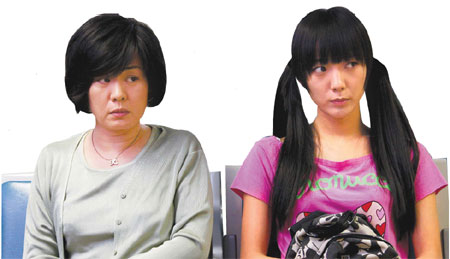
TV series Who Determines My Youth starring Qian Xiaoyang (played by Wang Luodan) and her mother (played by Cong Shan) explores the generation gap between the post-1980 youngsters and their parents. File photo

Pi Li's future was bright indeed, just as her mother planned. Having studied in the UK for three years, the 20-year-old had a good chance of getting into Cambridge University and was due to start her own business on her return to Beijing.

In fact, Pi intended to do nothing of the sort. She had actually been studying her first love - cooking - and on her return, her friends helped her to open a Western-style restaurant. A predictable storm erupted when her mother found out but Pi persisted and finally won over her parents.

So goes the TV series Who Determines My Youth (Wo de Qingchun Shui Zuozhu), which has touched many hearts with its tale of three mothers in their 50s and their daughters born in the late 1980s.

The generation gap is a familiar theme in Chinese books, movies and TV shows. Post-1980 youngsters are often called the ba ling hou, the "me generation" born after the introduction of the one-child policy and opening-up. They are now entering adulthood and beginning to play a role in society.

They are often stereotyped as spoiled and self-centered. One thing is for sure; they are more aggressive about making independent choices.

In the program, Qian Xiaoyang, played by rising mainland actress Wang Luodan, is another restless youngster. She leaves her home in the Ningxia Hui autonomous region and goes to Beijing with Fang Yu, a young man she meets on the road. Her mother takes her home but Qian still pursues her own dreams.

It is a theme that resonates with Wang Luodan, who is 25 years old and plays the role of Qian. She experienced a similar conflict with her parents and came to realize that communication was the crucial factor in finding a resolution, the same message the program tried to make.

When worlds collide

"I was determined to pursue my dream as a drummer," she says. "I also had to compromise with my parents. It is all part of the process of growing up. Our hopes of following our own paths may or may not succeed. It is like a battle, a gamble even, but as long as we give it a try and work hard on it, it will be worthwhile."

Beijinger Liu Ting, 25, can also identify with Pi Li. "That's exactly what I've done," she says.

Born into a wealthy family, Liu studied acting at China Communication University and graduated in 2007. With her parents' help, she secured a job at China Central Television as an editor of a popular program. "My job was making phone calls and sitting in front of the computer," she recalls. "I was bored."

Last year, Liu started her own PR firm. When she finally told her parents, they were so shocked and angry that her mother almost fainted. The ambitious young woman is optimistic about the future, even though her company didn't earn a cent for several months.

"I was restless at the beginning but I worked hard and stuck to my plan," she says. "I didn't ask for any money from my parents. I want to prove myself."

Beijing architect Wang Yu is another who can easily relate to the stressful situation. Having worked for a State-run company since graduating seven years ago, the 30-year-old has never given up his dream of developing his own toy kingdom based on a cartoon figure called WeaKid.

As a child, the toy-obsessed Wang spent plenty on collecting Japanese and American toys. He launched his own workshop in 2005 and is now trying to establish his own brand and popularize Chinese culture at the same time. He hopes his toys will help to change the image of "Made in China" to "Created in China".

His parents firmly believe his government job was ideal and guaranteed him a stable income but Wang wants to work for himself. "I tried to explain my goal to them," he says. "I know it is risky and unconventional from a traditional Chinese point of view but I want to try."

Lai Jinrong and his four buddies in indie rock band Lost Control of Logic are striving not only to make a name for themselves - in the past few years, they have played such small Beijing venues as D22, 13 Club and Starlive - but also to convince their parents.

"Their attitudes have changed a little from being totally against us to understanding us," says Lai. "At the beginning, they thought we just wanted to play games but later they realized we truly wanted to make it a career."

This defiance has come at a cost - one of the band was even been booted out of home by his parents. "We understand that they want us to live a healthy and happy lives but we want their recognition as independent people," says Lai. "This Cold War is useless - we need to talk."

The ba ling hou have grown up in an era of tremendous economic growth, social changes and rigorous educational requirements. The gulf between them and their parents is most evident in their purchasing habits, career pursuits and more open attitude towards love and marriages, says Zhou Xiaozheng, a professor with the Sociology Department of the Renmin University of China.

The producers of Who Determines My Youth interviewed many youngsters and tried to accurately convey their anxiety about the generation gap.

Parents' expectations of their children are often self-projections and therefore doomed to end in disappointment. "The parents do all they can to make it easy for the younger generation to do better than they did," says series director Zhao Baogang. "But the younger ones often have their own dreams that deviate from what their parents want."

When worlds collide

(China Daily 05/22/2009 page18)