> International
Swine flu kills 103 in Mexico
(China Daily)
Updated: 2009-04-28 07:56

 Swine flu kills 103 in Mexico

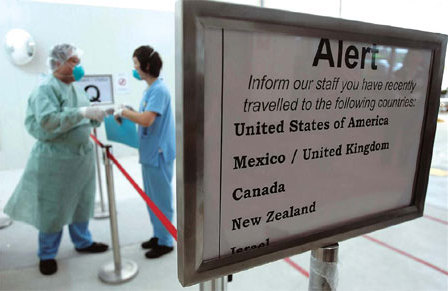
Medical staff wearing protective masks stand in an assessment area for patients with symptoms of respiratory illnesses at a hospital in Singapore yesterday. Reuters

MEXICO CITY: Governments around the world rushed to reduce the impact of a possible flu pandemic yesterday, as a virus that has killed 103 people in Mexico and spread to North America also reached Europe.

While the swine flu virus has so far killed no one outside Mexico, the fact that it has proved able to spread quickly between humans has raised fears that the world may be facing the flu pandemic that scientists say is long overdue.

Shares and oil prices fell in Asia and Europe, as investors feared a further shock to an already fragile global economy, if trade flows are curbed and manufacturing is hit.

The US government has declared a public health emergency and an official said it will also urge Americans to avoid all "non-essential" travel to Mexico, which relies heavily on tourism.

Spain became the first country in Europe to confirm a case of swine flu when a man who returned from a trip to Mexico last week was found to have the virus.

But his condition, like that of 20 cases identified in the United States and six in Canada, was not serious. A New Zealand teacher and around a dozen students who recently returned from Mexico were also being treated as likely mild swine flu cases.

As Spanish travel agencies scrambled to find alternatives for tourists who bought packages to Mexico, Russian agencies said 30 percent of those planning to travel to Mexico in early May had already canceled.

Germany's largest holiday tour operator, the Hannover-based TUI, suspended all charter flights to Mexico City through May 4. The suspension includes flights operated by TUI itself and also through companies 1-2 Fly, Airtours, Berge & Meer, Grebeco and L'tur.

No cause for alarm: Obama

US President Barack Obama said US officials were closely monitoring cases of swine flu, but he also tried to ease fears.

"This is obviously a cause for concern and requires a heightened state of alert. But it is not a cause for alarm," Obama told a meeting of the National Academy of Sciences.

"We are closely monitoring the emerging cases of swine flu in the United States," Obama said. "I'm getting regular updates on the situation from the responsible agencies, and the Department of Health and Human Services as well as the Centers for Disease Control will be offering regular updates to the American people so that they know what steps are being taken and what steps they may need to take."

"But one thing is clear: Our capacity to deal with a public health challenge of this sort rests heavily on the work of our scientific and medical community," the president said.

Cases of the flu, which has components of classic avian, human and swine flu viruses but has not actually been seen in pigs, were also suspected in Britain, France, Italy and Israel.

Many countries have stepped up surveillance at airports and ports, using thermal cameras and sensors to identify people with fever, and the World Health Organization (WHO) has opened its 24-hour "war room" command center.

Although most cases outside Mexico were relatively mild, a top official at the US Centers for Disease Control and Prevention said she feared there might be US fatalities.

WHO emergency meeting

The WHO has declared the flu a "public health emergency of international concern" that could become a pandemic, or global outbreak of a serious disease.

Its emergency committee was due to decide yesterday whether to raise its pandemic alert level, currently at 3 on a scale of 1 to 6.

"If we go to phase 4 because of the swine flu virus, it basically means that we believe that a potential pandemic virus has potentially shown it can transmit from person to person and cause large outbreaks," WHO Acting Assistant Director-General Keiji Fukuda said on Sunday.

A Briton who was treated along with his family with anti-viral drugs after he returned from Mexico with flu-like symptoms has been told he does not have the H1N1 swine flu virus, he said yesterday.

Chris Clarke, a businessman from Northamptonshire, said tests conducted by the Health Protection Agency had proved negative for him and his family. "I had a call from the Health Protection Agency... to let us know that the tests for H1N1 are clear so clearly that is very good news," Clarke told BBC television.

The HPA said it was monitoring the situation closely and its chief executive, Justin McCracken, said it was almost inevitable that some cases of the flu would come to Britain.

On Sunday, tests on a British Airways cabin crew member taken to a London hospital with flu-like symptoms after flying in from Mexico proved negative.

Mexico slows to a halt

In Mexico, the center of the swine flu outbreak, life has slowed dramatically in cities as schools have been closed and public events called off to slow the spread of the virus.

The number of suspected swine flu cases in Mexico has climbed to 1,614, including as many as 103 deaths, according to Mexican Health Secretary Jose Angel Cordova.

Many in Mexico City spent the weekend hunkered at home or wore blue surgical face masks handed out by truckloads of soldiers to venture out onto strangely hushed streets. The city government considered halting public transport.

Health Minister Jose Angel Cordova said on Sunday that the flu had killed 103 people in Mexico, and about 400 people had been admitted hospital. But he noted that a majority of infected patients had recovered.

Health authorities across Asia tried to give reassurance, saying they had enough stockpiles of anti-flu drugs to handle an outbreak.

Reuters - AP

(China Daily 04/28/2009 page12)