> Business
IMF sees deeper recession, slower recovery
(China Daily)
Updated: 2009-04-23 07:46

IMF sees deeper recession, slower recovery

The International Monetary Fund said the global recession will be deeper and the recovery slower than previously thought as financial markets take longer to stabilize.

The Washington-based IMF said in a new forecast released yesterday that the world economy will shrink 1.3 percent this year, compared with its January projection of 0.5 percent growth. The lender predicted expansion of 1.9 percent next year instead of its earlier 3 percent projection.

The fund's latest outlook highlights the precarious state in which the world economy remains, even amid signs the worst slump since World War II may be easing. Recovery isn't assured and will depend on policy efforts to cleanse banks' balance sheets and craft measures that spur demand, the IMF said.


"The key factor determining the course of the downturn and recovery will be the rate of progress toward returning the financial sector to health," the fund said in its World Economic Outlook. "Even once the crisis is over, there will be a difficult transition period, with output growth appreciably below rates seen in the recent past."

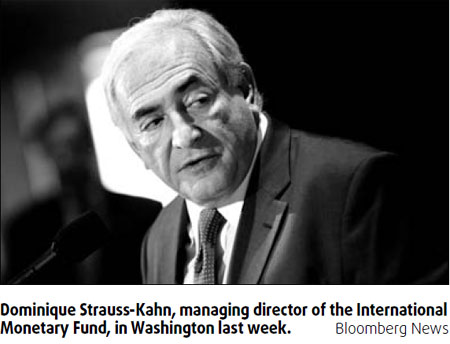
Having said this time last year that the world economy would grow 3.8 percent in 2009, the IMF tied its more pessimistic assessment to a "recognition that financial stabilization will take longer than previously envisaged". Managing Director Dominique Strauss-Kahn foreshadowed the prediction of a contraction a month ago.

The revised outlook comes a day after the fund calculated worldwide losses from distressed loans and securitized assets may reach $4.1 trillion by the end of 2010 as the recession and credit crunch exact a high toll on financial institutions.

'Heavy' strains

"Financial strains in the mature markets will remain heavy well into 2010," the report said.

Even as the IMF acknowledged "tentative indications" that the rate of contraction is moderating around the world, the fund said output per capita would decline this year in countries representing about 75 percent of the global economy.

Advanced economies will continue to lead the slump by shrinking 3.8 percent this year and failing to grow in 2010, the IMF said. The fund cut its forecasts for this year and next for all the Group of Seven economies and said Germany, Italy and the UK will still be shrinking in 2010.

The US economy will slide 2.8 percent this year before stalling next year and the euro area will contract 4.2 percent in 2009 and 0.4 percent in 2010, the report said. While Japanese gross domestic product will fall 6.2 percent this year, it will then rise 0.5 percent next year.

Emerging and developing economies will grow 1.6 percent this year and 4 percent next year, reductions of 1.7 percentage point and 1 percentage point respectively from previous forecasts, the IMF said. They will suffer net capital outflows of more than 1 percent of GDP this year and only the highest- grade borrowers will be able to tap new funding.

Growth in China, where the IMF said there is scope for further easing of monetary and fiscal policy, is forecast to slow to 6.5 percent this year before climbing to 7.5 percent in 2010. India's economy will grow 4.5 percent in 2009 and 5.6 percent in 2010, compared with 7.3 percent last year.

While stopping short of predicting deflation, the fund said the risk was greater than during the last such scare earlier this decade. Consumer prices will drop 0.2 percent in advanced economies this year before rising 0.3 percent next year and there is a risk of a steeper initial decline, the IMF said.

Quick action urged

Policy makers were urged not to delay their responses to the financial crisis. Balance sheets should be revived by removing bad assets and injecting new capital, the IMF said.

Monetary and fiscal policies should be "geared as far as possible" to bolstering demand and where flexibility remains for more monetary stimulus, such as at the European Central Bank, it "should be used quickly", the fund said.

Exit strategies also should be outlined for when recovery takes hold, the fund said. "Acting too quickly would risk undercutting what is likely to be a fragile recovery, but acting too slowly could risk a return to overheating and new asset- price bubbles," it said.

Risks to the outlook remain skewed to the downside and include the possibility that policies will fail to stop weakening economies and financial conditions from feeding on each other. "In a highly uncertain context, fiscal and monetary policies may fail to gain traction," the report said.

Meanwhile, the fund said confidence and spending could be revived faster than expected should investors endorse policy steps by authorities.

Global trade is forecast to plunge 11 percent this year after expanding 3.3 percent in 2008, undermining economies that rely on exports such as those of Germany and China, according to the report. The crisis has prompted a "flight to safety" which boosted the major currencies.

Bloomberg News

(China Daily 04/23/2009 page16)