> International
Robot brings hope to children with learning difficulties
(China Daily)
Updated: 2009-03-25 07:50


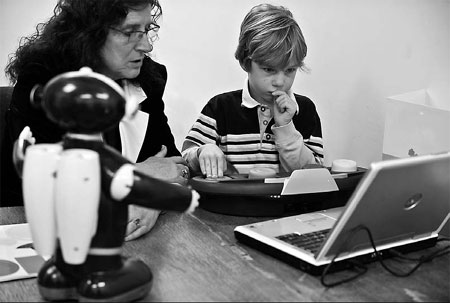
Kevin Fitzgerald uses the 4-button-panel dubbed "mission control" to direct a cartoon version of robot Cosmo around a computer screen with his therapist Carole Samango-Sprousse at a clinic in Crofton, Maryland, on March 16, 2009. AFP

A robot named Cosmo has become six-year-old Kevin Fitzgerald's unlikely ally in his uphill everyday battle with developmental difficulties.

At a strip mall clinic in suburban Maryland, Kevin is at the unlikely intersection of new efforts to treat symptoms of autism, cerebral palsy and other developmental disorders with robotics and computer work.

Here, he scrambles onto a swivel chair to examine a half-meter-tall robot on the table in front of him.

Prodding four brightly-colored buttons near the robot's feet, he directs a cartoon version of the machine around a computer monitor, furtively glancing up at the real thing for encouragement.

Kevin showed the first signs of learning difficulties when he was 18 months old, and was later diagnosed with developmental dyspraxia.

"It is like having a stroke," his mother Patty Fitzgerald said. "His brain is intact, but his body doesn't do what he wants it to do."

Some specific skills - like pronouncing consonants, matching cause and effect or grasping relative concepts such as better and faster - can be depressingly difficult for him to master.

But for the last year, a small blue-and-yellow android called Cosmo has offered some hope.

Programmed to respond to body movements, voice activation, or the four-button-panel dubbed "mission control," Cosmo is designed to teach basic behavioral and physical skills.

It can gesticulate, reproduce phrases and move around when prompted. It also cheers and gives clues to help children complete specific tasks.

As a piece of engineering, Cosmo is unspectacular. It has just nine moving joints - a number that might underwhelm robotics buffs.

But Cosmo's potential to help children has caught the attention of Minnesota's globally-acclaimed Mayo Clinic.

There investigators are conducting a second phase medical trial to see if the robot can help kids with cerebral palsy develop movements - such as twisting the wrist - more quickly than traditional methods.

"It is going extremely well," said Krista Coleman-Wood, a physical therapist at Mayo's biomechemical and motion analysis laboratory.

Wearing a glove fitted with sensors, children are asked to make movements that copy and are copied by Cosmo, building up muscle tissue and improving motor planning.

According to Coleman-Wood, it is too early to say if children make more progress with the robot than through traditional physical therapy, but fun levels are clearly in the robot's favor.

"Imagine lifting and moving your wrist repeatedly, it gets boring very quickly. (with Cosmo) there is cognitive engagement, the children are engaged," Coleman-Wood said.

Cosmo's designers hope a successful trial will mark a huge leap forward for robot-aided therapy.

The robot's inventor, Corinna Lathan, believes it can vastly improve on traditional and computer-based learning, serving simultaneously as a toy, a friend and a teacher.

"Manipulating a mouse or a keyboard is not the same as directly manipulating your environment," said Lathan, a graduate of Massachusetts Institute of Technology who also plans experiments for NASA through her research and development firm AnthroTronix.

"There is a lot of research that indicates if you want to learn social skills or spatial skills, that interacting in a three dimensional space, not just on flat screen or computer (is helpful).

"With the robot you can actually move from cause and effect to other developmental skills, you can move it round something, you can move it faster."

According to Lathan, Cosmo can also help improve behavioral problems, such as lack of focus, which frequently accompany learning disabilities.

"The idea is that rather than hiding in front of a computer you are actually starting to interact with a peer and the hope is that that starts to transfer to other peers, human peers - adults, care givers, parents," she said.

Five years after Kevin started therapy, Patty Fitzgerald says the last 12 months with Cosmo have proven revolutionary.

"When we first started there would be times when I could not get him out of the car if he knew it would be something challenging. Now if I mention that Cosmo is going to be here, or the computer, he comes running down the hallway."

According to Fitzgerald, Kevin's progress could allow him to continue to attend conventional schools, even if some ada ptations are necessary.

AFP

(China Daily 03/25/2009 page11)