> Insight
New face of human trafficking busted
By Cao Li (China Daily)
Updated: 2009-03-03 07:49


Maritime law enforcement vessels and frontier guard patrol boats conduct routine checks on cargo ships on the Yangtze River near Nanjing in July 2008. An Xin

For 60,000 yuan ($8,820), a Shanghainese woman named Wang bought her way to Europe with a legal passport and a business visa.

Once abroad, she discovered that she was an illegal immigrant and the only job she was able to land was washing dishes at a restaurant.

Wang was one of hundreds who fell for an ingenious and profitable human trafficking scheme that garnered huge profits for a gang brazen enough to open an office on the 31st floor of the Jinmao Tower in Pudong's Lujiazui, Shanghai's financial center.

Last week, Jiang Yi, 30, his wife and 23 other suspects stood trial at Jinshan District People's Court on charges of organizing illegal border crossings. They face sentences up to life imprisonment.

The loosely connected gang had more than 40 members and allegedly smuggled hundreds of people - mostly to Europe - between 2002 and 2008, making some 50,000 yuan per client.


Jiang Yi (far left), the leading member of a major human trafficking gang in Shanghai, is led into Shanghai Jinshan District People's Court to face trial, along with other gang members in February 2009. Xu Yongqi

"In six years, he succeeded in smuggling 166 and failed with more than 300," said Chen Yunguang of the Shanghai Jinshan District Procuratorate. Chen said Jiang obtained business or tourist by falsely claiming them as businessmen or tourists. Jiang was arrested in March 2008 and hired an expensive defense attorney.

Looking exceptionally relaxed, Jiang gave an interview to China Daily at Jinshan District Jail last month. "Everybody wants to go abroad," he said, "but visa restrictions make it difficult for many. Once you know what they need, it becomes easy. I help people realize their dream of going abroad."

Jiang said he once accompanied a friend for a visa interview and encountered many applying for business visas to go abroad for exhibitions or conferences. That gave him the idea. In 2002, he began to advertise his visa services in newspaper and on the Internet.

He rented a virtual office at Jinmao Tower for 2,000 yuan per month. "It was once the tallest building in Shanghai and having an office there made my company look good," he said.

He hired college graduates fluent in English to search for exhibitions and business conferences on the Internet and then contacted the organizers to sign up people to attend the event.

After receiving an invitation or registration letter to an event, he would prepare the application documents, claiming his clients were CEOs or managers, and then coached them for the visa interview. According to prosecutor Chen, Jiang told his clients what to say and even what to wear.

"I made them meet the visa requirements," Jiang said. For that, he charged from 30,000 yuan to more than 100,000 yuan. "It depended on how much a client asked me to do," he said.

Zhang Jieneng, 40, said he tried to find Jiang clients and was paid a commission. "If we fail to get them a visa or they are rejected by customs, we will refund them," he said.

Sometimes Jiang would send someone who had succeeded in obtaining a visa on visa application interviews with clients who had never been overseas. He Liliang, another suspect, was one of them. He said he often claimed that he was the client's "assistant".

"The consular visa office would think that if the assistant has such a good record, his manager should be okay, and that would ensure a better chance to obtain a visa for the client," He said. On some occasions, Jiang even hired people to pretend to be the client's spouse.

If a consulate called to seek more information on one of Jiang's clients after the interview, Jiang would have the call transferred to his office line and have Feng Li, 29, answer for the client.

After obtaining a visa, Jiang would coach his clients how to pass through customs and immigration, according to the indictment against him.


Illegal Chinese immigrants from Heilongjiang, Jilin and Fujian provinces hide their faces after being arrested by border guards in Zhejiang province in February 2007. These were among 39 farmers and jobless people who were heading for South Korea. Xinhua

Jiang's clients were people between 35 and 50 years old who had not yet found success. "They want to change their lives by going to another country," Jiang said.

Gan Baolong, the police officer in charge of Jiang's case, said a man from Shanghai paid 60,000 to be smuggled to the United Kingdom. "The only job he could find was at a shipyard," he said. "Six months later, he hurt his back but could not afford to go to the hospital, so he came back."

In 2007, a young man from Jinshan District, whose name was not released, was caught at Shanghai's Pudong International Airport for using a passport with a false name. He had been deported from South Korea and was attempting to go there again.

This led police to Jiang's gang. Jinshan District People's Court has already sentenced 20 gang members to prison for up to six and a half years.

Jiang, however, is defiant. "I did not organize illegal border crossing," he said. "From what I understand an illegal border crossing is crossing a border secretly, which is not true in my case. All my clients went abroad with legal documents."

Chen Ting of Shanghai's Public Security Bureau Exit-Entry Administration said the old methods of human trafficking were riskier and often cost lives, but the new methods are harder to trace.

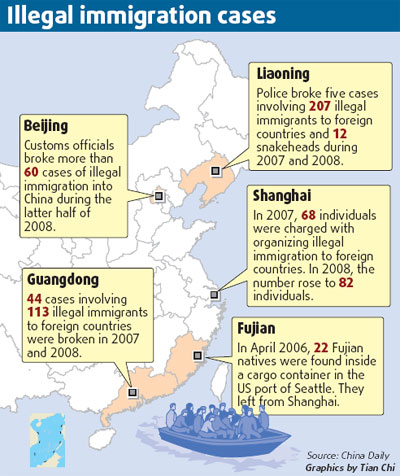
In April 2006, 22 Fujian natives were found inside a cargo container in the US port of Seattle. After leaving Shanghai port, they were at sea for 14 days. All were re-patriated.

Now with China more open to the world, it has become easier to obtain a passport and smuggling people abroad is not seen as often anymore, Chen Ting said.

"However, despite the fact that more and more Chinese are traveling and doing business abroad, some are still not qualified for a visa," Chen said. Most illegal immigrants go to European countries, the United States, Australia, Japan and South Korea to seek their fortunes, he said.

"Some of them go to a third country first to obtain a visa record," he said, "because people who hold a blank passport are unlikely to be approved for a visa."

"Some go to an African country and are smuggled to the destination country from there," he added.

Shanghai has become a popular transit place for illegal immigration.

In 2007, 68 individuals were charged with organizing illegal immigration. In 2008, the number rose to 82. "Jiang's gang is one of the largest," Chen Ting said.

Some illegal immigrants from other countries travel through Shanghai before reaching their destinations, he said.

Chen said that China has stepped up efforts to fight illegal immigration since 2002. "We are focusing more and more on gangs that organize illegal immigration," he said. In Shanghai, anti-smuggling teams have been formed at the municipal public security bureau and every one of its 19 district branches. The bureau has set up regular meetings with tourism associations and travel agencies.

"People think they can make a fortune by going abroad, but that is not always the case," Chen Ting said.

Wang, one of Jiang's victims, would certainly agree.

"I washed dishes from 11 in the morning until midnight," she told CCTV. She was provided food and lodging but no pay. Her boss told her: "If I am caught employing you, I will be severely fined", she recalled.

"Life was so hard, all I wanted was to come home," Wang said. She stayed abroad for only six months and returned to Shanghai with a broken dream and large amount of debt.

Wang said she would suggest that people not fall for illegal schemes to go abroad.

"It is better to do it legally," she said.

(China Daily 03/03/2009 page7)