> President of Change
Bush legacy: Better Sino-US relations
By Zhang Haizhou (China Daily)
Updated: 2009-01-21 07:48


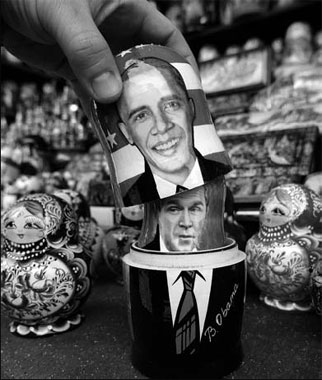
A man displays Russian Matryoshka dolls featuring former and current US presidents George W. Bush and Barack Obama in St Petersburg yesterday. Reuters

Last July, then US President George W. Bush joked with Chinese President Hu Jintao about getting tickets to the US-China basketball match at the Beijing Olympics.

"I'm hoping to get tickets for the US-Chinese basketball game. If you can help me get a ticket I'd appreciate it," Bush joked with Hu on the sidelines of the G-8 summit in Japan. And sure enough on August 10, Bush was watching the match with his family.

Such ties between the two countries would have been hard to conceive when Bush during his presidential campaign described China as a "strategic competitor". So it was an achievement that the first time a US president was attending an Olympic event on foreign soil it was in China.

Irrespective of what he leaves for Obama - an economic downturn, two wars and bitter international ties - his best gift will be improved Sino-US relations.

"A stable, mutual strategic perception formed during the Bush administration," said Rear Admiral Yang Yi, who worked as the naval attach in the Chinese embassy in Washington from 1995 to 2000. "Obama will be able to enjoy this biggest legacy for a period of time."

A stable Sino-US relationship, however, did not come easy.

The initial months of the administration suggested that Bush would adopt a confrontational approach to Beijing. Four months into the Bush presidency, a Chinese pilot died when a US reconnaissance aircraft collided with a Chinese fighter jet over the Hainan Province. The Pentagon said its aircraft was on "routine surveillance". The event turned ties between the two countries cold.

According to Yang, now a professor at the National Defense University, hardliners played a key role in affecting Bush's foreign policy in the early years. "The neoconservatives misled Bush's diplomacy into a wrong direction," Yang said, referring to the two wars in Bush's first term.

The 9/11 attacks were the turning point. Five hours after the attack, then Chinese President Jian Zeming called Bush, expressing sympathy with the American people. This was the time the US needed as much international support as it could drum up. Since then Bush's China policy adopted a more practical approach, pushing bilateral ties into the right trajectory. For instance, the US made it clear on several occasions that Washington would not tolerate any move by Taiwan towards independence.

In 2006, China and the US launched the first Strategic Economic Dialogue (SED) in Beijing. The biannual summit has since been held four more times. The two sides have reached consensus on nearly 150 areas during these sessions, covering issues like macroeconomic policy, environmental protection and energy efficiency, Assistant Minister of Finance Zhu Guangyao said last month.

Many are speculating if the Obama administration continues the legacy and the dialogue. Daniel Sullivan, former US Assistant Secretary of State for Economic and Business Affairs, said: "I know that the incoming Obama transition team are thoroughly briefed that the SED is important, its recognized pretty broadly in the US."

(China Daily 01/21/2009 page11)