> Insight
A personal look at modern Chinese diplomacy
By Lin Wusun (China Daily)
Updated: 2008-11-26 07:46


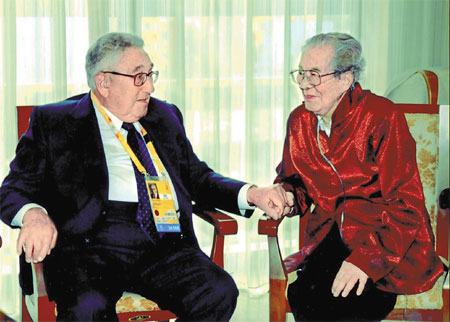
The tight handclasp between veteran diplomat Huang Hua (right) and former US national security advisor Henry Kissinger during the Beijing Olympics in August shows their long-standing friendship. The two were key figures in promoting the normalization of Sino-US relations in the 1970s. Courtesy of Huang Hua's family

After retirement from their official posts, Chinese diplomats used to keep a low profile. Some continued to serve in nongovernmental organizations (NGOs). Most just faded away. However, this is no longer the case. Quite a number now serve at NGOs, teach at universities and/or appear on TV interviews. Still others write memoirs. Qian Qichen, former state counselor and foreign minister, created publishing history when he authored a popular book called Case Histories in Diplomacy, expounding the principles and practice of Chinese diplomacy.

And now we have the benefit of reading the memoirs of Huang Hua, veteran revolutionary, senior statesman and diplomat-ambassador, foreign minister, vice-premier, and vice-chairman of the Standing Committee of the National People's Congress. It is unique in that it provides us with tales about the source and 70-year development of modern Chinese diplomacy, based on the author's own experience and backed by materials from the Foreign Ministry's files.

As the author is now 96, his memoirs cover an unusually protracted period, from the 1930s to a few years ago. Besides, having served as ambassador in different parts of the world, often taking part in significant international conferences and other types of negotiations, and finally as China's foreign minister, Huang Hua dealt with China's relations with all types of countries, especially major ones. While it was written in a matter-of-fact way, it does not lack profound observations on the making of history.

But let's start from the book's beginning in the 1930s, when Huang Hua was studying at school and university. This was the period when an impoverished China faced the danger of being subjugated by Japanese imperialist invaders. The harsh circumstances compelled Huang Hua and his fellow young intellectuals to seek ways to save the country and to join the progressive student movement then arising in North China. The severity of the national crisis gave rise to the popular saying, "Though North China is extensive in area, it has no place for a desk where we can study." At the missionary-run Yenching University, Huang Hua was a diligent student supported by scholarship, yet he soon got involved in the salvation movement and became a student leader organizing protest demonstrations against the authorities' non-resistance policy.

The dedication and courage of the participants in the face of harsh police suppression was vividly described so that almost 80 years later we can still capture the students' idealistic fervor. Huang Hua's experience in prison, where the faithful continued their study and exchange of views through a secret hand-written publication he edited, showed him and his comrades to be persistent fighters prepared for ever-harsher challenges in the future. There have been many write-ups of this 1935 December 9th Movement, but Huang Hua's account lends a direct source rich and reliable in details. In modern China, there were more than one intellectual movement which had significant impact on the course of the nation's history, the 1935 one and the earlier May 4th Movement of 1919 being the most significant.


Huang Hua (right) and his colleagues rejoice at the announcement of China's resumption of its United Nations membership on Oct 25, 1971. CNS

Huang Hua had joined the underground Communist Party at Yenching University. Following his 1935 experience, he decided to forego Yenching's graduation ceremony and join the American journalist Edgar Snow as his interpreter during the latter's coverage of the Chinese communists in North Shaanxi. The adventure of crossing the Nationalist blockade, of meeting with Mao Zedong, Zhou Enlai and the Red Army commanders and soldiers, and of hearing their stories of the Long March, as well as the off and on battles they encountered, all brought Huang Hua closer to China's rural realities. The role-model behavior of these men and women strengthened his revolutionary faith and discipline. From that time on till the end of the War of Resistance Against Japanese Aggression in 1945, Huang Hua stayed mostly in Yan'an, headquarters of the Chinese Communist Party. He has thus been able to give a lively first-hand account of life in the resistance base.

Huang's description of the US Army Observer Group in Yan'an, sent there in 1944 to coordinate the common struggle against Japanese aggression, is both detailed and fascinating. According to Huang Hua, himself a member of the Chinese liaison group, relations between the two sides were quite cordial, and the "Dixie Mission" members saw how effectively the Chinese Communist-led troops were fighting the Japanese. This relationship could be considered the prelude to New China's diplomacy.

Despite this rather auspicious beginning, Sino-US relations were tense and even antagonistic for many decades. Yet it was not caused by the Chinese side. Following Japan's defeat in 1945, the US Administration backed Chiang Kai-shek forces in launching a civil war against the Chinese communists, disregarding the Chinese people's common aspiration for peace and reconstruction after eight years of destructive war.

The tripartite Military Mediation Mission, of which the US was a participant, failed because the Chiang Kai-shek forces never intended to observe any agreement reached and the US side was partial to them. The breakup threw the country straight into full-scale civil war.

When the Chiang forces collapsed, Huang Hua was appointed the head of the foreign affairs office of the newly liberated Nanjing, formerly the Nationalist capital. US Ambassador Leighton Stuart, a long-time missionary in China and a former president of Yenjing University where Huang studied, remained in China. The two met informally on several occasions, and the topic of Stuart's possible visit to Beijing to meet the top Chinese leaders was broached. However, this northward trip was rejected by the US State Department, which reaffirmed Washington's continued recognition of the Chiang government in Taiwan. Thus, another historic chance for normalizing relations was missed. As the author observes, "It took the US 22 years to re-evaluate this policy."

When this re-evaluation did come and then US president Richard Nixon's national security advisor Henry Kissinger secretly came to Beijing to start the negotiations, Huang Hua was again a member of the Chinese negotiation team. Huang was about to leave for Canada as the Chinese ambassador there. So, to prepare for the coming meetings, he, like Kissinger, also "disappeared" at Mao's request. Thus began the grand about-face in Sino-US relations, altering the world's balance of power.

In 1972, Huang Hua, as China's permanent representative at the United Nations, again met Kissinger regularly on matters not suitable for the semi-official liaison offices to handle through the hush-hush "New York channel". Deng Xiaoping's visit to the US, establishment of diplomatic relations, and discussions and signing of a joint communique on US arms sales to Taiwan were highlights in which Huang Hua had a direct hand. Consequently, the background to the changed relations between the two powers and its significance and international implications are discussed by the author at length.

Guided by Deng Xiaoping, Huang Hua as China's foreign minister oversaw the negotiations and final signing of the Sino-Japanese Treaty of Peace and Friendship. He also made strenuous efforts to improve relations with India and the Soviet Union. The three chapters in the memoirs dealing with these events are worthy of special attention, as these are three of China's most important next-door neighbors and how China's relations with them fare makes a difference to peace and prosperity in this part of the world.

In the chapter dealing with India, Huang Hua not only recalled the historical ties between the two countries but also Indian leader Jawaharlal Nehru's support for China's resistance war and the contributions of the famous Indian Medical Mission in Yan'an. There existed deep sympathy between the Chinese and Indian people, so despite the border dispute, common interests really far surpass differences. This was reaffirmed during Huang Hua's meetings with Indira Gandhi and three other Indian prime ministers as well as with Sonia Gandhi, widow of Rajiv Gandhi and president of the Indian Congress Party. In his official or unofficial capacity, Huang Hua also visited many countries in Europe, Africa and Latin America, but they are too numerous to touch upon in this review.

What are the basic principles guiding China's foreign policy? Huang Hua devoted a special section in Chapter 12 to Deng Xiaoping's thinking on this paramount issue. Careful readers will note the descriptions of how Deng, as a strategist and tactician, combined the characteristics of Mao and Zhou and secure many useful pointers to current Chinese foreign policy.

Through reading his memoirs, one can see that this senior diplomat paid special attention to making friends and coming to terms with people of different backgrounds and beliefs. His straight-forwardness and warmth of character proved to be a great plus in liaising with diplomats and leaders. Even after his retirement, he strives to keep up with his wide circle of international friends. As Henry Kissinger pointed out, "I came to admire Huang Hua's diplomatic skills, subtlety and tenacity - all these qualities combined with extraordinary human warmth and reliability."

After his retirement, Huang Hua kept working in many capacities as he had a broad interest. He headed the China Welfare Institute, the child welfare organization founded by Soong Ching Ling, the China Society for People's Friendship Studies, the Great Wall Society and a host of other institutions. In all these capacities, he took the initiative to launch many worthy causes. Even after he had stepped down from all these posts, he maintained his studies, using a computer with an over-sized monitor to keep abreast of the world's development. In Huang Hua's own words, "I still try to stick to my motto, 'It is never too old to learn'."

Age advances imperceptibly but inevitably. Yet with age, one gathers experience and, through continuous learning, deepens understanding. Memoirs enliven and enrich history and provide many useful insights into life. Huang Hua's recollections provide plenty of precious insights into both Chinese diplomacy and modern history, which cannot be found anywhere else.

The author is a former president of the China International

Publishing Group

(China Daily 11/26/2008 page7)