> Top News
India celebrates launch of first mission to moon
(China Daily)
Updated: 2008-10-23 07:39


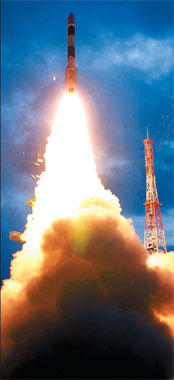
India's maiden lunar mission Chandrayaan I, or moon craft in ancient Sanskrit, successfully takes off from the Satish Dhawan Space Centre in Sriharikota, southeastern India, yesterday. AP

SRIHARIKOTA: India launched its first unmanned moon mission yesterday, as the emerging Asian power celebrated its space ambitions and scientific prowess.

Chandrayaan I (moon vehicle), a cuboid spacecraft built by the Indian Space Research Organization (ISRO) blasted off from a southern Indian space center shortly after dawn in a boost for the country's ambitions to gain more global space business.

To date, only the United States, Russia, the European Space Agency, China and Japan have sent missions to the moon.

"What we have started is a remarkable journey," G. Madhavan Nair, chairman of ISRO, told reporters.

India's national television channels broadcast the event live. Some scientists thumped their chests, hugged each other and clapped as the rocket shot up into space.

Greeted with patriotism in the media, the launch appeared to have helped India regain its self-confidence, which has taken a beating in recent weeks amid signs of an economic slowdown as well as international criticism over Hindu attacks on Christians.

Perhaps remarkably in a country where hundreds of millions of people still live in desperate poverty and millions of children remain malnourished, the cost of the moon mission has scarcely been questioned.

"Destination Moon ... Historic Day For India" blazed one TV channel on its screen.

Barring any technical failure, the spacecraft will reach lunar orbit and spend two years scanning the moon for any evidence of water and precious metals.

A gadget called the Moon Impactor Probe will detach and land on the moon to kick up some dust, while instruments in the craft analyze the particles, ISRO says.

A principal objective is to look for Helium 3, an isotope which is very rare on earth but is sought to power nuclear fusion and could be a valuable source of energy in the future, some scientists believe.

It is thought to be more plentiful on the moon, but still rare and very difficult to extract.

The project cost $79 million, and ISRO says the moon mission will pave the way for India to claim a bigger chunk of the global space business.

The mission is also expected to carry out a detailed survey of the moon to look for precious metals and water.

For many Indians, the launch is another notch in India's ambitions to be a global player. India recently signed a civil nuclear deal with the United States, effectively making it a de facto nuclear power.

In April, India sent 10 satellites into orbit, and ISRO says it is planning more launches before a proposed manned mission to space and then onto Mars in four years.

ISRO is collaborating with a number of countries, including Israel on a project to carry an ultra-violet telescope in an Indian satellite within a year.

India has launched 10 remote sensing satellites since 1998, has several broadcast satellites in space to control 170 transponders and has also launched light-weight satellites for Belgium, Germany, South Korea, Japan and France.

Agencies

(China Daily 10/23/2008 page1)