> Business
Amway meets challenge in Chinese market
(China Daily)
Updated: 2008-10-21 08:04

World-leading direct sales company Amway's dramatic experience in China may provide an ideal case for Harvard Business Review. It had to re-engineer its China network when its original marketing mode was virtually outlawed by central government as unsuitable to national characteristics. But it now runs 180 retail outlets around the nation which earned over 13 billion yuan in revenue last year, compared with the company's global sales of $6.4 billion.

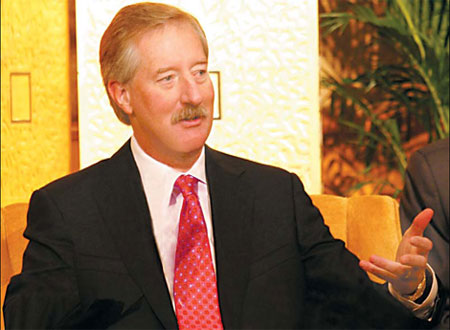
As a world-leading company, how did Amway make this transition? Steve Van Andel, chairman of Amway Corp and its parent company Alticor Inc, talks to China Daily's Wu Yong and Liu Ce in Liaoning province about its unique ways of marketing, management and development in the Chinese market.

Q: Amway started operations over ten years ago in China and has experienced up and downs during this process. But the company successfully adapted to the new environment and situation every time. How did Amway succeed in doing this?

A: As you mentioned, Amway had ups and downs when we started business in China. At first, not everyone could understand what we did. We believe that our business concepts are pretty good and can adapt to any country around the world. We take the principles and have to put them into different cultures. We need time to adjust to the local culture.

We also have regulations to adjust since there was no such thing in China before. Many companies pretend to engage in direct selling, but in fact, they are pyramid selling. So people may get confused as they cannot distinguish between the two. Now there is a regulation and legal companies can get licenses from the commercial department. We know some principles and we have never changed during this process.

Q: The management team of Amway China is entirely Chinese. As a famous foreign-owned company, why did you choose Chinese people instead of foreigners to manage the company? What do you think about the concept of localization?

A: We adapted to the market not because I understand the culture or somebody from the US understands the culture. Our local employees here help us to know the culture and to move on our business. They are more familiar with the local culture and give us advice on the direction of our development in China. And we don't need to translate during our work because all of them are Chinese.

As you mentioned, we cover over 80 countries and areas. As a business, we are trying to maintain flexibility in adaptation to different countries. But sometimes, we have to keep the American culture to be more efficient.

Q: The sales achieved by Amway this June created a new record for the company. What's the reason for this? What do you think of Amway's development prospects in China?

A: I think there are a number of reasons. The most important one is personnel, including our employees and salesmen. It's thanks to their hard work and concentration on their job.

The second is our products. Take Nutrilite as an example. The originator of Nutrilite lived in China for many years and he was very interested in the medical ideas that China has. So he brought it back to the US and combined it with modern technology. Even in the products we have today, we use many Chinese ideas.

Also, a couple of years ago, we set up a research and development center in Shanghai to help with developing Nutrilite products for China.

So there are two aspects that contribute to our success. One is people, and the other is our high-quality products.

Q: China's production price index (PPI) has continued to grow in recent years, and many foreign companies have moved their production bases out of China to cut costs. Does Amway have such a plan?

A: We have a manufacturing facility for China in Guangzhou. We also have facilities around the world. You have to find out the reasons why you produce products in different places. One is to acquire high efficiency around the world. Labor cost is not only concern, but also whether or not the facility can provide support for our business.

So the plant is a long-term decision. We do not make a decision today and change it tomorrow.

Q: 2008 is the 30th anniversary of the launch of China's reform and opening. As a foreign company with over 10 years' history in China, what have been the big changes in China during those years?

A: First I'd like to say the progress that China has made is astonishing.

I just came from Sichuan. Although it was struck by the earthquake, its economy has grown 11 per cent from the beginning of this year to now. This proves that China is developing very well and people are unbelievably hardworking here.

I've been to China many times during the past 15 years. And, as we know, the US is the biggest economy, but China, I think, has the most potential.

Q: Amway is very active in charity work in China, donating 250 million yuan by the end of this June. In addition, Amway donated a large sum of money to Sichuan following the May 12 earthquake. What do you think of corporate social responsibility?

A: That would go back to my dad. He told me it's very important to help others. In fact, my family always helps others. It's important for us to adapt to the community, society and market wherever we go. So I take it as a principle.

In fact, I do it as an individual instead of as a company. And we'd like to do charity work and share our wealth all around the world. So whether we work in China or India, we do work for children. And in Thailand, we have a project called "Smile". We do it all around the world. And we do it just because we can do it.

(China Daily 10/21/2008 page15)