> Insight
Grain prices slide back, but uncertainties continue to loom
(China Daily)
Updated: 2008-10-17 07:50


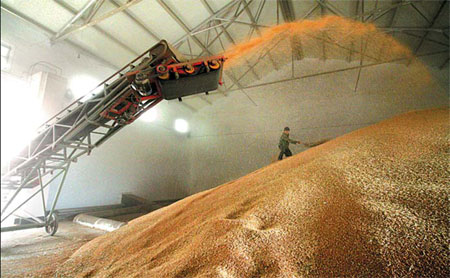
A man works on a wheat heap in a barn in Mengcheng county, Anhui province, in June. Global grain prices have seen a slump recently. Hu Weiguo

World grain prices have been tumbling back down the steep slope they climbed early this year, but from Manila's food stalls to London's supermarkets, everyday consumers have yet to see the change.

The experts worry, meanwhile, that the wild swings may turn uphill again.

The global financial crisis "puts us in a precarious position," UN food economist Abdolreza Abbassian, who fears farmers frustrated by falling prices and credit shortages will plant less, said recently.

Canadian Rolf Penner is one discouraged wheat grower.

"We literally went to the moon and back," the Manitoba farmer said of the seesaw in prices. "To watch them crash down as they have is not a great feeling."

That lunar leap, from 2006 to early this year, more than doubled on average the world prices of grains - the rice, wheat, corn and other cereals that are prime ingredients of so much that people eat, either directly or indirectly, as through livestock feed.

A worldful of factors pushed prices up, among them the skyrocketing cost of fertilizer, fuel and other petroleum-based farm "inputs", and a jump in demand for US corn to make the alternative fuel ethanol.

That jolt to the global grain market was an earthquake in many poorer countries, where hundreds of millions spend most of what they have on food, and where prices rose anywhere from 50 percent to 300 percent on some items.

In a global opinion poll released on Wednesday, Britain's BBC World Service reported that almost two-thirds of people surveyed in the Philippines, Panama, Kenya and Nigeria said they are now eating less because of the sharp price rises.

By the middle of this year, however, new factors took hold, including individual decisions by countless farmers worldwide to capitalize on the windfall by planting more. Soon, as bumper crops came in, prices began their backslide.

"There's no question better supplies have been a big component in the price declines," Joe Glauber, chief economist at the US agriculture department, said. "There's been over a 10 percent increase in world wheat production."

At the same time, plunging oil prices cut some operating costs on farms, although fertilizer prices have been slow to respond. And cheaper oil meant less demand for ethanol, diverting possibly 100 million bushels of US corn to the conventional market.

From their peak last March, wheat prices have fallen some 45 percent, to $264 a ton for US No 2 hard red winter wheat, the UN Food and Agriculture Organization reports. Prices for US corn and Vietnamese rice, big items in global trade, dropped 35 percent from their highs last June.

But corn and rice prices remain well above year-ago levels, the FAO said, and the latest declines have barely begun to nibble at prices on the street.

From London to Manila in the Philippines, to marketplaces in east Africa, food bills remain 9 percent to 16 percent higher than a year ago, according to the latest national reports.

In fact, the year's earlier high commodity prices are still working their way through the food-processing chain, FAO economist Abbassian said in a telephone interview from Rome.

"Domestic market prices may actually have room to increase still further," he said, before they begin to fall.

This UN expert's real concern, he said, is that collapsing grain prices, coupled with global financial turmoil and a possible drying up of credits for farm investment, might lead growers to plant less in the coming months. Many today are taking losses on crops planted when prices were high.

"If you were burned once, will you want to get burned again?" Abbassian asked. Glauber also sees a question mark, at least with wheat. "We'll certainly be looking to winter wheat plantings to see how that goes," he said.

The credit crunch, rooted in widespread defaults on US subprime mortgages, can undermine the global farm economy in many ways.

Grain shipments are stacking up on US and other docks because international buyers cannot obtain letters of credit to satisfy sellers.

To even the most plugged-in modern farmer, grappling with an increasingly interconnected world can be a daily challenge.

"I'm trying to understand," Rolf Penner said on his 770 hectares outside Morris, Manitoba.

"Here I am up in Canada, a guy growing grain and hogs, and I'm having problems with prices dropping, and guys I do business with are having credit problems, and it all has to do with housing mortgages in Florida and California."

Agencies

(China Daily 10/17/2008 page6)