> Life
A city on your desktop
By Lin Shujuan (China Daily)
Updated: 2008-10-16 08:06


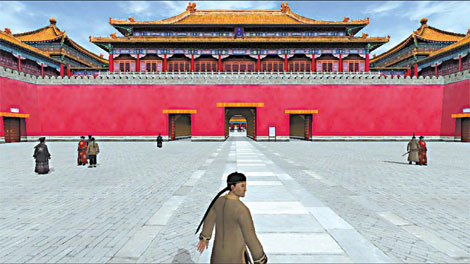
The Forbidden City: Beyond Space and Time presents a complete virtual world of the Palace Museum. Photos by Lin Shujuan

The Palace Museum has received a unique gift in celebration of its 83rd anniversary, a three-dimensional replica of the walled fortress able to receive any visitor any time.

After three years of development, IBM and the Palace Museum have launched The Forbidden City: Beyond Space and Time, the first complete virtual world created for a major historical and cultural attraction.

The downloadable Forbidden City is at www.beyondspaceandtime.org and can be explored as an avatar, taking visitors into a virtual world.

Virtual charm

The online environment is a fully immersive, interactive world that corresponds architecturally and historically to the vast grounds of the current Palace Museum.

Rather than being a solitary virtual experience, the virtual Forbidden City allows visitors to interact with each other and a wide range of volunteers, staff and automated characters.

Visitors can also experience three-dimensional representations of cultural artifacts and places like the majestic Hall of Supreme Harmony, as well as inspect scenes like "The Emperor Having Dinner" and "Court Painting."

They may also engage in activities in which their avatars take an active role in the culture of the period, including archery, cricket fighting and playing the ancient game of weiqi, now popularized as Go.

They may also take photos, share them with friends, join a group guided tour or even guide a tour.

"We hope this project will help people around the world understand the rich culture of China, its history and its people," says Stanley Litow, president of the IBM International Foundation.

Virtual interest

Completed in 1420 after 12 years of construction, the Forbidden City was created to embody the idea of the emperor as the center of the universe and to evoke a visceral sense of his power. Surrounded by a wall more than 30 feet high and 20 feet thick, the walled fortress once served the emperor exclusively but became "a palace of the people" in 1925 when the Republican forces transformed it into a museum.

Ever since then, people from across the world have flocked to it to explore the splendor of its architecture, culture and history but constraints of distance and cost have limited the number of foreign visitors.

The Forbidden City receives nine million visitors a year, mainly Chinese, but Hu Chui of the Palace Museum's Information Department says most of them consider it more of a tourist attraction than a museum. "Only a few of them really appreciate the rich culture and history the museum embodies," he says.

Efforts have been ongoing for more than a decade to bring the Palace Museum closer to visitors through up-to-date digital technology but Hu says the $3-million virtual Forbidden City is the most ambitious yet.

"We always aimed to achieve three things through our digital efforts: to introduce the museum to those who have never been to it; to let those who have been to the museum understand more about it; and to allow visitors to learn more about the cultural background behind each of the artifacts and buildings," says the museum's director-general Zheng Xinmiao.

Zheng believes the virtual Forbidden City is a giant stride forward.

The cooperation between IBM and the Palace Museum started in 2005, when the American company was finishing The Eternal Egypt, a collaboration with the Egyptian government providing worldwide access to 7,000 years of Egyptian history.

While IBM was considering its next partner for its cultural heritage project for online visitors, someone suggested the Palace Museum and it seemed ideally suited.

"The Palace Museum is a unique cultural institution," says Paula Baker, vice-president of IBM Global Community Initiatives. "Unlike many others that are based mainly on artifacts, it is focused on architecture, space, buildings and the atmosphere of the imperial court."

Virtual challenge

While there was unanimous approval about the chosen site, how to represent the awe and sense of space virtual visitors would experience presented a big challenge for IBM.

"Our earlier ideas were about what to represent on the web and what to do with high-resolution photography and multimedia," says project manager John Tolva. "But the sense of space and scale was missing. That's why we moved on to a gaming technology and a virtual world."

Tolva and his team have also added a cast of characters and a variety of activities and scenes to inject authenticity into the virtual world. Visitors can now conduct a 1- sq-km virtual walk of the Forbidden City.

"But this is not just about walking around," adds Nick Donofrio, an IBM vice-president. "This is about you literally being able to experience the way they lived their life."

Virtual benefit

With links to other virtual communities popular among the Internet-savvy, including Facebook and Second Life, Baker believes the virtual Forbidden City will encourage youngsters around the world to become interested in China's culture and history.

"We all know that young people are very interested in gaming technology and virtual worlds," says Baker. "By exploring the virtual Forbidden City, they will be learning Chinese culture and history without knowing they are learning it."

Baker believes the new site will enable netizens around the world to experience the Forbidden City in a way they would never have otherwise, either through a traditional website or even by actually traveling to China.

"We would never say this would replicate a personal visit," Baker stresses. "People should always try to come here in person but if they can't do that, this would give them a feeling of experiencing it in person when they visit the virtual world."


A three-dimensional representation of the architecture of the Palace Museum.

(China Daily 10/16/2008 page18)