> Business
Bailout points finger at Fed's previous move
(China Daily)
Updated: 2008-10-04 07:54


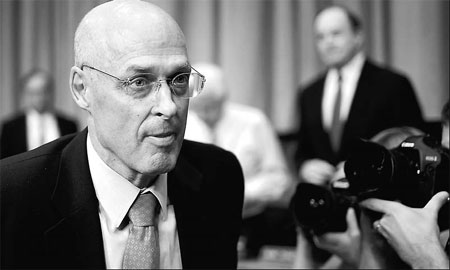
US Treasury Secretary Henry Paulson leaves a Senate committee meeting on Capitol Hill in Washington DC. Bloomberg News

The $700 billion rescue that the US House considered on Friday reflects the unintended consequences of decisions made by Treasury Secretary Henry Paulson and Federal Reserve Chairman Ben S. Bernanke since March.

Beginning with the orchestrated purchase of Bear Stearns Cos by JPMorgan Chase & Co, each step was a bold effort to forestall a collapse of the financial system. The economy grew in the first two quarters of this year, and financial distress eased for a while after the Bear Stearns rescue. Still, each decision to bail out or not created more instability, leading to further runs on securities firms, banks and insurers.

"Every time you tinker with this delicate system even small changes can create big ripples," said Dino Kos, former head of the New York Fed's open-market operations and now a managing director at Portales Partners LLC in New York. "This is the impossible situation they are in. The risks are that the government's $700 billion purchase of assets disturbs markets even more."

Paulson and Bernanke insist that the program to buy troubled mortgages and other securities is needed to revive lending and restore stability to markets. What they have not discussed is the risk that they inadvertently make matters worse. By creating a government pool of distressed real-estate and bad debt, they could depress the housing market further.

Risk may become even more concentrated through a wave of bank mergers that, if unsuccessful, would stick taxpayers with an even higher bill. The decision to launch the biggest bailout in history came on a Sept 17 conference call, when Bernanke and Paulson pulled the trigger on a proposal etched out over several months. Over the previous two days, they let Lehman Brothers Holdings Inc fail and seized American International Group Inc. The reaction to their visible hand: a rout in financial stocks, paralysis in the trillion dollar inter-bank loan market, and flight from money market mutual funds.

Treasury and Fed officials had long been uncomfortable with the way the safety net had to be expanded to catch Bear Stearns. Not a single creditor had suffered a default as the company was swept into JPMorgan Chase & Co with the help of a $29 billion Fed loan. Stock investors received about $10 each.

Their decision to pull back and let shareholders get wiped out in Fannie Mae, Freddie Mac, and then Lehman "sent shivers through investors," said Peter Kovalski, who oversees financial-services stocks for Alpine Woods Capital Investors LLC's $12 billion portfolio. "Everybody kind of backed off and said if this is the way the government is going to play the game, we don't want to risk our capital." Lehman's bankruptcy toppled other assumptions that investors had made. Bear Stearns, deemed too big to fail by the Fed and Treasury, had $399 billion in total assets. Lehman Brothers had $639 billion in total assets, possibly posing a bigger systemic risk than Bear.

"There was a perception, right or wrong, that after Bear Stearns, that in any firm as big, the senior debt holders would be okay," said Karl Haeling, head of debt distribution at Landesbank Baden-Wuerttemberg, New York, Germany's largest state-owned bank. "Obviously, that was the wrong bet."

Bernanke and Paulson began their discussions at the end of the day on Sept 17, when the Standard & Poor's 500 Financials Index fell 8.9 percent. Investors concluded after the AIG takeover - the price of an $85 billion loan - that any future federal aid would come at a similar cost, and they fled.

"Are we imploding right here?" Joseph Saluzzi, co-head of Themis Trading LLC in Chatham, New Jersey, and his colleagues asked each other on Sept 17. Shares of Goldman Sachs Group Inc were down 21 percent at noon and Morgan Stanley lost 36 percent. "People thought, 'Oh, my God, if Goldman's going out, we've got a real problem.'"

Agencies

(China Daily 10/04/2008 page4)