> Top News
Smooth start to 'Big Bang' test
(China Daily)
Updated: 2008-09-11 07:46


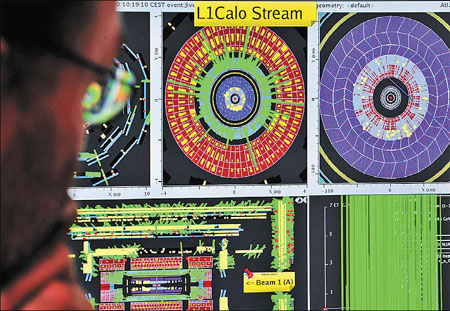
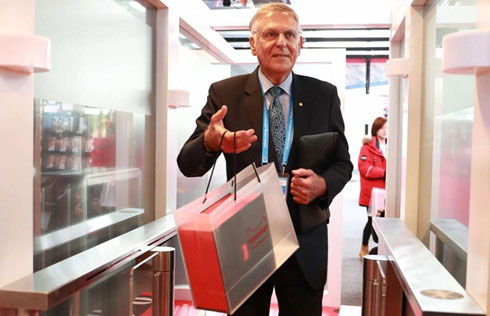
A European Organization for Nuclear Research (CERN) scientist is glued to computer screens at CERN press center showing traces of the first protons fired in the Large Hadron Collider during the "Big Bang" experiment near Geneva, Switzerland, yesterday. AFP

GENEVA: "Alice in Wonderland" completed its first major test successfully, with the world's largest particle collider firing a beam of protons all the way around a 27-km tunnel yesterday.

Scientists say the world's biggest scientific, or the "Big Bang", experiment in four major installations in a tunnel - ALICE, or "A Large Ion Collider Experiment" - is the next great step to understanding the make-up of the universe.

Skeptics, however, fear the collision of protons would create a black hole that could imperil the earth or even suck it in entirely. They say a byproduct of the collisions could be micro black holes, sub-atomic versions of collapsed stars whose gravity is so strong they can suck in planets and other stars.

After a series of trial runs, two white dots flashed on a computer screen at 10:36 am (16:36 Beijing time) yesterday, indicating the protons had traveled the full length of the $3.8-billion Large Hadron Collider.

"There it is," project leader Lyn Evans said when the beam completed its lap.

Champagne corks popped in labs as far away as Chicago, US, where contributing scientists watched the proceedings via satellite. Physicists around the world now have much greater power than ever before to smash the components of atoms together in attempts to see how they are made.

"Well done, everybody," said Robert Aymar, director-general of the European Organization for Nuclear Research, to cheers from the assembled scientists in the collider's control room at the Swiss-French border.

The organization, known by its French acronym CERN, began firing the protons - a type of subatomic particle - around the tunnel in stages less than an hour earlier.

After testing the beam successfully in clockwise direction, CERN plans to send it anti-clockwise. Eventually two beams will be fired in opposite directions with the aim of recreating conditions a split second after the "Big Bang", which scientists theorize was the massive explosion that created the universe.

The skeptics' fear is "nonsense", said James Gillies, chief spokesman for CERN, before yesterday's start. CERN is backed by leading scientists such as Britain's Stephen Hawking in dismissing the fears and declaring the experiment to be absolutely safe.

Gillies said that the most dangerous thing that could happen was for a beam at full power to go out of control. But the beam would damage the accelerator itself and burrow into the rock around the tunnel.

Nothing of the sort occurred yesterday, though the accelerator is still probably a year away from full power.

"Today we start small," Gillies said. "A really good result would be to have the other beam going around, too, because after you've got a beam around once in both directions you know that there is no show-stopper."

The project, organized by the 20 European member nations of CERN, has attracted researchers from 80 countries. About 1,200 are from the US, an observer country which contributed $531 million to the experiment. Japan, another observer, is a major contributor, too.

The collider is designed to push the proton beam close to the speed of light, whizzing 11,000 times a second around the tunnel.

Smaller colliders have been used for decades to study the make-up of the atom. Less than 100 years ago scientists thought protons and neutrons were the smallest components of an atom's nucleus.

But in stages since then experiments have shown they were made up of still smaller quarks and gluons and that there were other forces and particles.

The CERN experiment could reveal more about "dark matter," anti-matter and possibly hidden dimensions of space and time. It could also find evidence of the hypothetical particle - the Higgs boson - believed to give mass to all other particles, and thus to matter that makes up the universe.

Agencies

(China Daily 09/11/2008 page1)