![]() Nannies with smiley faces
By Liu Wei (China Daily)
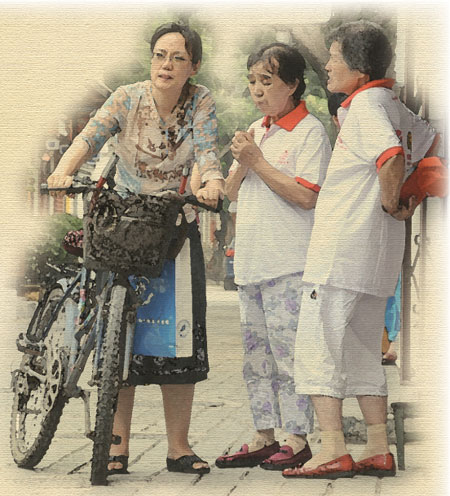
Updated: 2008-08-18 08:00 ![]() As bum raps go, neighborhood committees cop it pretty bad. Shunned by many in their community, their notoriety has spread far beyond China's borders, often as a symbol of State interference in people's private affairs. Committee members have been associated with policing family squabbles, stopping suspicious strangers, keeping records on everyone in their area and even helping to monitor the one-child family policy - though heaven only knows what that involves. Now, this institution dating back more than 50 years is being transformed as surely as the nation's economy. State appointees are being replaced by elected members and sinister practices are metamorphosing into more mundane - and socially popular - daily tasks. Take An Ruilan, for instance. She takes exception to being called a "small-feet scout". It is a nickname Chinese have long labeled on committee members in reference to old ladies whose feet were bound in feudal times. It is also linked in people's minds with the stereotype of the local nosey parker. "That era is so in the past," says An. "Today's neighborhood committees do a lot of public service rather than just intervening in people's private lives." The day before we met, the 57-year-old had got up at 5:30 am, leading her 14 members and 290 volunteers on their patrol around their community of more than 8,000 residents. An worked as director of the Yuhuili community committee in northern Beijing for eight years until passing the baton and going part-time. The committee now has only four members over 50 and two who are less than 30. Most of them have at least a high school diploma and are proficient in office duties. "We need both senior people's social experience and young people's energy," An says. Patrolling is only a small part of their duties - most of the time, they offer various public services, like helping poor and disabled residents apply for their benefits, organizing table tennis matches and song contests, helping the unemployed with job information and providing legal aid for those in need. For instance, they talked some university students into tutoring a girl from a poor single-parent family, persuaded a pigeon raiser to get his pet birds inoculated during the bird flu crisis, and coordinated with a real estate company on behalf of residents to get them better living conditions. Once, An even had to go out at midnight and act as mediator after a man complained of excessive noise by his neighbor. "We won't intervene in couples' fights unless they ask us to," An says. "People nowadays have a much stronger sense of privacy. And newcomers need not fear - with the intense immigration between cities, we no longer question strangers." "Chinese society has been experiencing a transformation since the economic reforms, which bring lots of new social problems," says Xia Xueluan, sociology professor at Peking University and an expert in community development. "Some of the government's duties have been transferred to non-governmental organizations. This is progress compared to when the government took care of everything in people's lives." The new order also means committee members need to have more skills and qualifications. "Knowing the government's policies isn't enough," says Tan. "You must also be quick-witted, be calm in emergencies and have excellent communication skills." An was once speaking to a political economics lecturer and told him: "Teaching can't be that easy these days, since today it is the market economy that dominates, not the planned economy, so a lot of things have to be updated." Needless to say, the teacher was pleasantly surprised that a neighborhood nanny could talk about economic matters and things were just fine between them after that. In An's community, every building has one or two "leaders", most of whom are elderly volunteers. They help the committee with various errands such as posting announcements, collecting votes for committee members' elections and negotiating with property managers. While full-time committee members earn a basic salary, volunteers aren't in it for the cash. Those who helped on patrols during the Olympics received 30 yuan a month, plus some soft drinks. An felt that was scant reward for their efforts so she took photos of each of them on the day of the Opening Ceremony and gave them all copies. "They were happy to get a little memoir which shows that they were doing something meaningful on a special day," she says. For the last 10 years these community-minded people have been able to put their names up for election to neighborhood committees by local residents. Another boundary has also been crossed: In 2006, a committee in Shanghai even welcomed two newcomers - an American environmentalist and a German entrepreneur. (China Daily 08/18/2008 page13) |