> Special Supplement
Shijiazhuang bridges past, present in tourism
By Cong Rong (China Daily)
Updated: 2008-08-12 08:16


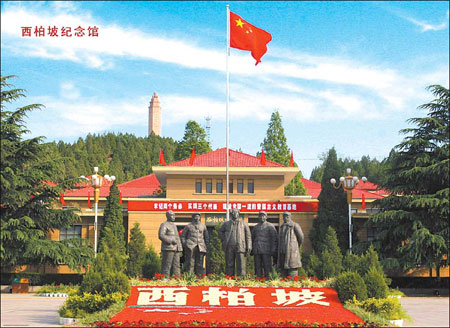
Xibaipo Memorial

Located at the foot of the Taihang Mountains and in the west of the north China plain, Shijiazhuang is the capital of Hebei province and the province's political, economic and cultural center.

With urban and rural population of 9.4 million, Shijiazhuang is a city with great development potential and an ideal place for investment.

Adjacent to Beijing and Tianjin, the city is a transportation hub located at the intersection of the Beijing-Guangzhou, Taiyuan-Dezhou, and Shuozhou-Huanghua railroads and many expressways.

It takes just two hours by train to reach the city from Beijing.

Though a young industrial city, Shijiazhuang has beautiful scenery and numerous sites of historical and cultural importance in the surrounding area.

Xibaipo, a small village located in Pingshan County, served as the seat of the headquarters of the Communist Party of China and its troops from May 1948 to March 1949.

The city boasts of 18 key cultural relics sites under the State protection, with Zhaozhou Bridge being the most famous one.

The Zhaozhou Bridge, built in the year 595 in the Sui Dynasty (581-618), is the world's oldest existing stone arch bridge.

Zhengding, a city noted for history and culture, and boasting many Buddhist relics, is only eight km from Shijiazhuang.

In recent years, the tourism infrastructure in the city has been greatly improved, providing more comfort and convenience to the tourists.

The city has now two five-star hotels, 19 four-star hotels and 26 three-star hotels.

The city received the honor of "China's Excellent Tourism City" in 2001.

Major attractions include:

Xibaipo Memorial

The memorial is located in Pingshan County, about 80 km northwest of Shijiazhuang. It is a national base for patriotic education.

It was the site of the Communist Party of China's last headquarters in a rural area before it moved to Beijing and liberated the entire country.

During 10 months of their stay there, Mao Zedong and the Communist Party launched three major military campaigns and won decisive victories against Kuomintang forces led by Chiang Kai-shek.

The Xibaipo Memorial was built in 1977 to commemorate this revered site.

Longxing Temple

The Longxing temple, also called "the Giant Buddha Temple" by local people, was first built in 586 during the Sui Dynasty (581-618).

It is one of the earliest, well-preserved and largest Buddhist temples in China.

It became a national key cultural relics site under State protection in 1961.

Since then, the government has spent a great deal on renovating and expanding the old temple.

Emperors of different dynasties paid visit to the temple to burn joss sticks to the Buddha statues and left behind many poems or notes on the steles in the temple.

Baoduzhai scenic spot

The Baoduzhai scenic spot, only 16 km from Shijiazhuang, is a hill with both historical and natural attractions.

With an altitude of 580 m and sheer cliffs on four sides, the hill was a strategic site in ancient battles and wars.

It was the ancient battlefield where General Han Xin and his troops combated the troops of Xiang Yu in the Han Dynasty (206BC-220AD).

Tiangui Mountain

The Tiangui Mountain is a famous mountain of Daoism, about 80 km from Shijiazhuang.

Covering an area of 60 sq km, the mountain is famous for the ancient temples, strange rocks, springs, mysterious caves and deep valleys.

It became a national key scenic spot in 2002.

Cangyan Mountain

The mountain is 70 km northwest of Shijiazhuang.

With an altitude of more than 1,000 m, it has impressive waterfalls and springs.

(China Daily 08/12/2008 page22)