> Life
Special Supplement: Sichuan's spicy cuisine sizzles its way to fame
By Zhou Liming (China Daily)
Updated: 2008-08-12 08:12

While walking down the steps of a pavilion-like building that overlooks the Dujiangyan irrigation system, the last thing I expected to see was a statue of the inventor of Kung Pao chicken. But there he was, sitting in one of the galleries, beard flowing, dressed in a greenish robe with a cape.

Ding Baozhen (1820-1886) was governor of Sichuan province during the Qing Dynasty (1644-1911) and instrumental in obtaining financial backing from the central government to rebuild Dujiangyan. The plaque did not mention the popular dish, but the guide hasn't forgotten it. To those who live in America and frequent Chinese restaurants, Kung Pao chicken is better known than Dujiangyan.

There are at least three versions of the origin of the recipe. One has the governor playing host by combining peanuts, dry pepper and sauted chicken cubes. The second says he stumbled on the dish elsewhere and asked his family chef to reproduce it. The third version contends the grateful public picked the dish and named it after him. Kung Pao was the title conferred on him by the royal court for his accomplishments.

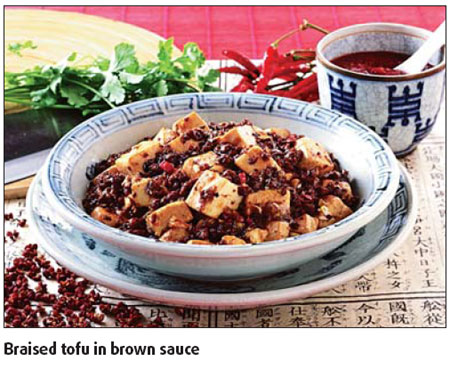
If you are aware of it as a Sichuan entree, you'll surely realize that mapo tofu, another spicy dish, could not have come from anywhere but Chengdu. Legend has it that in the Tongzhi (1856-75) years, a certain Mr. Chen opened a small eatery next to a bridge at the northern side of the city. Mrs. Chen noticed that many travelers liked spicy tofu with their bowls of rice. She thought of ways to improve on the recipe and soon gained fame. Since she had pockmarks on her face, it was nicknamed mapo - or pockmarked lady - tofu.

Sichuan cuisine evokes thoughts of numbingly spicy food. The first time I saw a fish cooked in a pot of red hot chili oil, I figured people in my hometown would never dare touch it because we use that amount of chili in half a year. But I was wrong. That dish has spread across China, even to a place as chili-resistant as my hometown in Zhejiang.

There is no way I can list all 3,000 dishes of Sichuan cuisine. Even the 10 percent that are really popular would fill a book. And there's no way an ordinary tourist can savor every restaurant in the city - there are 40,000 of them. It's no exaggeration to say that Chengdu is a gourmet's paradise. All you need is the stomach to take all the spices and flavors.

A common misconception is Chengdu food is invariably hot. Yes, many of the dishes are sizzling, but richly so. The variety of spice flavors is amazing. If you can keep your tongue from becoming numb, you can relish all the ingredients that make up the special meld.

Even ordinary families take great care in preparing their food. The abundance of crops and produce that make up the condiments from the Chengdu Basin has made it possible for the connoisseur in everyone to experiment. On top of that, several waves of migration from neighboring provinces throughout history have brought in outside gastronomic influences.

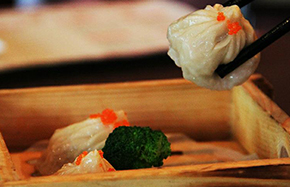
Chengdu snacks are in a league of their own. Rambling around one of the city's historical shopping districts, I tried one of each kind, as if I were a kid in a candy shop. One thing you have to remember - popular items have taken on new names here. Wontons are long chao shou, literally wontons in the shape of folded arms, invented by someone surnamed Dragon. Noodles are dan dan mian, named for the practice of selling them from shoulder pole baskets.

Many of Chengdu's snacks have retained the names of their originators, all street peddlers over the last two centuries, proving that everyone in the city has the chance to be a culinary great.

(China Daily 08/12/2008 page15)