![]() Economic slowdown fuels dramatic lifestyle changes in US
(China Daily)
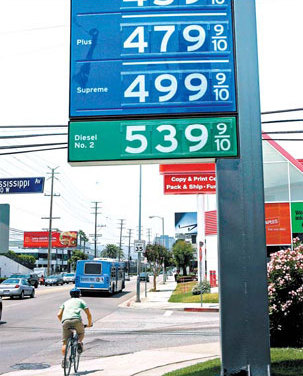
Updated: 2008-07-23 07:28 Adrienne Radtke plans to keep riding her bike to work even if gas prices drop. Steve Pizzini got rid of his Cadillac Escalade in favor of a 16-year-old Acura and does not expect to have another gas-guzzler. "I had a paradigm shift," said Pizzini, a financial analyst. "I spent the money on a nice car. But to me, it's not worth it. I don't think I will go that route again." Every economic downturn changes shoppers in some way. But this time, experts say the new behavior - fueled by higher gas and food prices, tightening credit and a slumping housing market - are the most dramatic and widespread that they have seen since the mid-1970s. So America's retailers, marketers and investors are all trying to figure out which habits shoppers will keep and which will they drop when the economy recovers. Will the people who switched to store-brand ice cream go back to Breyers or Edy's? Will shoppers return to department stores or keep looking for labels at discount prices at T.J. Maxx? "We are looking at stuff that reminds me of the 1970s," said Patricia Edwards of investment manager Wentworth Hauser and Violich. "Americans have seen a huge amount of their balance sheet evaporate. The effects will be more lingering." Wendy Liebmann, president of WSL Strategic Retail, says people's new spending patterns are forcing companies to change the kinds of products they sell and tweak their marketing to appeal to cost-conscious shoppers. She points to the last big recession of the early 1990s that helped trigger a fundamental shift in retailing as affluent shoppers started buying at discounters as well as upscale stores. Radtke, 31, who holds down two jobs - at a veterinarian's office and at a flower shop - recently picked up shoe glue to fix the soles of her worn sneakers. She is buying store-label soups and crackers and bought a bike for her commute after not having ridden one for five years. "We weren't big spenders, but now we are watching our money more," said Radtke, a Wisconsin resident, whose husband works in construction. "Even if I fell into a pile of money, I still wouldn't be spending a lot." According to a survey released last week by market research company Nielsen Co., which tracks consumer habits, about two-thirds, or 63 percent, of consumers are cutting spending due to rising gas prices, up 18 percentage points from a year ago. According to the study, which queried nearly 50,000 US consumers by e-mail during the first week of June, 78 percent of them are combining shopping trips and 52 percent are eating out less often. Consumers are also cutting more coupons, doing more of their shopping at supercenters and buying less expensive brands, the survey found. A rebounding economy may let some consumers revert to their old ways - like people who switched to smaller cars when times were hard in the 1970s but flocked to sport utility vehicles when gas got cheap again. But with more economists believing that the current woes will last well into next year, many think the underlying frugality will linger. Some Americans say their parents or grandparents affected by the Great Depression in the 1930s are still hoarding buttons and squeezing out several soup meals from ham bones. "I shop cautiously," said Edna Sott, an 88-year-old New Jersey resident. "I would say that is a hangover" from the Depression. Marian Salzman, chief marketing officer for public relations agency Porter Novelli, cites a "Depression mentality" that is making people "rethink their optimism in the economy". The widening gap between discounters and mall-based apparel sellers was evident in monthly retail sales figures released last week. The International Council of Shopping Centers-UBS tally of 38 stores found that same-store sales at discounters rose 5.1 percent in June and 9 percent at whole respond in big ways. Auto executives predict that consumers' newfound appreciation for smaller cars will be permanent, causing major pain at auto plants. Toyota Motor Corp. was among the latest to announce a product overhaul, saying it will shut down truck and SUV production to meet the changing consumer needs. Pizzini, 29, who lives in Pennsylvania, says his elderly Acura gets almost three times as many miles per gallon as the Escalade, whose lease he got out of through a company called LeaseTrader.com. Since last October, LeaseTrader.com has seen a 24 percent increase. Agencies (China Daily 07/23/2008 page7) |