> International
Drunk driving law stirs up discontent
(China Daily)
Updated: 2008-07-03 07:38


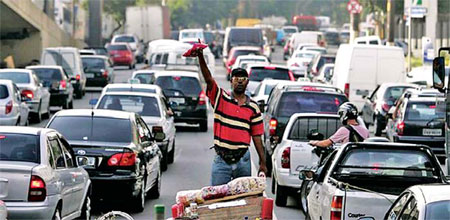
A street vendor sells food and soft drinks on a highway during a traffic jam in Sao Paulo, Brazil, on April 9. Reuters

Police have arrested hundreds of Brazilian drivers under a tough new law designed to crack down on rampant drunken driving, but bar owners are working to overturn the measure and many of their clients are flouting it.

Brazil has some of the world's most dangerous roads, with 7 deaths per 10,000 cars each year, compared to one or two deaths in most European countries, according to the Brazilian Association of Traffic Medicine.

An estimated 45 percent of those 36,000 annual deaths are due to drinking, the group says.

The law, which took effect on June 20, effectively bars drivers from drinking and imposes stiff fines. One beer is enough to exceed the new limit of 0.2 decigrams of alcohol per liter of blood. The old limit was 0.6 decigrams.

Violators face at least a $600 fine, a one-year suspension of driving privileges and temporary impoundment of their cars. Heavy drinkers can be imprisoned.

In 10 days federal police, who monitors the country's main highways, have arrested some 300 motorists and fined many more even though experts say they are undertrained, underfunded and underequipped. Some states only have a handful of breathalyzers.

Still, the law is prompting widespread discontent in a country where the rules of the road are often scorned.

"I'm for restrictions but they've gone too far. Where I live there's no public transport, so I can forget that romantic dinner, right?" said student Adelberto Santos at a Brasilia bar on Saturday. He and several friends drove home after drinking beer for several hours.

Media reports warning that liquor-filled candies or mouthwash could put drivers above the limit have heightened apprehension among some drivers.

Critics say legislators have mistakenly tried to make the roads safer by tightening the rules instead of working harder to enforce the old ones.

"The previous law was OK, had it been applied," said Julia Greve, a professor of medicine at the University of Sao Paulo. "Brazilians are shocked by what are commonplace controls in other countries because they've never seen a breathalyzer before."

Restaurant and bar owners worried about falling consumption are lobbying Congress hard to ease the new restrictions.

The sale of alcoholic beverages has fallen 25 percent in Rio de Janeiro since the law took effect, the city's bar and restaurant association said.

"You cannot consider someone a criminal for drinking two beers," said Norton Luiz Lenhart, President of the National Federation of Restaurants, Hotels and Bars, which may challenge the law before the Supreme Court.

Earlier this year, the federation succeeded in getting Congress to lift a ban on selling alcoholic beverages along urban motorways.

Some analysts say police are on shaky legal ground in testing suspected drunken drivers.

Agencies

(China Daily 07/03/2008 page10)