Canada says sorry to aboriginals
Updated: 2008-06-13 07:43
|

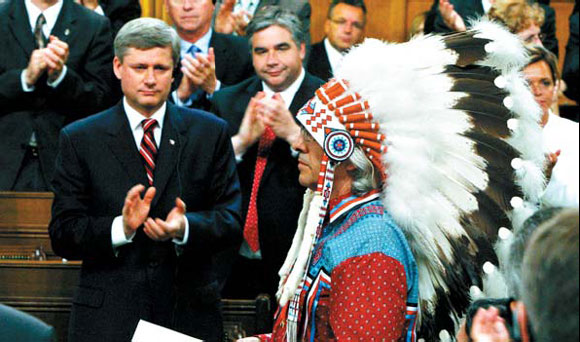
Canadian Prime Minister Stephen Harper and other members of Parliament give Assembly of First Nations Chief Phil Fontaine a standing ovation as he rises to respond to the official apology to the aboriginal Indians in the House of Commons in Ottawa on Wednesday. AP
|
Canada, addressing one of the darkest chapters in its history, formally apologized on Wednesday (local time) for forcing 150,000 aboriginal children into grim residential schools, where many say they were sexually and physically abused.

Prime Minister Stephen Harper told a Parliamentary chamber packed with legislators and aboriginal representatives that there could be no excuses for what happened at the church-run schools, which mainly operated from the 1870s to the 1970s.
"The government of Canada sincerely apologizes and asks the forgiveness of the aboriginal peoples of this country for failing them so profoundly. We are sorry," Harper said in a 15-minute address, at one point fighting back tears.
Native leaders said they hoped the apology would lead to a new era of reconciliation between Canadians and the often marginalized aboriginal population, which routinely suffers from poor living conditions and high unemployment.
The residential schools were initially set up to educate native children but later became part of a government campaign to assimilate aboriginals and eradicate their culture - "to kill the Indian in the child", as some put it at the time.
"There is no place in Canada for the attitudes that inspired the Indian residential schools system to ever again prevail," Harper said.
Contemporary accounts suggest up to half the children in some institutions died of tuberculosis and other diseases.
Many survivors say they were abused mentally, physically and sexually. Children were beaten for speaking their own languages and told they would be damned unless they converted to Christianity.
Twelve aboriginal representatives - including 104-year-old Marguerite Wabano, the oldest school survivor - sat on chairs in a circle in front of Harper.
Phil Fontaine, head of the Assembly of First Nations, said the apology "for this dreadful chapter in our shared history" would ensure the survival of Canada's aboriginal people.
"Finally, we heard Canada say it is sorry," he told Parliament, his voice breaking.
"It is possible to end our racial nightmare together. The memories of residential schools sometimes cut like merciless knives at our souls. This day will help us to put that pain behind us," said Fontaine, wearing a full native headdress.
Agencies
(China Daily 06/13/2008 page12)
|