Stocks dive on massive sell-off
By Jin Jing
Updated: 2008-06-11 07:44
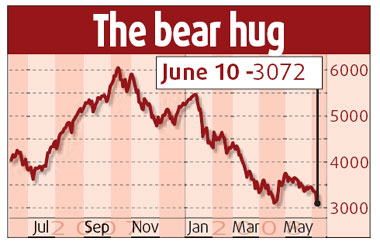
SHANGHAI: The Shanghai stock market plunged 7.73 percent yesterday, the biggest one-day drop since June 2007, wiping out 1.7 trillion yuan ($246 billion) of market capitalization.
The benchmark Shanghai Composite Index slid 257.34 points to close at 3072.33, with 860 out of the 912 stocks ending lower. The Shenzhen Component Index dived 8.25 percent, or 968.07 points to close at 10765.91.
The 88.3-billion-yuan turnover on the two bourses was, however, 35.4 percent more than Friday's, the last trading day.

Other Asian markets closed lower too. In Hong Kong, the Hang Seng Index fell 4.21 percent to 23375.52. Japan's Nikkei 225 index dropped 1.13 percent to close at 14021.17. And Australia's S&P/ASX 200 Index lost 2.8 percent, its biggest since March 20.
Analysts attributed the sharp fall in the mainland stock market to massive sell-off by investors, worried over the government's credit tightening measures to fight inflation and to the poor performance of the US and many other global equity markets.
The central bank announced over the weekend it would raise the reserve ratio for lenders by 1 percentage point. The move shows the government will maintain the tightening measures to curb inflation despite signs that food prices are moderating, the analysts said.
The tightening measures are expected to squeeze corporate earnings further too.
"The rate of the latest increase in the reserve ratio has taken many by surprise, cautioning investors as they weigh the impact of rising commodity prices in the corporate sector," said Jing Ulrich, chairman of JPMorgan Securities China Equities.
"The reserve ratio increase comes within less than a month of the previous one, and shows the government will maintain its tightening campaign," she said.
The consumer price index (CPI) for May, to be released tomorrow, is widely expected to be below 8 percent against 8.5 percent for April.
"It is difficult to see a turnaround in investor sentiment in the near future even if the authorities try to boost the market through new policy measures," said Stephen Green, research head of Standard Chartered Bank (China).
Ulrich said: "The recent weakness in the A-share market too has slowed down earnings as investment gains decline".
Bank stocks fell sharply yesterday because their net profits are expected to drop 0.42 percent owing to the increase in the reserve ratio, a BOC International report said.
Small- and medium-sized banks, including the Bank of Ningbo, Bank of Nanjing, Minsheng Bank and Shanghai Pudong Development Bank, plunged to the daily allowable 10-percent limit.
The current valuation of Chinese stocks is reasonable, said Zhang Xiuqi, an analyst with Guotai Jun'an Securities. After yesterday's fall, the average price/earnings ratio of A-share companies is 20 times, half of that at the beginning of the year.
"If the market falls sharply at the current level, investors can take in some stocks," said a China International Capital Corporation report, released yesterday.
Despite market insiders' worries that hot money from Vietnam may flow back into China triggering a financial crisis, some economists and experts said the impact of the Vietnamese financial crisis on China would be limited.
Liang Hong, an economist with Goldman Sachs China, said: "China's strong fiscal and balance of payments positions should minimize the impact."
(China Daily 06/11/2008 page1)
|