GPS grows as crime-fighting tool
Updated: 2008-05-15 07:28
|

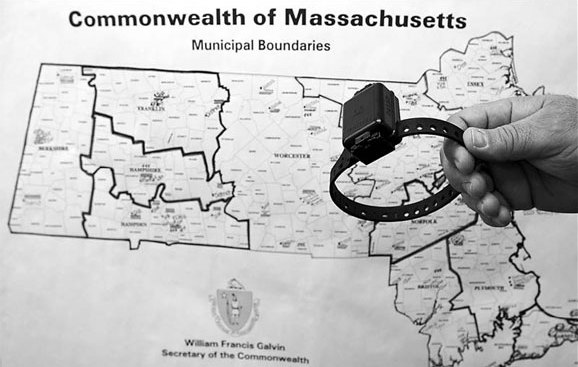
Joe Lucci, deputy commissioner in the Office of the Commissioner of Probation in the state of Massachusetts, holds a GPS ankle transmitter in Boston, Massachusetts, on May 5. Reuters
|
It was just after 10 pm when William Cotter burst into the home of his estranged wife, Dorothy, shooting her in the back with a sawed-off shot gun before taking his own life.

Just five days earlier, a court had ordered him to stay away from his wife after decades of drunken violence and she was carrying a panic button linked to the local police station, in Amesbury, Massachusetts. But it wasn't enough to save her on the night of March 26, 2002.
Fast-forward six years. Electronic surveillance technology is changing the way authorities in the United States monitor repeat offenders. Its advocates say the new technology could have saved Dorothy's life. Its detractors fear a widening breach of civil liberties and an illusory sense of protection.
Coast to coast, authorities are expanding electronic monitoring to fight crime - moving beyond its early use in tracking movements of sex offenders to include gang members who have been released on probation, people accused of repeated violence against women and even truant students at schools.
At the heart of the surveillance is a technology best-known for helping people on the road: the global positioning system (GPS).
Massachusetts, one of the first states to employ it in 2006, now has about 700 people fitted with electronic bracelets that send signals via satellite to computer servers if they go places they shouldn't - so-called "exclusion zones".
The Massachusetts law, which allows judges to impose electronic monitoring as a condition of a restraining order, has become a model for states such as Illinois and Oklahoma.
Part of the appeal is money. GPS is a cost-effective alternative to prison, said Paul Lucci, deputy commissioner of the Massachusetts Probation Service, pointing to a chart taped to his office wall showing a state-wide surge in use of GPS - mostly to track sex offenders but also for others.
"These people probably should be in jail but the cost of incarceration can be as much as $30,000 or $40,000 a year. The GPS costs about $3,400 a year," he said.
The Massachusetts law was inspired in part by Cotter's death and other cases of repeated abuse in a country where authorities say more than 1,000 women are murdered each year by intimate partners. It alerts police whenever an offender enters a restricted zone such as near a woman's home or office.
"It's more than just slapping a GPS on a guy. You have to really have an intelligent coordinated approach to it and then it really can save lives," said Diane Rosenfeld, a professor at Harvard Law School who helped draft the Massachusetts law.
The Jeanne Geiger Crisis Center, a women's shelter which in 2006 began piloting the GPS program in Newburyport, a Massachusetts city north of Boston, has a high success rate - none of the eight men fitted with GPS have violated protective orders while wearing the bracelets.
Authorities see it as an alternative to overflowing prisons in a country with the world's highest incarceration rate.
North Carolina's eastern Pitt County, a rural tobacco-growing region of 138,690 people, adopted the technology in late 2005 to relieve overcrowded jails by freeing more accused batterers on bond and tracking them with GPS before they go to trial. It was expanded last year to four more counties.
In a measure of success, police dispatchers receive fewer calls involving the same person when an offender wears a GPS bracelet.
Agencies
(China Daily 05/15/2008 page11)
|