Hezbollah gunmen seize control of western Beirut
Updated: 2008-05-10 07:38
BEIRUT: Shi'ite Hezbollah gunmen seized nearly all of the Lebanese capital's Muslim sector from Sunni foes loyal to the US-backed government on Friday following the country's worst sectarian clashes since the 1975-90 civil war.
At least 11 people have been killed and more than 20 wounded in three days of street battles and gunfights, security officials said.
The takeover presented a blow to US policy as President George W. Bush's administration has been a staunch supporter of the government in Beirut over the past three years.

About 100 Shiite Hezbollah militants wearing matching camouflage uniforms and carrying assault rifles marched down Hamra Street, a normally vibrant commercial strip in a mainly Sunni area of Beirut. They took up positions in corners and sidewalks and stopped the few cars braving the streets to search their trunks.
The Hezbollah takeover was peaceful in some neighborhoods as the militants fanned out across the Muslim sector of the city.
Later in the day, Lebanese troops began taking up positions in some Sunni neighborhoods abandoned by the pro-government groups, but did not intervene in the clashes, which had largely tapered off into sporadic gunfire by early afternoon.
A senior security official said the army began deploying on some streets with the end of the clashes and would soon take over the Sunnis' last stronghold of Tarik Jadideh.
In some cases, Hezbollah handed over newly won positions to Lebanese troops, presumably after having made clear to everyone its strength ahead of the next round of negotiations with opponents over the country's political future.
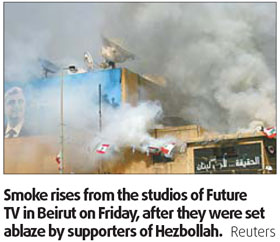
Hezbollah's power was demonstrated dramatically on Friday morning when it forced the TV station affiliated to the party of Lebanon's top Sunni lawmaker, Saad Hariri, off the air.
Gunmen also set the offices of the party's newspaper, Al-Mustaqbal, on fire in the coastal neighborhood of Ramlet el-Bayda.
Lebanon's army, which has stayed out of the sectarian political squabbling that has paralyzed the country for more than a year, only intervened after the building was set ablaze. Troops provided cover for firefighters, who eventually extinguished the flames.
The army also evacuated employees from the TV station, but only after gunmen massed near it and threatened to destroy it, Nadim Mounla, the station's chief, said.
With top leaders Hariri of the Sunnis and Druse leader Walid Jumblatt besieged in their residences in Muslim western Beirut, officials of the pro-government majority held an emergency meeting in a mountain town in the Christian heartland northeast of Beirut, LBC TV, a pro-government Christian station, said.
An emergency meeting of Arab foreign ministers to discuss the crisis will be held in Cairo in two days, Egyptian Foreign Ministry spokesman Hossam Zaki said.
Street clashes exploded into gun battles in parts of Beirut on Thursday afternoon after Hezbollah leader Hassan Nasrallah accused Lebanon's Western-backed government of declaring war on his Shi'ite militant group. It was the militant leader's strongest comments since Lebanon's political crisis erupted 17 months ago.
Hariri later went on television urging Hezbollah to pull its fighters back and "save Lebanon from hell". He proposed a compromise that would involve the army, one of the sole national institutions respected by Lebanon's long deadlocked factions.
But Hezbollah and its allies swiftly rejected the offer.
The unrest has virtually shut down Lebanon's international airport and barricades closed major highways. The seaport also was closed, leaving one land route to Syria as Lebanon's only link to the outside world.
Hezbollah first blocked roads in Beirut on Wednesday to enforce a strike called by labor unions, but confrontations quickly spread and became more violent. Factions threw up roadblocks and checkpoints dividing Beirut into sectarian enclaves, and the chattering of automatic weapons and thumps of rocket-propelled grenades echoed across the city overnight.
Agencies
(China Daily 05/10/2008 page1)
|