Harrowing tales of suffering surface

Updated: 2008-05-09 07:25


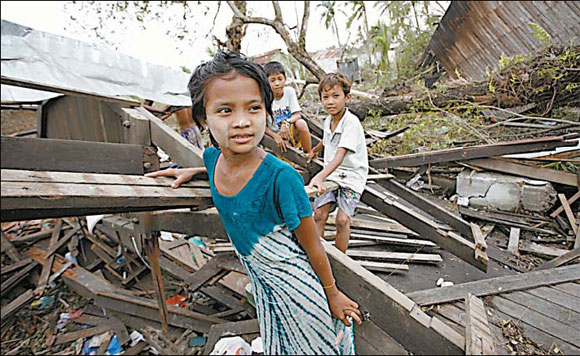
Children sit amid the debris of their destroyed homes southwest of Yangon on Tuesday. Reuters

When the massive storm surge churned up by Cyclone Nargis struck his village, fisherman Zaw Win clung to a tree for three hours.

The strength in his arms saved his life. He could only watch helplessly as his wife, 10-year-old son and 4-year-old daughter were dragged to their deaths by the head-high waves.

"I just held on and cried. I knew I'd lost my family," the 32-year-old said in Bogalay, one of the towns in Myanmar's Irrawaddy delta, worst-hit by Nargis' 190 kph winds and the wall of water they generated.

Of his coastal village of 2,000 people, just 40 survived, he said.

To get to Bogalay, 90 km southwest of the former capital Yangon, he had to wade through floating corpses before finding a boat to carry him for two hours through devastated swampland - all that remains of what was once the "Rice Bowl of Asia".

Desperate for help, all he found were whole streets flattened and virtually nothing to eat or drink.

His is just one of the many harrowing tales told by survivors paddling their way out of the delta in splintered wooden boats.

Almost no aid has reached the town of 50,000 where rice mills have been ripped apart and fishing boats washed away.

Twenty soldiers guarded meager supplies of rice and instant noodles in a brick building commandeered from a women and children's association. Residents said they had received some small handouts.

Some of the first relief workers to reach Bogalay were astounded at the damage. "It's disastrous, terrible," said Saw Simon Tha, a neurosurgeon who runs a charity-funded mobile health clinic.

Roofs were blown off almost all the houses, holes blasted in wooden walls and the streets littered with the remains of matted bamboo and thatched huts.

Amid the destruction, Saw Simon Tha's medical team came across Than Win, 41 years old and eight months pregnant. She survived by climbing a tree as the water rose around her house, drowning seven of her 10 children.

That evening, in a makeshift clinic set up amid the rubble, she gave birth to her 11th child, a boy she called Chit Oo Mg. It means "first love".

Bogalay's Buddhist temple and primary school are teeming with the homeless from nearby villages.

But many others have chosen to stay near their collapsed huts, building tents from snapped branches and reeds and drying what is left of their rice stocks on blue mesh sacking laid out on the road.

Some of the refugees lie on the bank of a creek that empties into a coconut tree-lined river as even more boats glide silently into the town during the night.

Fisherman Kyaw Way, managed to lift his wife, 10-year-old son and 7-year-old daughter into a tamarind tree. His other children, a girl of 8 and boy of 6, are missing.

China offers more aid

The Chinese government decided to offer another 30 million yuan ($4.3 million) worth of aid for cyclone disaster relief and reconstruction work in Myanmar, Foreign Ministry spokesman Qin Gang announced yesterday.

Qin said that, considering the sever damage caused by the disaster, China offered the aid to show the friendship of the Chinese government and people to Myanmar people.

China has decided to offer $1 million worth of aid, including relief materials worth $500,000, to help Myanmar with its disaster relief and rehabilitation efforts. The first batch of relief materials had been delivered by Wednesday afternoon.

Agencies - Xinhua

(China Daily 05/09/2008 page10)