Discarded computers poisoning Africa's kids
Updated: 2008-05-07 07:16
|

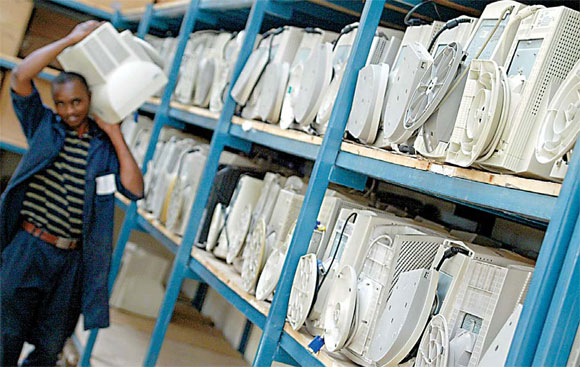
A technician at a Kenyan non-governmental organization carries a computer monitor to be converted into a television set in Nairobi in this file photo. Computer for Schools Kenya has been rehabilitating donated computers since 2002 but opted to convert old monitors into television sets to reduce the huge amount of toxic electronic waste being generated. AFP
|
Thousands of discarded computers from Western Europe and the United States arrive in the ports of west Africa every day, ending up in massive toxic dumps where children burn and pull them apart to extract metals for cash.

The dumping of the developed world's electronic trash, or e-waste, is in direct contravention of international legislation and is causing serious health problems for inhabitants of the shanty towns that have sprung up amid the smoldering dumps in Lagos and Accra.
Campaigners believe unscrupulous scrap merchants are illegally dumping millions of tons of dangerous waste on the developing world under the guise of exporting it for use in schools and hospitals. They are calling for better policing of the ban on exports of e-waste, which can release lead, mercury and other dangerous chemicals.
"Ghana is increasingly becoming a dumping ground for waste from Europe and the US," said Mike Anane, director of the League of Environmental Journalists in Ghana.
"The people that break open these monitors tell me that they suffer from nausea, headaches and respiratory problems."
More than half a million computers arrive in Lagos every month but only about one in four works. The rest are sold as scrap, smashed up and burned.
"Millions of tons of e-waste disappear from the developed world every year and continue to reappear in developing countries, despite international bans," said Luke Upchurch from Consumers International, which represents more than 220 consumer groups in 115 countries.
The illegal trade in e-waste is highly lucrative. It is possible to extract more gold out of a ton of electronic circuitry than from a ton of gold-bearing rock. But illegal dumping is putting at risk charities and other organizations that donate second-hand equipment to the developing world.
Since the introduction of the Basle Ban outlawing the export of hazardous waste from developed to less developed countries in 1992, computers have become an everyday item. Consumers and businesses are replacing their kit at an increasing rate, creating a new waste mountain.
Six years ago the EU produced the waste electrical and electronic equipment (WEEE) directive, which introduced new curbs and restrictions on the movement of e-waste. The directive, which came into effect in Britain in January last year, heavily regulates the movement of e-waste for recycling and bans its export for disposal. It also introduced a scheme under which the cost of properly disposing of electronic equipment put on the market after August 2005 must be picked up by the producers of the waste - manufacturers, retailers, branders and importers.
But DanWatch, a partner organization of Consumers International, has evidence that computer equipment from British companies and even local authorities is being dumped in West Africa.
"We filmed children as young as 6 searching for metal scraps in the earth, which was littered with the toxic waste from thousands of shattered cathode ray tubes," said Benjamin Holst, co-founder of DanWatch.
"A whole community is virtually living and working in this highly toxic environment, which is growing every day."
Properly functioning computer equipment is exempt from the WEEE rules about export. In fact, the regulations encourage refurbishment and re-use of computer equipment. But there is no regime that checks computer equipment destined for re-use before it is shipped overseas.
Regulating waste in England and Wales falls under the remit of the Environment Agency.
"Our position would be that genuine reuse of working equipment is generally a good thing," said Adrian Harding, the agency's policy advisor.
The trouble lies in the phrase "genuine reuse". Harding admits that the agency simply does not have the resources to check every consignment destined for reuse in the developing world. Part of the problem is that the agency does not even have to be notified about the movement of goods for reuse so it would not know which containers to target.
One organization that has already made a name for itself as a legitimate supplier of second-hand computers to the developing world is Computer Aid International, which is celebrating its 10th anniversary and has sent more than 119,000 computers to countries including Kenya and Chile.
The charity is registered with the Environment Agency as an official e-waste treatment company. Any machines it cannot use are sent to specialist recycling facilities within the EU. Founder Tony Roberts believes the problem with existing e-waste regulations is that outside the EU, they do not make the producer of computer equipment pay for its proper disposal.
Without this cash, there is little incentive for developing nations to start investing in proper recycling facilities. As a result, the e-waste problem is likely to grow, not because of unscrupulous European exporters but because of the increasing number of computers being sold in the developing world.
"When you look at the whole product lifetime of a computer, 75 percent of the environmental damage is done before the computer is switched on for the first time," he pointed out.
"It is the production, the mining, the factories producing the kit and the use of toxic materials - that is where the environmental damage is done. So if we do not make the producer responsible for dealing with these environmental issues, we are never going to get a redesign of computers; we are never going to get computers that are produced in a more environmentally friendly way."
Once Computer Aid's donated equipment reaches the end of its useful life, the company tries to limit the environmental damage caused by its disposal. In Kenya, for instance, it is helping to build a recycling facility that will take not just its own kit but broken machines from across the country. The process is basic but better than using landfill - and circuit boards are re-exported to Britain.
"The problem is the producers are not providing any funds in the developing markets, where they are selling millions of PCs, so we just need to set up similar funds in all markets," Roberts said.
It is a call taken up by Martin Hojsik, toxics campaigner at Greenpeace International. "We want the producers to be responsible for the take-back of their kit," he said.
The hope is that the sheer expense of making producers pay for the disposal of their computer equipment wherever it is sold or used across the world, will spur the industry towards making "greener" machines.
To bring a quick end to the spectacle of children scrabbling around in toxic waste dumps in Africa, Europe's regulators and more importantly, its consumers and businesses, need to take responsibility for the disposing of their computer equipment.
(China Daily 05/07/2008 page7)
|