Stock market slips further
By Jin Jing
Updated: 2008-04-18 07:02
|

An investor monitors price changes at a securities house in Haikou, capital of Hainan province. The Shanghai Composite Index dropped 2.09 percent to close at 3222.74 yesterday. Shi Yan
|
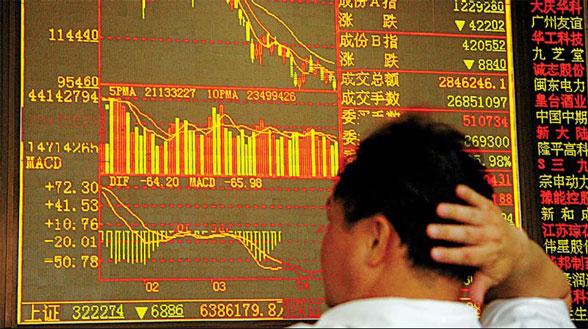
SHANGHAI: Concerns of a further-tightened monetary policy and a hike in bank reserve requirement to take effect next Friday pushed the benchmark index of the mainland stock market down 2.09 percent, or 68.86 points, to close at 3,222.74 - the lowest point since March 30, 2007.

Losers outnumbered gainers 776 to 82. The Shenzhen Component Index dipped 3.32 percent, or 400.19 points, to close at 11657.08.
Turnover on Shanghai and Shenzhen bourses amounted to 89.8 billion yuan, up 13.9 percent from Wednesday. Total market capitalization fell 2 percent to 20.73 trillion yuan.
"The hike of banks' reserve requirement has, to some extent, lessened investors' worries about an interest rate increase in the short term," TX Investment Consulting Co Ltd analyst Wu Feng said. "But investor sentiment has remained depressed, and the market is expected to stay in the doldrums."
Orient Securities analyst Zhang Yang said: "The central government is expected to continue exercising credit control through window guidance to commercial banks."
Wu said he believed an interest rate hike might be on the horizon, as "it is an effective tool to curb inflation while the CPI index has been running higher than 8 percent for two consecutive months".
Investor sentiment was also dampened by the most recently released corporate earnings, which were lower than expected.
Huaneng Power International plunged 9.96 percent to 7.23 yuan after it posted a 1.24 percent net profit increase for last year.
China Yangtze Power Co Ltd shed 4.43 percent after announcing its net profit increased slightly more than 50 percent in 2007, which showed a slowdown in the fourth quarter, as it already announced an 83.7 percent net profit jump in the first three quarters of last year.
"In such a weak market, many listed companies seem less interested in issuing a beautiful annual report to attract investors," Wu said.
Mutual funds' performances were hit by the weak stock market. All funds' classifications lost profits in March, according to a study by Lipper.
Equity funds led the fall with a 17.15 percent loss. Mixed-asset aggressive funds followed, diving 14.78 percent, while mixed-asset flexible funds fell 14.39 percent and mixed-asset balanced funds shed 12.39 percent.
QDII funds lost 9.58 percent in profits in March. QFII funds received a continued redemption from February. The 12 QFII funds Lipper tracked averaged losses of 16.39 percent in March.
(China Daily 04/18/2008 page13)
|