Questions raised over faith 'vote'
By Zou Ren
Updated: 2008-02-05 07:26
|

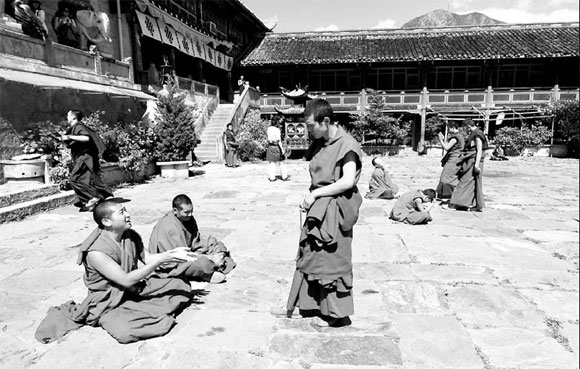
Monks discuss Tibetan Buddhist theories, a mainstay of their studies, at a temple in Kangding, Sichuan province. Hu Dechuan
|
On Jan 6, the Dalai Lama compelled monks in India's Gaden Monastery to sign a pledge not to believe in the Buddhist Guardian, Gyaiqen Xudain, and expelled nine monks who refused to take the pledge.

On Jan 9, he brought up the Gyaiqen Xudain issue again, and said a final decision must be made through a "public vote".
Following the Dalai Lama's order, some Tibetan Buddhism temples in India held a "public vote" on whether they should believe in the Gyaiqen Xudain or not. This resulted in great uproar among Tibetan communities and Tibetan Buddhism believers.
Why is the Dalai Lama so concerned about the Gyaiqen Xudain?

According to him, there are two reasons: The Gyaiqen Xudain is harmful to the fundamental cause of Tibet and "he is no good for the Dalai Lama's health".
Second, the Gyaiqen Xudain is heresy, a sect with evil wishes.
In recent years, whenever the Dalai Lama fell ill or there were frustrations with the so-called "Tibet Independence" cause, he would blame the Gyaiqen Xudain.
It indicates the 14th Dalai Lama has self-doubts, but that is no reason to force others to stop worshipping what they believe in.
In the 1990s, in the name of fighting against the Buddhist Guardian, the Dalai Lama started slaughtering members of the New Kadampa sect.
He incited the Tibetan Youth Congress, Tibetan Women's Federation and some other branches to forcefully dismantle statues of the Gyaiqen Xudain, and beat up people who refused to obey. Those who refused, were suppressed, and lamas and nuns were driven out of monasteries and nunneries.
Now, the Dalai Lama has resumed his old tricks by calling for a public vote.
Public votes are in line with democracy and modern civilization, but the Dalai Lama's "public vote" is religious autocracy under the cover of democracy to attack and persecute the monks, nuns and others who have faith in the Gyaiqen Xudain.
Such a "public" vote is indeed blasphemy and is a mockery to democracy and freedom. Due to the Dalai Lama's religious autocratic behavior, people cannot help but think of the inquisition during the Dark Ages and the Pope's slaughter of heathens.
In August, German newspaper Die Welt published an article co-authored by Victor and Victoria Trimondi that said: "Tibet did not end its dark medieval period until the mid-20th century. Before that, it was plagued by violence, wars and power struggles under the name of religion. The religious trials held under the Lama regime were no different from those under Catholic rule during medieval days.
"For the problem of the Buddhist Guardian, Gyaiqen Xudain, the 14th Dalai Lama emphasizes his exclusive authority and orders an end to worshipping the Buddhist Guardian which has been inherited for hundreds of years.
"Though he himself stands for democracy, the 14th Dalai Lama's leader station cannot be altered through the so-called public vote."
The Dalai Lama's religious autocracy has caused strong resentment among international religious people and believers in the Gyaiqen Xudain.
As recently as 10 years ago, more than 300 Gyaiqen Xudain believers marched in the United Kingdom to protest against the Dalai Lama with the slogan: "Your smile is charming, but your behavior is harming".
The protesters also sent a 51-page document to more than 300 news agencies to reveal the Dalai Lama's persecution of believers of the Gyaiqen Xudain.
Time goes by, but the Dalai Lama has maintained his religious autocracy and continues violating the human rights of Gyaiqen Xudain believers, and splitting Buddhism sects.
How can such a "Tibetan Buddhism leader" and winner of the "Nobel Peace Prize" resort to such actions?
It is funny that those who flatter the Dalai Lama and call him a guardian of democracy and human rights stay silent as he continues to persecute Gyaiqen Xudain believers.
Do these people really know nothing about it, or have no choice but to keep silent?
It is hoped such advocates of democracy and human rights are brave enough to give a public answer.
China Tibet Information Center
(China Daily 02/05/2008 page4)
|