Antarctic ice riddle keeps sea-level secrets
Updated: 2008-02-01 07:27
A deep freeze holding 90 percent of the world's ice, Antarctica is one of the biggest puzzles in debate on global warming with risks that any thaw could raise sea levels faster than UN projections.
Even if a fraction melted, Antarctica could damage nations from Bangladesh to Tuvalu in the Pacific and cities from Shanghai to New York. It has enough ice to raise sea levels by 57 meters if it melted, over thousands of years.
A year after the UN's Intergovernmental Panel on Climate Change (IPCC) projected sea level rises by 2100 of about 20 to 80 cms, a Reuters poll of 10 of the world's top climatologists showed none think that range is alarmist.

Six experts stuck by the projections, saying the response of ice sheets in Antarctica and Greenland was still unclear, and four other experts, including one of the authors of the IPCC report, projected gains could be 1 or even 2 meters by 2100.
"Most people looking at it are thinking more in terms of a meter," said John Moore of the Arctic Centre at the University of Lapland. "Insurance companies don't know to a factor of 100 where to set their insurance premiums for coastal areas in Florida."
Some island nations, such as the Maldives in the Indian Ocean, are building defences costing millions of dollars and want to know how high to build.
"I think it will be...certainly at the high end of the range," said Kim Holmen, research director of the Norwegian Polar Institute, at the Troll Station 250 km from the coast in Antarctica.
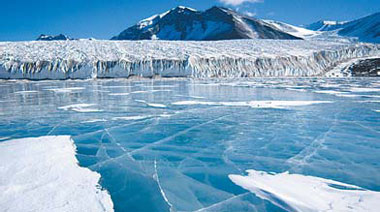
Set amid jagged mountains like the mythical homes of troll giants, this part of east Antarctica is the world's deep freeze with no sign of a thaw. Temperatures were about minus 15 C at the height of the Antarctic summer.
"It's my view that more than a meter of sea-level rise can't be ruled out," said Stefan Rahmstorf, of the Potsdam Institute for Climate Impact Research in Germany. He said many experts "think the IPCC range is unfortunately not the full story".
Even so, most experts said it is still impossible to model how the ice will react. Antarctica may accumulate more ice this century because of warming, blamed by the IPCC mainly on human use of fossil fuels, rather than slide faster into the sea.
"The crux of this problem is that we are moving into an era where we are observing changes in the climate system that have never before been seen in human history," said Gerald Meehl, of the US National Center for Atmospheric Research.
"Ice sheets fall into that category. Quite simply, at this time we don't have a good upper-range estimate of 'how much sea-level rise and how fast'," he said. Meehl, a coordinating lead author of the IPCC report, said that gave the best view.
The core prediction for sea-level rise by the IPCC, which shared the 2007 Nobel Peace Prize with former US vice-president Al Gore, is for a gain of 18 to 59 cm in the 21st century, after 17 cm in the 20th.
The forecast rate includes faster ice flow from Antarctica and Greenland observed from 1993-2003 but the IPCC said this could increase or decrease in future. If the flow grows in line with temperature rises, it would add a further 10 to 20 cm.
Agencies
(China Daily 02/01/2008 page12)
|