Thai parties start coalition bargains

Updated: 2007-12-25 07:40

Thailand's political parties got down to hard bargaining yesterday after voters rejected last year's military coup but failed to give supporters of ousted prime minister Thaksin Shinawatra an outright majority.

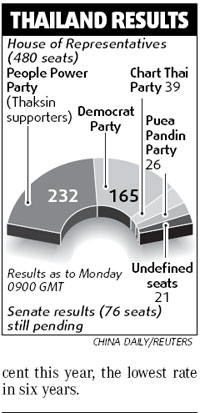
The deal-making looks likely to be long and tense after Sunday's vote showed a country polarized between Thaksin supporters in the People Power Party (PPP) and opponents represented mostly by the Democrat Party.
The PPP said it had managed to gain enough support to form a coalition government but refused to name its partners, prompting speculation the announcement might be part of the usual post-election bargaining process.

"There is still plenty of room for mischief," the Bangkok Post said in an editorial. "Other groups, including the military, must abide by the election decision."

Combative PPP leader Samak Sundaravej, who openly admits to being a Thaksin proxy, is not shy about his job prospects, saying his party's 232 seats in the 480-member parliament will "certainly" allow him to be Thailand's next prime minister.

The big question is whether the army and royalist establishment, whom the Thaksin camp accuses of masterminding the coup, will stand by and let this happen.

Two of the crucial minor parties, Chart Thai (Thai Nation) and Puea Pandin (Motherland), with 65 seats between them, would act together and take their time making a decision, Chart Thai leader and former prime minister Banharn Silpa-archa said.

Parliament must meet within 30 days of the election and then has a month to elect a prime minister.

However, the army and Thailand's old elite are likely to call in every favor to stop Thaksin making a comeback by proxy.

There was no immediate market reaction as Thailand is on a holiday for the election. The stock and currency markets reopen today, Christmas Day.

But reflecting fears of another coup, ratings agency Standard & Poor's said any more military meddling would be likely to lead to a credit downgrade, making it harder for Thailand to borrow money on international markets.

"If such divisions result in another unconstitutional replacement of the government, or social unrest, the political and economic consequences will be much more negative than experienced so far," S&P said.

Underlying the political horse-trading is the fear of trouble on the streets of the capital, where prior to the coup the middle classes staged months of anti-Thaksin protests, paralyzing government and hitting consumer confidence.

Despite his unpopularity in the capital after four fractious years as governor there, Samak shrugged off fears that protests would give the army cover to step in again.

"It is a victory for this country," Samak said of the vote, adding that new army chief Anupong Paochinda was a "good guy" committed to keeping out of politics.

The military's preferred outcome is a government led by the Democrats, who won 165 seats according to a full count, even though most analysts say such a weak five-party coalition would be unlikely to last beyond a year.

Financial markets hope the return of an elected administration will signal the end of a period of disappointing economic growth, likely to fall from 5.1 percent in 2006 towards 4 percent this year, the lowest rate in six years.

Agencies

(China Daily 12/25/2007 page8)