Bomb kills senior Lebanon general

Updated: 2007-12-13 07:38

A car bomb killed a Lebanese army general in a Christian suburb of Beirut yesterday, removing a leading contender to replace military chief General Michel Suleiman, who is set to be elected president next week.


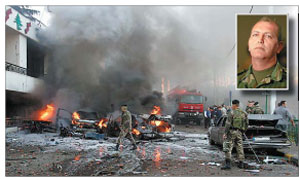
Cars burn at the site of an explosion in the Christian town of Baabda, east of Beirut, yesterday. Inset: Lebanon's Brigadier General Francois al-Hajj who was killed in the blast yesterday. Reuters

The attack heightened tension in Lebanon where rival leaders are embroiled in a struggle over the presidency that has fuelled the biggest political crisis since the 1975-90 civil war.

Brigadier General Francois al-Hajj, head of army operations, and his bodyguard were killed in the early morning blast that hit their car in Baabda, a wealthy area that houses the presidential palace and several embassies.

Hajj was the ninth fatality in a string of assassinations that began with the 2005 killing of ex-premier Rafik al-Hariri.

Lebanese politicians from the Western-backed ruling coalition and the Hezbollah-led opposition denounced the attack, as did the United States, France, Germany, Syria and Iran.

A White House spokesman said President George W. Bush would "continue to stand with the Lebanese people as they counter those who attempt to undermine their security and freedom".

Security sources said 35 kg of explosives packed into an olive-green BMW car were detonated by remote control as Hajj's four-wheel-drive vehicle drove by.

Hajj, 54, had been seen as one of two main contenders for the job of army chief, traditionally a Maronite Christian. The post would fall vacant if parliament elects Suleiman president in a long-delayed vote now slated for Monday.

Political and religious leaders said the killing showed the need to reduce tensions by electing Suleiman swiftly. Prime Minister Fouad Siniora said the military was targeted for its role in preserving the country's security and stability.

No group claimed responsibility for Hajj's killing, which followed eight deadly attacks on anti-Syrian politicians and journalists. The most recent was a September 19 car bomb that killed Christian lawmaker Antoine Ghanem.

Some Lebanese politicians accuse Syria of carrying out the killings. Damascus has denied any involvement.

Syrian Foreign Minister Walid al-Moualem denounced the "criminal attack" on Hajj, saying: "We condemn any action that threatens Lebanon".

Hajj helped lead an army onslaught on Al-Qaida-inspired militants at the Nahr al-Bared Palestinian refugee camp in northern Lebanon earlier this year in which 168 soldiers and about 230 Fatah al-Islam fighters were killed.

The blast wrecked Hajj's car, set others on fire and damaged nearby buildings. Charred metal littered the blackened streets.

The army has stayed largely neutral in Lebanon's political turmoil and is seen as a unifying force.

On Monday, Lebanon's parliament speaker postponed the presidential election to December 17, the eighth delay to the vote.

Pro- and anti-Syrian factions agreed last week that Suleiman should take the presidency, reserved for a Maronite. It has been vacant since the term of Emile Lahoud ended on November 23.

Agencies

(China Daily 12/13/2007 page7)