Censoring movies done according to script
By Liu Wei
Updated: 2007-08-31 07:16
Zhang Hongsen, vice-president of the State Film Bureau gives, China Daily reporter Liu Wei the lowdown on censorship in Chinese cinema.
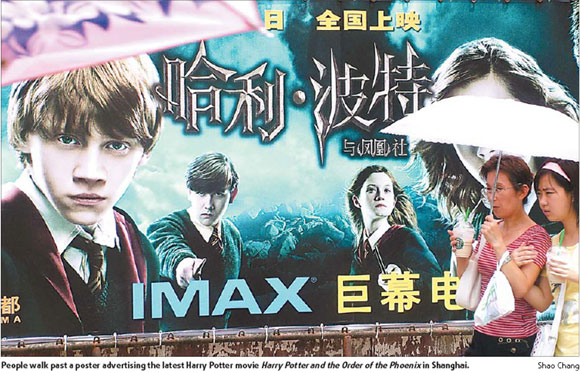
The idea of making a film in China is an intriguing prospect riddled with rules and intricacies. There are issues such as censorship as well as the finer points about who decides what films are shown in Chinese cinemas.
Who makes these decisions, and what procedures must filmmakers follow to make and release a movie? Are famous directors such as Zhang Yimou and Feng Xiaogang given special treatment?
Q: Since June 2006, film producers have only had to submit a summary of at least 1,500 words to the bureau while before it was essential they submitted a completed script before they started filming; at the same time, the bureau's provincial branches have the right to censor films shot by local production teams. What brought about the changes?

A: Before 2006 we required script approval, which meant filmmakers had to submit a finished screenplay and could only start filming after it was approved. After the film was completed, they had to submit the picture to the bureau for a second censoring.
In practice we found sometimes that it was too demanding for the filmmakers to have a complete script at the early stage of a project.
We also wanted to simplify the administrative procedures to improve the efficiency and quality of service for the filmmakers.
Besides, China is producing more and more films. We do not have enough staff and time to examine every script.
In view of the reasons above, we simplified the procedure of script censoring into summary submission.
The local censorship has the same responsibility. A special advantage is that this measure engages more people in the film industry, instead of the limited staff in the bureau.
There are now seven regions endowed with local censorship rights, namely Jilin, Guangdong, Zhejiang, Shaanxi, Beijing, Hubei and Shanghai.
Production teams in these regions only have to submit their summaries to the bureau's local branch. Within 20 days they will get a reply of revising the summary or not. After they have finished the film, they only have to send the film to the local department.
But if the film story is related to significant revolutionary or historic subjects, religion, diplomacy, minors, or judicial system, a complete script still must be submitted to the state bureau.
Q: Who are the censors?
A: The censorship committee has 24 members. There are five officials of the bureau, four filmmakers, such as playwrights and directors, and the remaining 15 are scholars on film study, film critics and experts on film technology.

We also have a special committee, made up of those working in army, police, judicial departments, educational institutes, and associations of women or youth. Only when the film is related to their field will they come and join in.
Q: How do they achieve a result?
A: At least half of them have to be at present when a film is screened.
When they have differing opinions, they have a discussion before taking a vote. The majority decides the result. A vote of Tong Gang, president of our bureau, counts the same as a vote from a professor.
For imported foreign films, we have the same committee and criteria.
Q: How do the censors convey their suggestions to the filmmakers if revision is needed?
A: If the suggestions are simple enough to express in writing, we will send the filmmaker a letter. If the situation is more complicated, we will have a face-to-face discussion with the filmmaker. Sometimes we even invite some experts to join in.
The goal the government and filmmakers have agreed on now is to discuss together, revise together, and pass together.
We can achieve this goal because we share a larger common objective - the prosperity of Chinese cinema. There is no need to create tension between the bureau and filmmakers. Tension used to exist, but not now.
Q: Are gambling, ghosts, and erotic scenes forbidden?
A: Because running a gambling house is forbidden on the Chinese mainland, we will not have films such as Gambling King or Gambling God (two popular titles of the genre in Hong Kong cinema), in other words, films focusing on gambling or gamblers.
But Hong Kong or Macao films are different. If the film does not focus on gambling, and the scene of gambling is only a panoramic view or short transition, we will make slight changes or keep it.
Scenes that strongly evoke incidents of horror and pornography need revision or deletion, even in Hong Kong or foreign films, because we have no rating system so far.
We are against horror scenes that frighten the audience just for fright's sake. We have to respect science.
Q: Excessive exposure of the body and violence are to be revised, according to the criteria listed on your website. Why do we still see half-exposed breasts and violent beatings in Curse of the Golden Flower? Is it because it is a Zhang Yimou film?
A: I don't think there are scenes of an excessively exposed body in Curse. If you are talking about the maidens' costume, many wear clothes in that style on the streets in the summer.
The scene in which the King beats his son with a golden belt already has been toned down by a revision. The original scene was three or four times the length of the one that now appears.
If we deleted the scene, the story would be incomplete. I think on the basis of administrating according to the law, every administrator should make decisions with a kind heart. It would be a big loss for such an expensive movie (which costs $47 million) to become an incomplete film.
One thing I want to make clear is, we do not give extra favors to famous directors.
Q: Do you agree that the costume epic craze in recent years is partly because films of this genre are easier to pass through censorship?
A: The tendency of blockbusters, not only in Hollywood, but also throughout the world, is to create visual wonder. Few depict daily life. The pursuit of wonder and fantasy is more suitable to be set in a remote time and place, rather than in contemporary everyday life. The best setting, therefore, is ancient times or a world built entirely on fantasy, such as Transformers.
In the first place, I think the fever is the result of directors thinking such stories will win a wide audience, in view of the previous cases' box office successes. So I do not think the craze is directly related to censorship.
Also the new media have been placing great pressure on traditional films, so filmmakers are trying to figure out what kind of pictures will succeed in today's market. In this process, they may go back to history, and they come back to reality. Chen Kaige is working on Mei Lanfang, a biopic of the Peking Opera legend, Feng Xiaogang, whose Banquet is a Chinese martial-art version of Hamlet, is shooting Assembly, a story set in the civil war (1945-49).
I personally hope more and more will get rid of the stereotypical ancient genre to make films closer to people, capturing the spirit of our society.
Q: If you are a filmmaker, don't you think making ancient stories are safer?
A: I used to be a script writer. As a filmmaker, I believe a film's success does not depend on censorship, but on imagination and creativity; as a member of the censoring committee, I am responsible for what I will say: China's censorship never destroys anyone's imagination and creativity.
Q: But are there any limits?
A: Even imagination and creativity are not totally free. Is it proper that you force some adult's imagination onto children?
Q: What are "underground films" in China?
A: So-called underground films refer to pictures that never have anything to do with the bureau. No summary, script or sample film is submitted to the bureau or local branch. They cannot be screened in China's theaters.
Some films turn underground simply because the filmmakers do not know the system. But some directors choose not to communicate with the bureau when they know the system well. Some even intend to play the censorship card to win awards in the West.
Q: How many films obtained the right to screen last year? How about this year so far?
A: Only one film among the 330 sent to the bureau was rejected last year, because it had something to do with a transsexual's privacy. So far in 2007, no film has been rejected among the 202 pictures submitted.
(China Daily 08/31/2007 page12)
|