|
China's food quality report
Updated: 2007-08-18 07:36
The quality and safety of food is a major benchmark of the economic development and people's living conditions of a country. Adhering to the people-oriented approach, the Chinese government has always attached great importance to food quality and safety. Moreover, sticking to the principle of nipping problems in the bud, it has built and improved a supervisory system and mechanism for food safety, strengthened legislation and the setting of relevant standards, exercised strict quality control regarding food, actively promoted international exchanges and cooperation in this respect, and has greatly raised public awareness of food safety. Thanks to such efforts, the overall level of food quality in China is being steadily enhanced, the situation of food safety is continuously improving, and the order in food production and operation have markedly turned for the better.
I. Food Production and Food Quality
1. The Quality and Safety Level of Processed Food Is Steadily Improving

(1) Rapid and Sound Development of the Food-processing Industry
In recent years, China's food industry has maintained fast and sound growth, with a steady increase in economic benefits. Foodstuffs can be classified by their raw materials and processing techniques into 525 kinds in 28 categories: processed grain products; edible oil, fat and fat products; seasonings; meat products; dairy products; soft drinks; convenient food; biscuits; canned food; iced drinks; fast-frozen food; potato and dilated food; candies (including chocolate and chocolate products); tea; alcoholic beverages; vegetable products; fruit products; roasted seeds and nuts; egg products; cocoa and bakery coffee products; sugar; processed aquatic products; starch and starch products; pastries; bean products; bee products; special diet food, and others. At present, China has 448,000 enterprises engaged in foodstuff production and processing. Among them, 26,000 enterprises of designated scale occupy 72 percent of the market, taking the leading role in terms of output and sales revenue; 69,000 are enterprises not up to the designated scale and those with more than ten employees, taking up a market share of 18.7 percent; and 353,000 are small businesses or workshops with fewer than ten employees, with a market share of 9.3 percent.
Statistics show that, in 2006, industrial food enterprises of designated scale generated 2,158.695 billion yuan of output value (excluding tobacco), accounting for 6.8 percent of the national industrial output value, and up 23.5 percent year on year. The average annual industrial added value and profit of processing enterprises of grain, oil, meat and dairy products all exceeded 20 percent. The output of major foodstuffs in 2006 were: wheat flour, 51.93 million tons; edible vegetable oil, 19.855 million tons; fresh frozen meat, 11.125 million tons; dairy products, 14.596 million tons; beer, 35.152 million kl; and soft drinks, 42.198 million tons. These figures show rises of 28.2 percent, 17.5 percent, 24.0 percent, 23.5 percent, 14.7 percent and 21.5 percent year on year, respectively. In the first six months of 2007, the accumulated output value of the food industry amounted to 1,281.62 billion yuan, up 29.9 percent as compared with the corresponding period last year. The output of beer, edible oil, soft drinks and gourmet powder led the world.
At present, the development of China's food industry displays the following features:
One, the processing techniques and equipment of some food enterprises reach or approach the advanced international level. Large meat, dairy product, beverage and beer producers all have world first-class production and testing facilities, which guarantees the quality of their products. The development and application of such key processing techniques as membrane-separation technology, physical property modification, cold-aseptic filling, concentration and cold processing has narrowed China's gap with the world advanced level in terms of processing technology and equipment.
Two, quality control of the enterprises has become more scientific and standard. So far, 107,000 food producers have obtained market access permits regarding quality and safety, and 2,675 have been granted hazard analysis and critical control point (HACCP) certificates.
Three, the structure of products is being improved to cater to the increasingly diverse demands of consumers. The proportion of intensively or deeply processed foodstuffs to the total output of foodstuffs keeps increasing. For instance, liquid dairies now account for more than 85 percent of the total output of dairy products; colas no longer dominate the market, as a result of the mushrooming of packed drinking water and fruit, vegetable and tea drinks; special flour above second grade accounts for 65 percent of the total output of wheat flour; standard rice above first grade accounts for 88 percent of the total output of rice, and special rice for 33.9 percent of the total output of rice; and Grades I and II oil (salad oil and quality culinary oil according to previous national standards) accounts for 58.5 percent of the total output of edible vegetable oil.
(2) Continuous Improvement of Food Quality
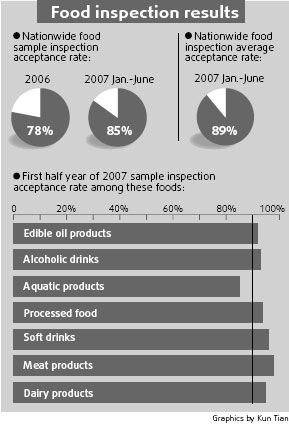
One, the acceptance rate of foodstuffs on the whole is steadily rising. The rate was 77.9 percent in the 2006 national foodstuffs sample survey, and it rose to 85.1 percent in a similar survey in the first half of 2007. The level of food quality and safety remains stable, with a gradual upturn.
Two, the quality of food produced nationwide is improving. In the first half of 2007, the 31 provinces, autonomous regions and municipalities directly under the Central Government on the mainland of China reported an average 89.2-percent acceptance rate of foodstuffs, and the figure in 14 of them surpassed 90 percent.
Three, the quality of food in key sectors is fairly high. Thanks to the country's endeavors to improve the work of food producers and processors, the quality of 525 kinds of foodstuffs in 28 categories has been enhanced to various degrees, with remarkable progress in the quality of food with a large daily consumption. According to statistics, the ten foodstuffs with the largest consumption are edible oil, fat and fat products; alcoholic beverages; aquatic products; processed grain products; soft drinks; meat products; dairy products; seasonings; starch and starch products; and sugar. In the first half of 2007, sample surveys showed a 90-percent or higher acceptance rate of all the above ten foodstuffs except aquatic products, whose acceptance rate was 85 percent. That of meat products was 97.6 percent.
(3) Quality Food Dominating the Market
Along with the development of the food industry, the scale of food producers keeps growing, production is becoming more concentrated, and the quality of foodstuffs of large and medium-sized producers is sound. In 2006, the top 100 revenue earners held 24.9 percent of the total sales of the food industry; the top ten dairy producers generated 54.7 percent of the total revenue of the dairy industry; the top ten soft-drink producers generated 39.5 percent of the total output of that industry; the top ten sugar makers produced 43.6 percent of the total output of the sugar industry; the top 50 meat producers accounted for 70 percent of that industry in terms of production capacity and sales; the eight beer brewery groups, each with a production capacity of over one million kl, produced 57 percent of the national beer output; the ten largest wineries produced 62.1 percent of the national output; and the three largest instant noodle producers occupied 76 percent of the Chinese market.
2. The Quality and Safety of Agricultural Products Is Steadily Improving
(1) Fast Growth of High-quality and Safe Brands
Quality agricultural products are steadily expanding their market. Agricultural standardization has been notably enhanced, which increases farmers'income and changes their farming patterns. Hazard-free, green and organic products make up 90 percent of all agricultural-product exports. Over the past five years, the export of green food has shot up 40 percent annually, and has been accepted by over 40 of China's trading partners. So far, China has developed 28,600 kinds of hazard-free agricultural products, and set up 24,600 hazard-free production bases with a total area of 21.07 million hectares. Five thousand three hundred and fifteen Chinese enterprises use the green food logo on their 14,339 kinds of products totaling 72 million tons and grown on 10 million hectares of land. In addition, 600 producers use the organic food logo on their 2,647 kinds of products totaling 19.56 million tons and grown on 3.11 million hectares of land. Altogether, there are 539 state-level agricultural demonstration zones, 100 demonstration counties (farms) and nearly 3,500 provincial-level demonstration zones, with a combined growing area exceeding 33.33 million hectares.
(2) Acceptance Rate of Agricultural Products Rising Continuously
Inspections in the first half of 2007 showed that the average acceptance rate regarding pesticide residues in vegetables was 93.6 percent; those regarding clenbuterol hydrochloride contamination and sulfa drug residues in livestock products was 98.8 percent and 99.0 percent respectively; and that regarding chloromycetin in aquatic products was 99.6 percent, of nitrofuran 91.4 percent, and of pesticide residue over 95 percent in sample surveys done at production bases.
3. The Quality of Imported and Exported Foodstuffs Stays High
China is a large importer and exporter of foodstuffs, with the amount of each growing steadily in recent years. The import and export volume in 2006 totaled US$40.448 billion-worth (excluding wheat, corn and soybean, same below), up 21.45 percent year on year.
(1) Safety of Export Food Guaranteed
In 2006, China exported 24.173 million tons of food, worth US$26.659 billion, up 13.29 percent and 16.0 percent year on year, respectively. The top ten varieties in terms of export value were aquatic products, processed aquatic products, vegetables, canned food, juices and drinks, processed grain products, seasonings, poultry products, alcoholic beverages, and livestock meat and chopped entrails.
Foodstuffs of the mainland of China have been exported to more than 200 countries and regions, of which the top ten in terms of trade volume are Japan, the US, the ROK, Hong Kong, Russia, Germany, Malaysia, Holland, Indonesia and the UK.
For many years, over 99 percent of China's exported foodstuffs have been up to standard. In 2006 and the first half of 2007, China exported to the US some 94,000 batches and 55,000 batches of foodstuffs, respectively, and 752 batches and 477 batches of each were found by the US to be substandard, making the acceptance rate 99.2 percent and 99.1 percent, respectively. In the case of the EU, the figures were 91,000 batches and 62,000 batches, with 91 batches and 135 batches found by the EU to be substandard, making the acceptance rate 99.9 percent and 99.8 percent, respectively. On July 20, 2007, the Ministry of Health, Labor and Welfare of Japan, the largest importer of Chinese food, released an examination report on food imported from China in 2006, which showed that Japan conducted more sample surveys on Chinese food (15.7 percent) than on food from anywhere else, but Chinese food had the highest acceptance rate (99.42 percent), followed by that imported from the EU (99.38 percent) and the US (98.69 percent). The mainland of China is a major supplier of food for the Hong Kong Special Administrative Region. Two large food sample surveys conducted by Hong Kong's Food and Environmental Hygiene Department in the first half of 2007 showed that the acceptance rate stood at 99.2 percent and 99.6 percent, respectively.
(2) Quality of Imported Food Stable
In 2006, China imported 20.273 million tons of food, worth US$13.396 billion, up 37.94 percent and 25.11 percent year on year, respectively. The top ten varieties in terms of import value were vegetable oil, aquatic products, cereals, sugar, dairy products, alcoholic beverages, tobacco and associated products, poultry and chopped entrails, oil crops, and processed grain products.
China imports foodstuffs from 143 countries and regions, and the top ten in terms of trade value are Malaysia, Russia, the US, Indonesia, Argentina, Thailand, Australia, New Zealand, Brazil and France.
For many years, the quality of food China imports has been fairly stable, and no serious hazard has been caused by imported food. During the period from 2004 to the first half of 2007, the acceptance rate of imported food, according to statistics released by the ports of entry, were 99.29 percent (2004), 99.46 percent (2005), 99.11 percent (2006) and 99.29 percent (first half of 2007), respectively.
II. Food Safety Regulatory System and Work
To ensure food safety, the Chinese government adheres to the principle of giving priority to prevention and control at its root by monitoring and controlling the whole process, and has formed a regulatory format in which the local governments take the responsibility, related departments provide guidance and conduct coordination, and different sectors make concerted efforts under the unified national leadership. In response to the circumstances in China, the State Council issued the Decision on Further Strengthening Food Safety Supervision in 2004, according to which one monitoring link is supervised by one department; sectional supervision is adopted as the main means while supervision of different varieties as the supplementary means, making clearer the functions and responsibilities of the food safety supervisory departments. The Decision divided food safety supervision into four links, managed by the departments of agriculture, quality supervision and inspection, industry and commerce, and health, respectively. The production of primary agricultural products is supervised by the agriculture department, the quality and daily hygiene supervision of food processing is overseen by the quality supervision and inspection department, supervision of food circulation and distribution is done by the department of industry and commerce, and that of the catering industry and canteens is taken care of by the health department. The integrated food-safety supervision and coordination, and investigation of and penalties imposed for major incidents in this regard are the responsibility of the department of food and drug administration, while imported and exported agricultural products and other foodstuffs are supervised by the quality supervision and inspection department. In this way, there is a strict, complete regulatory system for food safety supervision in which the departments concerned work in close cooperation, with clearly defined functions and responsibilities.
As it is a prolonged and arduous task to strengthen food safety control, a regulatory system and a lasting efficiency mechanism should be established and improved, and planned with consideration given to both present and future needs to deal with both the symptoms and root causes of food safety problems, especially the latter.
The Chinese government stresses food safety from the source, improvement of the related basic regulatory systems, and strengthening of food safety supervision.
1. Intensifying Supervision on the Quality and Safety of Agricultural Products
In 2001, China started to implement the Hazard-free Food Action Plan, focusing on the control of residue of high-toxic pesticides in vegetables and clenbuterol hydrochloride contamination in livestock products, to address the most concerned problems of illegal use of high-toxic pesticide and veterinary medicines, as well as violations of residue standards. The Plan stipulates a complete supervisory process from farmland to market by emphasizing the three key aspects of materials used in farming, production and market excess. By carrying out regular monitoring and inspection, the Plan aims at enhancing people's awareness of food quality and safety, ensuring management responsibility, and improving the levels of management and quality and safety of agricultural products by means of standardization. Today, the system for securing the quality and safety of agricultural products is improving, with steadily strengthened supervisory capacity and notable progress in agricultural standardization, leading to the formation of a work mechanism integrating service, management, supervision, penalty and emergency response, to ensure the quality and safety of agricultural products.
2. Establishing and Strictly Implementing Market Access Systems for Food Quality and Safety
The food quality and safety market access systems established by the Chinese government in 2001 comprise three major ones. One, the production license system, which requires that food-processing enterprises cannot produce and market their products without having the capability to control the source materials' quality, and the adequate conditions to ensure food quality and safety in terms of production equipment, technological flow, product standardization, testing equipment and capability, environment, quality control, storage and transportation, packaging and labeling, and production staff. Enterprises can produce and sell food only after obtaining a food production license. Two, the compulsory inspection system, which means that enterprises have the legal obligation to ensure that their food products pass quality inspection before entering the market. Three, the market access labeling system, i.e., enterprises are required to put on food products the QS label, guaranteeing their quality and safety. Following the principle of phased implementation, by the end of June 2007, some 107,000 food production licenses had been issued to enterprises, which took up over 90 percent of the market of their trades. Meanwhile, supervision has been strengthened over enterprises with food production licenses. By the end of June 2007, 1,276 food production licenses had been withdrawn, cancelled, revoked or nullified for substandard food products.
In pace with the growing number of enterprises obtaining the license, the General Administration of Quality Supervision, Inspection and Quarantine has released lists of such enterprises, making clear that producers without the license and products without the QS label must not enter the market, and warning consumers not to use such products.
3. Intensifying State Supervision by Sample Survey for Food Quality
The Chinese government carries out a food supervision and inspection system mainly by means of sample survey. Since it was set up in 1985, the system has been strengthened and become more focused to enhance its efficiency. In recent years, daily-consumption food items, such as dairy products, meat products, tea, beverages, grain and edible oil, have become the major targets of sample surveys, especially those produced in workshops and enterprises located in concentrated food-producing areas. Special attention has been given to the hygienic indices of microorganisms, additives and heavy metals in food, and to follow-up inspections of small enterprises with unstable product quality. By increasing sample survey frequency and coverage, the goal of rectifying producers of the same type of food by means of sample survey has been by and large met. The state supervisory sample surveys were carried out on 11,104 batches of foodstuffs produced by 7,880 enterprises from 2006 to June 2007. Meanwhile, greater efforts have been made to rectify and punish enterprises turning out substandard products, and to set things straight by means of the following: First, strictly implementing the public announcement system. Three hundred and fifty-five batches of food with serious quality problems produced by 355 enterprises were found in sample surveys and publicly announced. At the same time, publicity is given to good enterprises, quality products and sound brands. Two hundred and forty products winning the title of "Famous Chinese Brand" and 548 freed-from-inspection products have become popular among consumers. Second, strictly carrying out the rectification system. Enterprises with substandard products are urged to rectify themselves strictly, to be examined again in due course. If problems persist, they will be ordered to stop production for an overhaul. If they still cannot pass the inspection after the overhaul, their business licenses will be revoked. Third, strictly implementing the penalty system. Producers who mix impurities or imitations with their products, or pass fake or defective products off as genuine ones will be ordered to stop production, and their products be confiscated. Legal liabilities will be imposed in serious cases by the judicial organs.
4. Intensifying Rectification of Food Workshops
Regional differences and disparities between urban and rural areas in China make the supervision of food workshops a prolonged and arduous task. At present, food workshops with fewer than ten employees are the ones that pose the most difficult problem for ensuring food quality and safety. For workshops engaged in traditional, low-risk food processing, the government sticks to the principle of supervision and standardization while giving guidance to such workshops for consumers' convenience. On the one hand, the government has tried to upgrade them to the market-access requirements by means of shutdown, stoppage of production, merging or changing line of business; on the other, more stringent supervisory measures have been taken to prevent food safety accidents. In recent years, supervision of workshops and small enterprises has been conducted mainly in four aspects: One, transformation of basic work conditions. Workshops cannot start production without meeting the requirements. Two, restrictions on market scope. Food products processed by such small workshops are not allowed to sell outside the administrative areas of townships or towns in which they are located, not allowed to enter shopping centers and supermarkets. Three, restrictions on food packaging. Before obtaining a market access permit, food products from the workshops are not allowed to have marketing package, so that they cannot enter the market disguised as licensed goods. Four, public undertaking. Food workshops must undertake to the public that they do not use any non-food materials, misuse additives, use recycled food, send their products to shopping centers or supermarkets, or market their products beyond the approved region, and guarantee that their food products meet the basic safety and hygienic standards. After such rectifications, the average acceptance rate in sample surveys of food workshops rose to 70.4 percent in 2006. By the end of June 2007, 5,631 workshops had been closed down, 8,814 had been made to suspend production, and 5,385 had reached the requirements after rectification.
5. Promoting the Responsibility System for Regional Food Safety Control
The responsibility system for regional food safety control mainly comprises the following aspects. First, to have specified persons responsible for specified regions and enterprises. The system requires that food safety inspectors of the quality supervision and inspection department go to the townships to supervise the food-processing enterprises; township government coordinators assist the inspectors in supervising food quality and safety; and local reporters bring to attention anything illegal regarding food quality and safety. The number of inspectors, coordinators and local reporters must be fixed, their duties defined, and their working areas and inspecting enterprises designated. Second, the system requires "three enters" and "four graphs." The former refers to entering villages, households and enterprises to find out their working conditions and set up files of food producers and processors; the latter refers to drawing up a graph showing dynamic changes in enterprises, a graph showing the distribution of food producers and processors, a graph showing the implementation of supervisory duties, and a graph giving food safety precautions, so as to carry out proactive monitoring and control. Third, the system requires local governments to sign documents of responsibility, enterprises to sign letters of undertaking, and quality supervision and inspection departments to submit regular food safety reports.
|