A dose of TCM was just what the good doctor ordered
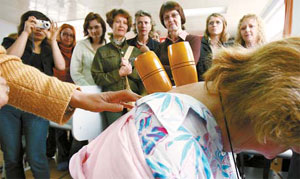
A woman receives cupping treatment in a TCM clinic in Suzhou, of Jiangsu Province. TCM is increasingly being seen as a safer alternative to Western medicines and therapies. Xu Zhiqiang |
But rather than go to a chiropractor or physiotherapist, as he might do back home in New York, the 32-year-old finance professional instead spends a few hours a month receiving acupuncture. Despite his initial reservations about having his back and neck pierced with needles, he was surprised to find that the treatments relieved his pain.
For Gretchen Moussa, several visits to Shamian Traditional Chinese Medical Center, located in the heart of the historic foreign enclave of Shamian Island, for acupuncture and reflexology provided much-needed relief for her ongoing sinus and throat infections.
"I have needles inserted into my face, arms and legs and lie there for about an hour," she said. "I've found it is a very effective treatment. My husband has been suffering from back pain recently, but after he had reflexology, it was amazing how quickly he got better.
"I come from Sarasota, Florida, and our community there has a strong interest in such treatments. I find that Chinese medicine is more natural and works with the body. After you leave, you feel better already and the recovery time is much faster."
And, as she pointed out, it's much cheaper. An acupuncture session costs about $50, while medicines for the same illness back home might cost around $150.
Moussa isn't alone in her praise of acupuncture, one of the myriad forms of traditional Chinese medicine (TCM), which also includes herbal remedies, reflexology, medicated baths, massage and more obscure treatments such as cupping and ear candling.
As recent scandals connected with Vioxx for arthritis and pain relief, Lunesta for insomnia and antidepressants for children make headlines in Western markets particularly in the United States for unwanted and even fatal side effects, TCM is increasingly being seen as a safer alternative to Western medicines and therapies.
And in Guangzhou, one of the key hubs for TCM treatments and research and geographically near to the robust markets of Hong Kong, Macao and Taiwan, foreigners and locals alike enjoy great access to a body of treatments that draws on more than 5,000 plant and herb species and is dispensed in thousands of shops around the city.
"A lot of foreigners come with arm and wrist injuries from work," says Chen Peixian, one of the center's doctors.
For those suffering from the type of repetitive strain injuries caused by long hours tapping away at computer keyboards, Chen says a course of acupuncture should help.
The clinic, which has been open for five years, has six experienced doctors and eight very experienced doctors who handle 80 patients a day. About 60 percent of these thousands the clinic treats annually are foreigners, said assistant manager Li Zhengtao.
"We get many foreign professionals, visiting businessmen, foreign residents and tourists here. We opened in 2002, and it has been growing in popularity since," Li said.
"TCM focuses on making the individual stronger and healthier in order to fight illness," says Zhang Zhuangtao, TCM practitioner and assistant dean of the International College at the Guangzhou University of Traditional Chinese Medicine, where more than 10,000 students are currently studying some branch of the discipline. "People are different, so TCM will prescribe different cures for people who have the same illness," Zhang said.
Zhang explained that a key difference between TCM and Western medicine is that TCM is more individually focused and treats everybody according to their unique circumstances. Also, the because of the strength of Western drugs, they can cause side affects which create stomach problems or allergies.
"I believe TCM is becoming more popular, because there are no side effects, and (the treatments) have good effects. They are also easier to access and cheaper than Western medicines."
For burnt out expats suffering from stress and overwork, TCM treatments target the organs, which have become vulnerable to damage or failure, Zhang said.
"Acupuncture, is useful for relieving pain, muscle pain, sinus problemsby stimulating and regulating the function of the vital organs. It balances the active heat and calm cold cycles within the body. Reflexology can also help this."
TCM also effectively treats insomnia by improving vital organs' ability to store, rather than release, the "hot" energy that disturbs sleep patterns, Zhang said.
Zhang also said that in order to be healthy, it is essential for everyone to know at least some rudimentary TCM theories. "TCM isn't just medicine; it's a whole lifestyle. People need to watch what they eat, relax and seek mental relief."
(China Daily 04/25/2007 page19)