The crisis in Darfur is humanitarian in nature, and ought to be treated as
such. The root cause of the problem there is poverty, and the world should join
hands to alleviate it. China is well aware of its responsibility in the
international arena and has played a key role in persuading Sudan to be more
flexible on former UN secretary-general Kofi Annan's peace plan. It will
continue to do whatever it can to restore peace and stability in Darfur, and
strive for its development.
On its part, the international community should realize
it cannot get anywhere by trying to dictate terms to Sudan. In fact, it's high
time, the world stopped looking at Sudan with tinted glasses and blaming it for
everything that has been happening in the region.
|

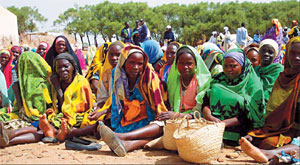
People wait to collect seeds distributed by Irish aid agency GOAL at
Golo village in the Darfur region of Sudan. Karl Maier/Bloomberg
News |
Not surprisingly, though, all the parties involved in Darfur share the same
goal: helping people out of poverty and restoring peace and stability, but their
ways of achieving it is different. So let us try to restore peace and happiness
among the people of Darfur in a way that is acceptable to all and harms none.
This summarises Assistant Foreign Minister Zhai Jun's observation on the
Darfur crisis and China's role in bringing an end to the suffering of the people
there.
Zhai had a first-hand experience of the situation in Darfur during his
four-day official visit to Sudan that ended recently. In Darfur, he inspected
the refugee camps and talked to the inmates. He met with regional officials,
too. During his visit to Al-Fashir, he held a meeting with North Darfur Governor
Osman Mohammed Yousef Kibir, and in Nyala he met with South Darfur Governor
Al-Haj Ata al-Manan.
Talking to reporters in Beijing on his return yesterday, Zhai said: "Annan's
peace plan is practical, close to the demands of the Sudanese government and
well accepted by the international community." The Annan Plan aims to deploy a
combination of African Union and UN peacekeeping force in the Darfur region to
restore peace and stability and end the humanitarian crisis.
The Sudanese government has accepted the plan in principle but wants further
talks to remove the differences that still remain. Among its important demands
is placing international troops in Darfur under the command of an officer from
an African country.
The international community and the Sudanese government are now discussing
the number of troops actually needed for the peacekeeping mission. Sudan says
their number cannot be decided till the commander of the international troops
surveys the region carefully and suggests one.
Sudan's reservation on the peace plan is quite understandable, said Zhai,
because it's afraid that if more troops than are actually needed move in, the
situation in a country plagued by conflicts could worsen.
The crisis can be resolved permanently only through a three-way approach:
political consultation, especially among Sudan, the African Union and the UN;
economic aid; and peacekeeping, Zhai said.
"I have understood from my meetings with Sudanese leaders that they want to
talk to the international community to find a political solution to the Darfur
problem But they want the talks to be held on an equal footing." They have a
point there, he said, because "you cannot just send a letter to the Sudanese
government and expect a positive response".
Demarcating no-fly zones over the region and imposing sanctions on Sudan is
not going to help either. Besides, China is vehemently opposed to such practices
because they take us nowhere they will only make people poorer and more
helpless. "Such moves will create more troubles in an already troubled area."
The best option thus is to work on the Annan Plan. "If it is implemented and
the Sudanese government asks China to contribute some peacekeeping troops, we
will definitely consider it seriously," Zhai said. China already has more than
1,000 peacekeepers in southern Sudan.
But for peace and stability to be restored permanently in Darfur, poverty has
to be alleviated, he said, because that's the origin of the humanitarian crisis.
North Darfur, for instance, only has a 38-km asphalt road.
In some remote areas, people's lives are no better than those living in the
refugee camps. "That's why many choose to stay in the refugee camps rather than
return home because in the camps they at least don't have to worry about food
and safety."
If the living condition of the Sudanese people doesn't improve, they will
keep on fighting for the limited natural resources, aggravating the situation.
China, he said, has donated 80 million yuan ($10.3 million) to Sudan. But
donation alone is not the solution, and Beijing knows that. Hence, it is
encouraging more Chinese enterprises to invest in Sudan, especially in its
remote areas where development is an urgent need. The international community,
too, should do the same, he said.
But can China's role in Sudan damage its reputation and lead to a boycott of
the 2008 Beijing Olympic Games by some countries?, asked a reporter. Zhai said
such remarks reflected ignorance.
"Those who link the Olympics to Darfur are either ignorant or have mala fide
intentions Such an idea will never sell. Nor will it be able to stop China from
staging a successful Olympic Games next year."
Conflicts among the different ethnic groups of Sudan are almost a century
old, and began when the country was still under the United Kingdom's rule. "They
had never ceased and only got worse during recent years."
"The friendship between the two countries began long ago and has nothing to
do with Darfur." Sudan is a developing country, and as its friend, China will
continue playing a constructive role in Darfur.
(China Daily 04/12/2007 page12)