Trash or treasure? Wolfgang weighs in
Wolfgang Kubin, a professor of Sinology from the University of Bonn, reinforces his criticism of modern Chinese literature at a recent conference held at Beijing's Remin University of China. |
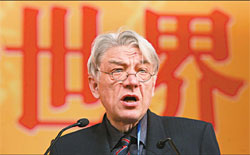
"Blindly believing in themselves as great writers is a very strange phenomenon among Chinese authors," he says. "They should have the guts to open their eyes and recognize that from the international literary perspective they have been hopelessly backward for decades."
It's fair to say that this is one academic who doesn't mind getting straight to the point.
"Chinese authors are backwards because of their style, their world outlook and the literary forms they make use of. In such a case they should either stop writing or start reflecting upon their one and only important medium: language," Kubin says.
A professor of Sinology from the University of Bonn, Kubin has written numerous essays on modern Chinese literature and criticism. He also spoke at the recent conference entitled Dialogue of Civilizations and a Harmonious World, which was held at Beijing's Remin University of China.
However, it was a 2006 interview with broadcaster Deutsche Welle that saw Kubin make
Mian Mian, or Wang Xin, 37, published her first novel in 1997 and her novel Sugar has been translated into many languages. |

When asked for his view of what the interviewer called the "pretty girl writers like Mian Mian and Wei Hui", Kubin's answer was remarkably blunt.
"You must be joking. That is not literature. That is trash," he said.
Kubin also referred to Jiang Rong's best-selling social allegory, Wolf Totem (Lang Tuteng), as "fascist", slammed the Chinese Writer's Association as serving "no purpose whatsoever" and said of the Novel Prize for Literature "if you write well, you'll never win it".
However, while criticizing a large chunk of post World War II Chinese authors as being insignificant, Kubin defended the integrity of contemporary Chinese poets, such as Ouyang Jianghe, Xi Chuan and Zhai Yongming.
The subsequent reporting of the Deutsche Welle interview, which Kubin claimed was a distortion of his words, spread to the mainstream Chinese media and inspired a flurry of comments from Internet readers. Still, it seems that the
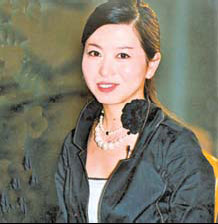
Wei Hui's books, such as Shanghai Baby, have been very controversial. |
"My point of view has not changed at all since then. Unfortunately, the state of contemporary Chinese literature seems to be even worse. People not only in China, but also in Germany are making fun of Chinese writers."
Kubin said many writers and online contributors support his damning observations.
"I was only told that some Chinese writers felt insulted by my words which I can understand. I was also told that 85 percent of netizens agree with my views."
Born in 1945, and a native of Bonn and Vienna, Kubin is also a published poet and has been lauded for his translation work, a skill that he believes is sorely absent among Chinese literary circles. In his interview with Deutsche Welle, Kubin said that Chinese writers' ignorance of foreign languages was the greatest impediment preventing them from producing work that might be revered outside of the mainland.
"All great modern writers I know were translators and/or could handle a lot of different languages: Goethe, Rilke, Celan, Lu Xun, Dai Wangshu," he said.
"It is true that Gu Cheng and Zhai Yongming once told me that learning German or English would destroy their mother tongue. But if there is any truth in this, why did Zhang Ailing (Eileen Chang) or Bian Zhilin not loose their Chinese when they even wrote in
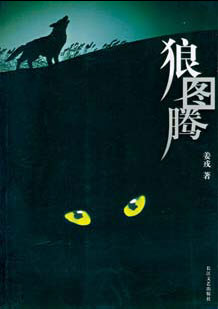
Wolf Totem by Jiang Rong talks about lives of herdsmen and wild wolves on the Mongolian grassland. Many entrepreneurs find the novel relevant to their businesses. |
It was this point Kubin made in the Deutsche Welle interview that Chinese writers largely remain lingually deficient he says was the most hotly disputed.
"If I remember rightly, no one agreed with my theory that the backwardness and clumsiness of many Chinese writers might have to do with their dearth of knowledge in foreign languages. By the way, the same might be true for Chinese scholars, too."
In addition to language barriers, Kubin also sees a more systematic problem within the domestic literary community: writers being critical of work other than their own.
"The emperor and poet Cao Pi once said: 'wenren xiang qing', meaning scholars and writers despise each other," he said. "This has been true for nearly 2,000 years. Most of the Chinese writers are always criticising others, but never themselves."
Added to this perceived inability to foster a supportive writing community, Kubin also said that many were not dedicated enough to their craft.
"What many Chinese writers and literary critics lack is a sense of responsibility for literature, for language and for society," he said.
Being surrounded by a booming economy isn't helping writers either, according to Kubin. He argues that the temptation of the more lucrative business world may have lured some away from the difficult pursuit of producing world-class literature. And perpetuating the relatively low standards of writing are literary critics who accept cash from publishers to write favorable reviews.
"Many writers left the field after 1992 when they discovered they can make a better living by 'xiahai' (entering the sea, meaning to do business) than by writing. Also, many literary critics are given 'hongbao' (red envelopes that could contain some 4,000 yuan, or $520) by publishing houses so that they only write their book reviews in the way they are expected to do," he said.
"Others write about sex and crime to satisfy the demands of the international market, thus confusing sensationalist writing for great literature."
On the other hand Kubin believes that the isolation of Chinese poets such as Zhai Yongming, Xi Chuan, Wang Jiaxin and Ouyang Jianghe, who struggle to find a Chinese readership, is a reason they continue to produce reputable work. Without the commercial pressure experienced by their prose counterparts, could the poets' struggle to make money be of benefit to their writing?
"True Chinese poets are at the edge of Chinese society. Even if they would like to write for the market, they would not be willing or able to do so. All they can do is to contribute to (their) language and fulfil what is the foremost duty of a writer: to work hard for every single word," he said.
"In some respect one could also say, some poets do not even belong to Chinese literature any more."
(China Daily 04/10/2007 page18)