Tiger, thou art but a mouse
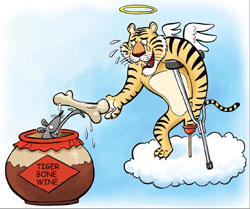 TCM practitioner and rheumatism expert Zhou Naiyu always turned to tiger bone for her prescriptions in the 1980s. But the 1993 ban on trading in tiger products has led to this ingredient disappearing from TCM prescriptions.
But many doctors, like Beijing Traditional Chinese Medicine Hospital's Zhou, continue to swear by its potency in strengthening bones and tendons and believe it has no substitutes.
Nevertheless, scientists have been trying to sniff out alternatives for tiger bone ever since the ban was imposed. The long list of candidates include dog bone and ginger. But the bone of a type of plateau rat has emerged as the most promising one to date.
Scientists from the Northwest Institute of Plateau Biology have said the bone structure and content of this rat are very much similar to tiger bone and even superior in some aspects.
The rat, called Sailong, is found on the Qinghai-Tibet Plateau. Sailong is seen as a pest in the plateau as it feeds on the roots of grass and breeds quickly. It has long been blamed for the depletion of the grasslands.
More than 20 years ago, professor Zhang Baochen from the institute began to research the Sailong. He was amazed to find during his dissection of the rats that no cases of arthritis or other bone diseases had ever been identified in this species although the rats live in areas of low temperatures and high humidity.
Zhang said he realized that this rat's unique ability to fight rheumatism could hold hope for human beings afflicted with this disease.
Visits to nearby families bolstered Zhang's hypothesis. He found that locals used Sailong bones to treat the rheumatism women developed after delivery. Also, he found, since they often ate the rats they caught, they had very strong teeth.
The ban on tiger bone led Zhang to develop rat bone as a substitute for tiger bone.
Currently, Sailong bone wine is sold in drug stores for the same purpose that was once served by tiger bone wine to strengthen the bones.
A new drug combination of proteins extracts from Sailong bone and some rare herbs has shown promising results in treating rheumatism and bone diseases in clinical trials at nine prestigious hospitals in China, with no side effects being reported.
However, despite the efforts at finding substitutes, the glamorous image of tiger bone cherished by the people is hard to erase.
Recently, nature conservationists in China have been expressing worry over a resurgence of the trade in tiger parts.
Businessmen who stand to profit from such trade are putting increasing pressure on the Chinese government to overturn the ban, according to a new report from TRAFFIC, a wildlife trade monitoring network. It says that such a move will allow domestic trade in captive-bred tiger parts for use in traditional medicine, to resume.
Conservationists have said the 1993 ban was essential to prevent the extinction of tigers by curbing demand in what was historically the world's largest consumer in tiger parts.
Undercover surveys conducted by TRAFFIC late last year found little tiger bone available in China. Less than 3 percent of 663 medicine shops and dealers claimed to stock it, and most retailers were aware that tigers were protected and trade in tiger parts was illegal.
However, some illegal trade in tiger parts does exist. The report documented 17 instances of tiger bone wine for sale on Chinese auction websites, with one seller offering a lot of 5,000 bottles.
Last year, China Youth Daily reported that a wine company in South China's Guangxi Zhuang Autonomous Region was quietly producing tiger bone wine calling it "Bone Strengthening Wine".
Of particular not is the fact that the number of captive-breeding tigers has increased rapidly and now stands at 4,000, according to Xu Hongfa, China Wildlife Trade Program Coordinator.
He said that original purpose of large-scale captive breeding was to put the tigers back into the wild, but it turned out to be an impossible task owing to their lack of hunting skills and appropriate habitats. So now these breeding centers are pushing for legalizing trade in tiger products from these facilities to compensate for the expenditure on the breeding.
Conservationists are strongly opposed to any lifting of the ban. "A legal market for tiger parts from captive-breeding centers could give a stimulus to the poachers to kill tigers in the wild as it is hard to distinguish which ones come from those in the wild and which from the breeding centers," said Xu.
So far there are only about 50 wild tigers in survival in China, distributed mainly in Northeast China's Heilongjiang Province, Southwest China's Yunnan Province and Tibet Autonomous Region.
Both conservationists and TCM practitioners agree that developing substitutes for parts from endangered species is of critical importance to both wildlife conservation and sustainable development of Chinese medicine.
The substitutes can come from non-endangered sources and also be synthetic alternatives. Synthetic bezoar and musk have already shown themselves to be nearly as effective as their natural counterparts. Trials on substitutes for two other critically endangered species, rhinoceros horns and saiga horns, are also being carried out.
However, TCM practitioners remain somewhat wary of substitutes as they believe the curative effect of an important ingredient has been tested through the centuries.
"Any substitution should be based on conditions of similar or same effects and no toxicity," said Shao Aijuan, a research fellow with the Institute of Materia Medica of the China Academy of Chinese Medical Science.
She quoted the case of a bad substitute. Mutong (Caulis Hocquariac manshuriensis), a rare medicinal herb, was once substituted by another ingredient called guanmutong which was cheaper and more easily available. In 2003, guanmutong contained in Long Dan Xie Gan Wan, a heat clearing Chinese medicine, was reported abroad to cause uremia. The use of guanmutong has since been banned.
According to Shao, her institute is currently establishing evaluation standards for TCM substitutes.
She said substitutes should not be such that they endanger other plants and animals in the wild.
(China Daily 04/05/2007 page19)