Brains behind new X-ray treatments
Wu Zhongxue, a leading practioner of interventional neuroradiologists of Beijing's Tiantan Hospital. |
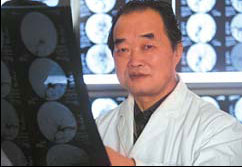
Known as interventional radiology, this newer mode of surgery is gaining ground in China, and experts in the field look forward to the day when it will be an affordable alternative for a majority of eligible patients.
Because of the expense of equipment and imported materials, Chinese surgeons use the method only in 30 percent of relevant brain problems, including blood vessel abnormalities, blockages and swellings, brain tumors and some kinds of strokes, according to a leading practioner among China's first generation of interventional neuroradiologists, Dr. Wu Zhongxue of Beijing's Tiantan Hospital.
By contrast, Wu said, interventional neuroradiology is applied in treatment of 90 percent of cases in Europe, 70-80 percent in the United States and 70 percent in Japan even though his hospital first adopted the approach as early as 1982, about the same time it was becoming prevalent in Europe and earlier than in the US.
Tiantan Hospital's Interventional Neuroradiology Department, which the 56-year-old Wu now heads, has completed more than 900 intracranial aneurysm operations alone, including 200 at the hospital and 700 at other hospitals nationwide, Wu said. "None of the other hospitals in the country could possibly have done so many," he said.
Wu himself, who began working at Tiantan Hospital in 1988 after completing a doctorate at Capital Medical University, used to do two of the intricate procedures in a day, and up to 400 operations in a year. Many of these cases were referred to him by other hospitals that could not handle them.
Wu said an interventional brain operation may cost from 50,000 to 300,000 yuan ($6,460-38,780), beyond the means of ordinary Chinese.
Researchers at his hospital are working on locally-made substitutes for some of the expensive imports, which is likely to cut the cost of such operations by half in the future, he said.
The technique involves snaking specially designed catheters, some no larger than 1.5 mm in diameter, through the blood vessels of the body to the affected region, guided by X-ray imaging from CT (computerized tomography) and MRI (magnetic resonance imaging) machines. "With interventional methods, the incision is small, recovery fast, and the death rate much lower," said Wu.
International studies also have established that hospitals doing a greater volume of the procedure have higher success rates, and Tiantan Hospital has earned a national reputation for its track record with the treatment.
Nevertheless, given the gravity of their problems, not all patients survive. Wu noted that some days bring highs and other lows: "Some patients may recover quickly and leave the hospital happily in three days, while others may die the next day."
Ironically, while Wu is devoting his career to curing others, he thinks his own health is suffering as a result. Besides the stress accompanying his job, he said another repercussion of his daily work is radiation exposure, which he likens to "chronic suicide".
Doctors working alongside the X-ray machines wear protective clothing around the torso, but arms and legs remain unprotected so that mobility is not affected. "I have suffered all the effects of radiation, like catching colds easily and lowered levels of white and red blood cells," he said.
(China Daily 04/05/2007 page19)