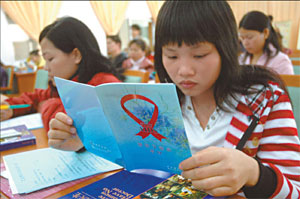
"Will a kiss contract HIV?" Zhu Yuangang raised his hand to ask - he had just
learned that body fluids such as blood, milk and semen could transmit the
disease.
The answer from Yu Dongbao, a representative from the HIV/AIDS Prevention
Committee under the State Council, puzzled Zhu.
"Ordinary kisses will not," he was told.

Intrigued by the doctor's answer, Zhu further enquired: "But what is a not an
ordinary kiss?"
"Well," Dr Yu replied: "A kiss that is not considered ordinary would be one
which produces at least 20ml of saliva, with one or both of the participants
having ulcers or deep cuts in their mouths."
However, such a scenario is highly unlikely and, according to Dr Yu, no such
case has ever been confirmed by scientists.
Zhu was attending a two-day workshop on HIV/AIDS in Beijing at the end of
December last year, where he listened to lectures given by prestigious
university professors, along with medical and legal experts on current HIV/AIDS
challenges and prevention policies.
As director of the Publicity and Education Division of the Publicity
Department of Heilongjiang, Zhu routinely works with the media and provides them
with tips or guidelines on coverage of various issues of public concern,
including HIV/AIDS.
He explained that local citizens and journalists had asked him numerous
questions about the disease, such as the one he had raised in Dr Yu's lecture.
"Even I was not sure about the answers," he said.
Such lack of knowledge about HIV/AIDS, and Sexually Transmitted Diseases
(STDs) in general, is not unusual among China's populace sex education in
Chinese schools is inadequate, and little information about preventing the
spread of STDs is provided to the public.
The lack of knowledge, Dr Yu said, could hinder the battle against HIV/AIDS.
The officially sponsored workshops, like the one Zhu attended, are designed
to educated and help local officials provide more accurate, detailed information
regarding the disease, according to Dr Yu.
At the end of the two-day workshop, Zhu received a certificate, several
publicity pamphlets on HIV/AIDS and video discs. However, he said, the most
important change he noticed in himself after attending the workshop was his
attitude toward people afflicted with the disease.
"The more you know about HIV/AIDS, the less fear and bias you have, and the
more accurate the media coverage on the disease will be," he said.
Jointly sponsored by the office of the State Council HIV/AIDS Prevention
Committee and the publicity and education bureau of the Publicity Department
under the Central Committee of the Communist Party of China (CPC), the December
workshop was based on the initial success of the inaugural one, which took place
in November 2005, according to Yu, who is also a leading official of the China
AIDS Roadmap Tactical Support (CHARTS) project.
Publicity officials from 28 municipalities, provinces and autonomous regions
attended the workshop, up from just eight in 2005.
The annual workshop is part of a program initiated by the CHARTS project,
which aims to strengthen China's efforts to deliver an effective and coordinated
response to HIV/AIDS through capacity building, support policies and training
for government officials.
Starting from January 17, 2005, the three-year project has a combined joint
funding of 5 million pounds, provided by the Chinese government, UNAIDS and the
British government's Department for International Development (DFID), along with
an additional 6 million Norwegian Krone from the government of Norway.
According to Dong Junshan, deputy director of the CPC Central Committee
Publicity Department's Publicity and Education Bureau, the workshops show the
unprecedented attention that the central government gives to tackling HIV/AIDS.
"They indicate that the Chinese government is now taking a high-profile,
positive stance in dealing with a possible HIV/AIDS explosion - the fight
against the disease in China is now of political significance," Dong said.
The training courses targeting nationwide publicity officials has broken new
ground, Dong said, as "opinion leaders at all levels will make HIV/AIDS
reporting a priority and combat discrimination against sufferers".
Dong said more media publicity of HIV/AIDS is essential if the disease is to
be brought under control in China.
Professor Li Xiguang, one of the trainers from the Center for International
Communications Studies at Tsinghua University, agreed with Dong.
He said that these opinion leaders' coverage of HIV/AIDS "could have a direct
bearing on the effects of HIV prevention - therefore, alerting them to HIV/AIDS
policies is a top priority in China's control drive".
"The key for HIV/AIDS control and prevention in China is leadership, the key
for anti-HIV/AIDS media coverage is also leadership," said Li, adding that the
support from local opinion leaders is indispensable to the program's
development.
The December workshop was based on China's 2005 AIDS report, published by the
Ministry of Health, UNAIDS, and the World Health Organization (WHO), along with
government documents on AIDS prevention and control. The workshop included case
studies and discussions on how to promote a fair, transparent and effective
anti-AIDS media environment.
By the end of October last year, China had reported HIV/AIDS cases totalling
183,733, up from 144,089 at the end of 2005. However, both the government and
the United Nations estimate the real number to be about 650,000.
Hao Yang, deputy director of the Ministry of Health's department of disease
control, said despite the fact that the disease has begun to spread from
high-risk groups to ordinary citizens throughout the country, some officials
still think it is not yet a serious threat to public health,
"Some prejudices are still engrained in local officials - they think that
AIDS patients should be treated as a sub-class of citizens," Hao said, adding
that this had set a bad example for the general public.
Liu Yongqiang, director of the publicity and education department of the
Publicity Department of the Xinjiang Uygur Autonomous Region, who also attended
the December workshop, admitted that she was reluctant to hug or even shake
hands with people with HIV/AIDS.
"Although I know through normal social contact you cannot contract HIV, I
just cannot help feeling both emotionally and psychologically uncomfortable when
I find myself around people infected with the disease," Liu said.
Her lack of knowledge about the disease is not uncommon.
The latest survey, conducted in 2005 among more than 3,000 party officials
with a university education and below the age of 50, showed more than 60 per
cent were unaware there are no existing HIV vaccines and about 30 per cent
thought HIV carriers should be isolated for treatment.
Hao said the fear of discrimination could explain what prevents people with
HIV/AIDS from coming forward to register for free anti-retroviral drug
treatment.
"The opinion leaders' awareness and understanding of HIV/AIDS problems and
policies are crucial in the war against the disease, as they are the backbone of
the government's policies and they have the power to influence others," Hao
said.
Deng Zegui, deputy director of the Publicity Bureau of Chongqing
Municipality, said the workshop changed his previous views that the
understanding of HIV/AIDS was restricted to the medical world.
Deng, who left the workshop with a heap of notes, said: "The lectures alarmed
me of the severe situation China is facing and how crucial the role of the media
and public opinion is in battling against this disease."
"Publicity about the disease should not be viewed as extra work or a burden,"
Deng said, "it is our obligation and, according to the government's new
regulations, if our work is not good enough we could be reprimanded."
Long Yinyi, deputy director of the Zhejiang Publicity Bureau, who attended
the first workshop in 2005, said what he had learnt had helped him to cope
better at news conferences.
"I used to feel embarrassed when I was asked questions about HIV/AIDS by the
local media as I lacked any serious knowledge about it. After the workshop, I
felt more prepared and confident, and thus I have more to offer to journalists,"
he said.
China Features
(China Daily 02/13/2007 page12)