This blast is just bombast
A year can be divided in many ways. For China's television-obsessed, a year is made up of two halves: Half the year, they deplore a certain variety show and swear they'll never watch it again, and the other half is spent anticipating the next turnout, poring over every tidbit of gossip and devouring whatever the press can spit out about it.
It is China Central Television's annual Chinese New Year's Eve gala, a show that puts the Oscar ceremony to shame in terms of sheer length and totally overshadows the US Super Bowl or for that matter, the total population of the US in terms of audience size. It is the biggest television entertainment show on earth.
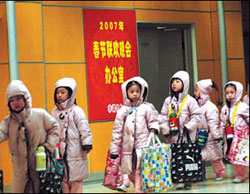
Young performers gather to rehearse for the CCTV New Year's Eve gala. Wang Zhide |
Stale stuff
It all started innocently in 1983 when a few dozen entertainers sang, danced and performed comedy routines or magic tricks to a relatively small urban audience. But as television began to penetrate the national market, the show snowballed into an avalanche and molded instant celebrities out of total unknowns. In 1987, Kris Phillips (Chinese name, Fei Xiang), who had previously enjoyed a brief stint as a pop idol in Taiwan, burst on the scene with two songs and, the next day, was reborn as a superstar. It helped that he has striking features thanks to his American father and Chinese mother. When a forest fire broke out later in the year, superstitious people traced it to one of his songs A Fire in the Winter.
With this kind of impact, the show, which quickly turned into a juggernaut, can hire anyone in the Chinese-speaking world for only a nominal fee, and put them through long and rigorous rehearsals. Very often, a top-billing star has to share a ballad with a dozen other similar singers.
The show has also evolved from the most beloved to one people love to hate. As the production gets bigger and more lavish each year, the numbers are more and more generic and derivative, with saccharine celebratory content all squeezed into one giant candy bottle, so to speak. The comedy skits are toothless, the applause orchestrated, the reading of telegrams the butt of a national joke. Often the show does not produce a hit song in a long stretch, and the last number that tugged at the heartstrings of the nation was the dance "Thousand-hand Bodhisattva" performed by a troupe of deaf-mute girls.
The deficiency in creativity is blamed on many factors. But a show of this magnitude carries a lot of baggage. Because it aims to please every person of every demographic description, it is doomed, in this age of growing plurality, to end up as a disappointment to many.
Slow turnaround
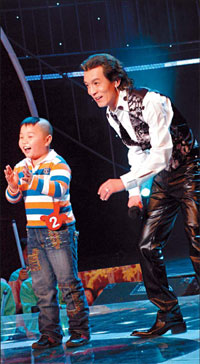
Well-known CCTV anchor Li Yong performs with a boy in the newly revised Special 6+1, a top-ranking TV Program on CCTV. Li is reported to be among a string of popular CCTV hosts to emcee the upcoming Spring Festival gala. Wang Zhide |
That leaves a glimmer of hope for some competitors. Since CCTV is the only national television network, those who covet a slice of the market are province-tier stations with strong market positions. Hunan, Shanghai, Beijing and Chongqing are all planning their own gala programs. When ratings for the CCTV show plummeted from 23 percent in 2005 to 17 percent in 2006 in the Shanghai market, the local station put on its own version and won 2 percent ratings in several southern metropolises.
However, experts warn that going head-to-head with CCTV is suicidal. "There's no point in creating another variety show. You cannot shake down CCTV as the Goliath. You'd better come up with new formats of programing," said Yuan Fang, professor of television research at China Media University.
On their part, the Davids of the TV industry are playing catch-up by scheduling their shows a day ahead of or after the New Year's Eve. "Our show will have a southern flavor," said Bao Xiaoqun, programing director of SMG, the company behind the Shanghai station, "and it will target the young, trendy, urban viewers. We do not mean to break CCTV's monopoly. We just want to add something new to the holiday feast."
Another reason: These regional stations have created their own array of celebrity entertainers from their contest shows. "We have at our disposal plenty of resources in both talent and production team," said Chen Libo, deputy director of the Zhanjiang Satellite Station, which is also jumping into the fray this year.
In addition to broadcasters, the new media of the Internet is beginning to flex its muscle. This year, Mop.com will run its first ever online gala, but it will appear during the Lantern Festival, the 15th day of the Lunar New Year, traditionally the end of the holiday season. As websites do not have gargantuan budgets, their shows tend to be quirky, relying on flash or live-action shorts submitted by netizens.
The eve of the Spring Festival is the occasion for family reunions, for fond memories of the year past as well as New Year's resolutions. The pageant has grown beyond that of a television show, and into a national ritual. And just like the firecrackers that light up the sky that night, the grandest bash will have its sparks and flukes. To be fair, no programing created by humans can be transcendent and indelible every time, but if it adds to the joy of the moment, it will have served its purpose.
(China Daily 02/08/2007 page18)