Harry R Lewis, the former dean of Harvard College, looks every inch the mild
mannered professor. He is dressed in a warm brown suit. His speech is direct but
gently alert, and his gestures are precise but informal.
You would never entertain the idea that this PhD in
Applied Mathematics had just created an uproar by publishing a book about why
the United States' most famous educational institute is going down the moral
drain.
|

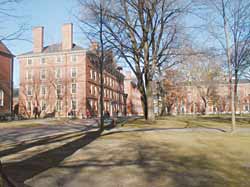
Harvard, the United State's most famous educational institution,
becomes the target of criticism in the book Excellence Without A Soul by
Harry R Lewis. File photo |
But that is precisely what Lewis has done, and he is in no mood to apologize.
Entitled Excellence Without A Soul, Lewis' 270-page book comes with a daring
and controversial subtitle: "How A Great University Forgot Education".
When the book was released in the Unites States last year, it created a storm
of protest within certain educational circles, who claimed that the book was
little more than sour grapes from a man who was allegedly pushed out of his post
as dean of Harvard in 2003 for being too critical of the College's policies.
However, Lewis also received a robust defence in the shape of glowing reviews
in The Wall Street Journal and The Boston Globe, but one only needs to have a
cursory glance through the book's chapters to see what all the fuss is about.
In short, Lewis does not hold back.
He claims Harvard has paid too little attention to students' development as
"moral citizens". He attacks parents who expect the world-famous university to
treat them like "customers". He wades in by defending grade inflation, an issue
that has brought Harvard a torrent of criticism. He blames Harvard professors
for failing to teach their students "simple truths". He blames students for
being spoilt and selfish.
He then runs down a checklist of what he thinks is
missing on campus: community feeling,
|

Former dean of Harvard College Harry R Lewis creates an uproar by
publishing a book claiming that Harvard is going down the moral drain.
File photo |
ethics, moral reasoning, cooperation, tolerance, a sense of
teamwork and selflessness.
And just when you think he has given Harvard both barrels of his critical
machine gun, the really big weapons come out.
"Despite its good intentions, Harvard has failed," Lewis says in his book.
"It does not help students grow up and learn to take responsibility for their
lives and it fails to insist on honorable behavior between both men and women."
No wonder he has received criticism, but does the professor protest too much?
As dean of the United States' best and brightest university between
1995-2003, one cannot help but think that his tenure at Harvard might have been,
if not a total success, then partly to blame for the university going off track.
Had he not seen the writing on the wall? And where exactly are his big guns
pointing? At the Harvard faculty? At the students? At their parents? At American
society in general? Or at himself?
"I am a teacher and an idealist," Lewis told China Daily during his five-day
tour of Shanghai to promote the book.
"My criticisms, though tailored to Harvard, concern many universities in
America. Our role as teachers is to make students think who they are, what their
place in the world should be, and to give them lessons that will last long after
the figures and dates of what they are taught have been forgotten."
Lewis' concerns, then, are all about character, or the lack of it.
Focus of concerns
He focuses his attacks squarely on moral and ethical targets, and it is
difficult to find disagreement with him. He believes in truths that lie hidden
behind human life, and in basic common decency, and for that he has won much
praise and support from the deans of many other American universities.
He also believes Harvard is becoming "consumerized" and that it has a desire
to brand itself like a loaf of bread or a line of automobiles.
"Harvard is famous enough," says Lewis. "Everybody in the world knows who we
are and what we do. We do not need a marketing campaign." He happily adds that
the ongoing question of branding Harvard has since quietened down.
What has refused to quieten down are the attacks made against him by certain
book reviewers, some of whom seem to have affiliations with Harvard College.
They have claimed his book lacks insight, is narrow in focus, or else is poorly
argued. A few have even suggested that he is feeling his age.
But Lewis, a sprightly 59-year-old, who has been married to a Harvard
graduate, Marlyn McGrath Lewis, for nearly 40 years, and who also has two
children who have both studied at the university, says his heart belongs to
Harvard.
"In spite of my book, I am a Harvard lover," he said.
"But my book is a case of tough love. My distress about Harvard is that it
has more resources than any other US university, and so therefore it can be more
idealistic."
'New' proposals
Lewis has outlined several "new" proposals in his book, almost in the form of
essays, on how he sees Harvard reversing its trend as a consumer-driven
institution obsessed with results and competitive muscle. Clearly, he wants to
see a mould-breaking university for the 21st century.
Most of his proposals are grounded in philosophical ideals (the book is
littered with cerebral quotations) which, while being worthy and well presented,
have raised little more than an eyebrow of agreement.
One proposal, however, has drawn gasps of horror from the teaching galleries.
This is that candidates applying for an academic post at Harvard should first
be evaluated for their moral character, not just in the public eye, but in their
private lives as well. Lewis understands the knee-jerk response this "radical"
proposal has received, but is not about to change his mind.
"People have found this proposal horrifying, but I am puzzled as to why," he
says, betraying a flare of passion behind his mild words for the first time.
"Academia has long had a bad history for using these kinds of proposals as
shorthand for discrimination. But that is not what I am doing. Students need to
have good role models. They must learn from moral grown-ups, and yet by contrast
we can hire an athletic coach to win us games and yet never be concerned with
their moral character."
"I understand a moral appraisal sounds radical, but to most ordinary people
it makes common sense. I don't know what all the fuss is about. This is not an
issue about likeability, or the hiring of nice people. It's about moral values."
Another personal gripe is Harvard's new bar on campus. When challenged that
students can conduct electric discussions, and even epiphanies of insight, while
gathered around a pub table, Lewis is forthright in his defense.
"I totally agree!" he says, "but when you put the pub in the middle of the
freshman dormitories, in front of people who are under the legal drinking age of
21, when there are 100 places to put a bar, it is a terrible mistake." Lewis
thinks the legal drinking age in America should be lowered to 18.
Finally, you sense that Lewis is proud in having written this book. He is
clearly a lover of Harvard, clearly a proud American (he wears the Patriot
Stars-and-Stripes badge on the left breast of his jacket) and clearly a man who
wishes that education should reclaim its moral compass.
"I still love Harvard," he says. "I have no desire to go anywhere else. But
Harvard must take a greater responsibility."
(China Daily 01/27/2007 page8)