The Democratic People's Republic of Korea (DPRK) hinted at flexibility in its
position on the Six-Party Talks yesterday, raising hopes that a new round of
negotiations aimed at dismantling its nuclear weapons program could make
headway.
The DPRK's chief negotiator, Kim Kye-gwan, dropped the hint in Beijing where
he was meeting with Chinese counterpart Wu Dawei and Republic of Korea (ROK)
envoy Chun Yung-woo.
|

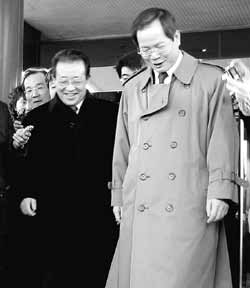
ROK chief negotiator Chun Yung-woo (right) and DPRK negotiator for the
Six-Party Talks Kim Kye-gwan leave a meeting in Beijing yesterday.
AFP |
"Everything can change," Kim told reporters after meeting Chun, when asked if
there has been any change in the DPRK's position. He did not elaborate.
The last round of the talks, aimed at denuclearizing the Korean peninsula and
involving the DRPK, ROK, China, the United States, Japan and Russia, ended
inconclusively in Beijing December, but three days of meetings in Berlin last
week between Kim and Washington's envoy, Christopher Hill, have raised hopes of
a breakthrough.
Another session of negotiations, which have continued off and on since 2003,
is expected to be announced soon.
"We and the DPRK agreed on resuming (the talks) in a few days, but the
positions of the other countries involved need to be checked so there is no
confirmation yet," the ROK's Yonhap news agency quoted Chun as saying.
Chinese Foreign Ministry spokesman Liu Jianchao said yesterday no date has
been set yet for another round of talks.
All the countries involved in the talks have agreed to restart the
negotiations as soon as possible, but the date for resumption has yet to be
fixed, Liu told reporters.
Japan's chief delegate to the talks Kenichiro Sasae will also arrive in
Beijing today to discuss the issue with China's chief negotiator Wu.
"We believe these meetings and talks are good for the next phase of the
Six-Party Talks," said Liu. "The relevant parties are hoping for an early
resumption of the talks."
China has already begun preparing for the next round, he said.
Liu said China hoped for progress on implementing a September 2005 joint
statement, in which Pyongyang pledged to give up its nuclear program in exchange
for security guarantees and economic aid.
"We hope related parties can reach a consensus on the actions to be taken to
implement the joint statement, and gradually set up a mechanism for implementing
it and lay out a timetable for concrete measures," he said.
China Daily-Agencies
(China Daily 01/24/2007 page2)