WASHINGTON: More Americans are dunking their children in Chinese immersion
classes and hiring Mandarin-speaking nannies in the hope of giving them a
competitive edge as China imposes itself as an economic giant.
"The Chinese language is extremely hot at the moment," said Michael Levine,
vice-president of the New York-based Asia Society, a non-profit organization
that promotes knowledge and understanding of Asia. "Chinese is a language that
people in the hinterland in states as diverse as Kansas and Kentucky - now want
to speak."
|

A student is tested by school teacher Ms Li during her full Chinese
immersion class at Potomac Elementary School in Maryland.
AFP |
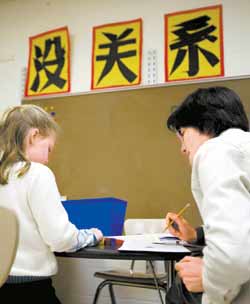
The trend is such that many schools across the country are unable to meet the
growing demand for Mandarin Chinese, the most widely spoken language in the
world but one that is just starting to make inroads in US schools.
"Parents and people in the school business are beginning to see China as one
big opportunity," Levine told AFP. "The question is: where on Earth, literally,
are we going to find the high-quality teachers that we need to fulfill the
demand?"
Shuhan Wang, executive director of the Asia Society's Chinese Language
Initiative, said between 300 and 400 schools nationwide currently offer Chinese
to an estimated 25,000 to 50,000 students and many more are gearing up for it as
the federal government makes funding available.
"I have been waiting for this for 20 years and I was always hopeful that
finally one day the US will wake up to the fact that we really need to expand
language offerings in our schools," Wang said.
At Potomac Elementary School, near Washington, the Chinese immersion program
launched in 1996 has become so popular that about 40 children are on a waiting
list to join and several of the spots available each year are given through a
lottery. About 18 percent of the students are of Asian origin.
"It's been a hit," said principal Linda Goldberg. "We're in a global society
and the parochial view of English first ... no longer holds."
Diana Conway said she and her husband decided to enroll their three children
in the Chinese immersion program at Potomac to expose them to a different
language and culture increasingly present on the world stage.
"Whatever path my children follow, this will be terrific for them," she said.
"French is a wonderful language, it will open Europe to you and a lot of Africa
but ... it won't open any doors to you in Asia."
The 150 students in the program at Potomac, where signs are posted in English
and Chinese, spend half their school day learning mathematics and science in
Mandarin and then switch to English for reading, social studies and language
arts.
Many of the children also get to travel to China during spring vacation.
The public school's three Chinese teachers speak only in Mandarin to their
pupils, using the blackboard, body language, facial expressions and objects to
get their message across.
"It's kind of difficult but it's cool and people recognize you for it," said
James, a 10-year-old struggling with a math equation in one of the classrooms.
Olivia, 7, said she enjoys learning the language for another reason.
"It's fun because I can speak it with my brother and we tell secrets in
Chinese that my parents don't understand," she said.
While US schools rush to fill the growing demand for Chinese, the same trend
is hitting companies that place nannies and au pairs who say they are being
deluged with requests for Chinese speakers.
In New York, Chinese nannies are in such demand that some can command a
salary of $20,000 more than an average nanny would earn.
One nanny reportedly even managed to secure a $70,000-salary after a bidding
war between two families.
Agencies are also reporting a surge in the demand for Chinese au pairs.
Michael DiMauro, senior vice president for marketing at the American
Institute For Foreign Study (AIFS), which oversees Au Pair in America, said his
company in the last year has received requests from about 1,400 families
nationwide interested in hosting an au pair from China.
So far, the company has only been able to provide two, but about 200 more are
expected to arrive in the United States this year.
"There is greater demand than supply," he told AFP. "But government relations
are improving in terms of cultural exchange, so what wasn't possible a few years
ago is now possible.
"There is a movement between the two governments to promote exchange," he
added. "We bring in about 4,700 au pairs from around the world annually and we
expect in a couple years that China will be one of our strongest countries."
AFP
(China Daily 01/23/2007 page12)