The most interesting thing to watch last week was certainly
Beijing's Financial Work Conference, despite the debate featured in all the
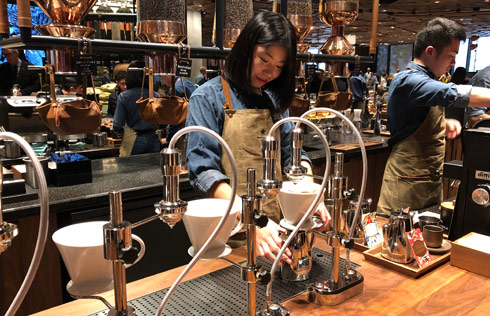
media over whether Starbucks coffee should be driven out of the Forbidden City.
Not all the Financial Work Conference's policy proposals have yet been
released to the public, as the nation's key financial institutions are still
holding their own meetings to set their work agenda for the year that has just
begun.
But whatever the specific policies, the stage is already set for China's
domestic capital market to show unprecedented liquidity and become one of the
world's main magnets for investor money.

Rumor abounds in Chinese-language financial newspapers about millions of US
dollars pouring into the Chinese stock market, now partially open to overseas
investors.
Supposedly, one manager was asked to handle $700 million, probably from some
large international hedge funds. Some people estimate that there could be as
much as $80 billion worth of international hot money already inside China.
It doesn't matter whether the rumor can be confirmed. The basic facts are
beyond doubt: With 20 trillion yuan ($2.57 trillion) in its 2006 GDP and close
to 10 trillion yuan ($1.29 trillion) in domestic stock market capitalization,
China is a new breeding ground for the world's largest corporations and merger
and acquisition deals.
With few ready channels to other investment markets, China's domestic capital
from social security funds to private savings is large enough to send its stock
market skyrocketing. Enough signs were seen in 2006, when the domestic
yuan-denominated A-share index almost doubled in just a few weeks before the end
of the year.
Even though A-shares are now supposedly only traded by domestic and licensed
foreign institutional investors on the Chinese mainland, there is no way to
completely block or effectively check the international money flowing into the
market. I personally have some friends, mostly overseas Chinese, who have been
busy stir-frying the A-shares quite happily for the last few months.
I was not surprised about the rumor that Lenovo plans a domestic listing in
addition to its Hong Kong listing. And if I were Lenovo's finance advisor, what
I would say to Lenovo Chairman Yang Yuanqing is: "Do it. Better do it now."
Having said all this, it will be for the benefit of the entire world if the
central government in Beijing can handle its "financial work" with new concepts
and new skills. Despite the old name, Beijing's financial work is vastly
different now from just two years ago, and increasingly changing. There will be
a day, not far from now, when the renminbi is fully convertible and the A-share
market completely open to international investors, including all the hot money
that can easily throw a careless government into a helpless state.
For one thing, controlling the market by dividing its players into different
classes and sectors, a method used in the past, will no longer apply. The system
will have to shift to the control of process, which requires minute-to-minute
monitoring and swift reaction in regulating all players.
So it is right that this year's Finance Work Conference did not accept the
proposal for setting up a super bureaucracy to control the State-owned financial
institutions. Following such a proposal is like wasting time on whether to have
a Starbucks in the Forbidden City.
Instead, to have a responsible and truly independent financial auditing
system is a much more pressing task.
(China Daily 01/22/2007 page4)