


 Comments
  Print
Print  Mail
Mail  Large Medium Small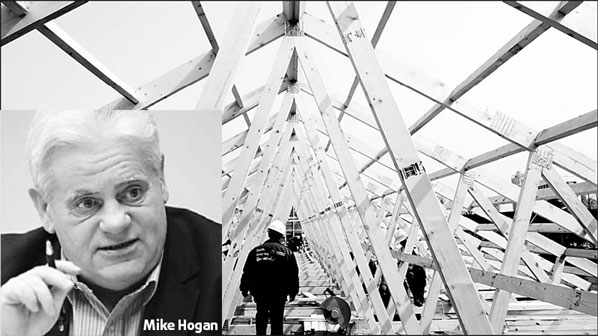
With its renowned Forbidden City and Summer Palace, the Middle Kingdom is known globally for its invention of post-and-beam wood construction.
Westerners have introduced their ways of building wooden structures in modern times, but although the techniques and materials have been adopted in places, most Chinese still consider wood construction less durable and desirable than concrete or brick.
Yet modern wood frame construction is not only more environmentally friendly - using trees that are replanted - but also durable, energy efficient and easily built, according to Mike Hogan, general manager of Forestry Investment Innovation (FII) China.
He says important characteristics of today's wood buildings include being fire and damp proof due to air pockets between wood and gypsum-board walls.
FII is wholly owned by the government of British Columbia (BC), Canada's western-most province, formed to market the province's lumber overseas.
According to the World Wildlife Fund, China's economic development and construction boom will see demand for 200 million cu m of lumber this year, half of it imported.
Arriving in China in 2003, FII found wood buildings were mostly villas for rich people. After market research, the government-funded institute decided to focus on average and middle-class consumers.
"FII is rather smart to make that decision," says Zhou Haibin, a researcher with the Chinese Academy of Forestry, noting that China has reined in luxury property development so FII has avoided the bottleneck.
FII's first breakthrough in China came using its wood-truss design in renovation of old houses in Shanghai.
Instead of copying the exact approach used in North America, it began working in 2004 with Shanghai Municipal Housing, Land and Resource Administration Bureau and Tongji University to tailor the system to local conditions. The demonstration project is designed to showcase FII's strengths and lure Chinese clients to accept modern wood frame construction.
"If wood trusses and wood parapet walls are used on old roofs, a wood truss system can be erected up to three times faster than any other system," says Hogan.
"The tailored roof design also addresses the cost issue, as there are thousands and thousands of these roofs all over China," he says. "Though the cost of repairing them all is much cheaper than replacing the buildings, the repair work is also an enormous expense."
The approach shares with light steel a weight advantage over concrete and can stop roof leaks, a common weakness in old Shanghai buildings. Wood roofs can also better withstand earthquakes.
A report by Tsinghua University shows that during construction wood structures use 27.75 percent less energy and save more than 39.2 percent of water over steel construction, while it consumes 45.24 percent less energy and saves 46.17 percent more of water compared to concrete structures.
In Shanghai, the energy used to build a wood house is 38.09 kWh per sq m, 8.79 per lower than light steel and 7.33 percent lower than a concrete structure.
The dry, cold climate of Beijing requires more energy to complete a finished wooden structure - in part to further weatherproof wood - yet such structures are still more energy efficient, requiring 53.26 kWh per sq m, 9.43 percent lower than light steel and 10.92 percent lower than concrete buildings.
Once all variables are considered, including use of Chinese materials instead of more expensive Canadian products, FII made a design that is both equal in cost to light steel and more "green".
Hogan says that if a general contractor uses the design on a wide scale, further cost reductions would come through mass production of trusses themselves instead of buying them from a supplier. While the roof truss design is complex, manufacturing them is not once the design is complete.
"In many ways this is a new kind of roof specially designed for the Chinese market. It takes advantage of existing Western wood design technology, but goes one step further and combines that with local products and conditions to produce a new roofing," says Hogan, adding that he is proud the demonstration project, a good start on promoting BC's wood products and technologies to China.
A second breakthrough Hogan cites is the "fully commercialized" renovation of 25 buildings in a common residential community in East China's coastal city Qingdao and 10 roofs in Shanghai's Zhabei district.
Challenges
Hogan admits the great challenge for him is communication.
"I don't mean miscommunication because of the language differences," he says, explaining that Chinese people have many legitimate concerns about using wood in construction. He says Canadians have developed a modern solution that addresses those concerns, but until that is successfully communicated there will be a great amount of resistance to using wood in China.
FII's greatest communication success to date has been in dealings with Chinese construction experts.
"Chinese and Western engineers or architects have their own language. And once FII has been able to demonstrate the benefits of the Canadian wood system to them, they have become of strongest supporters and most effective communicators," says the general manager.
FII China opened its Beijing office at the end of last year. "Beijing is the seat of government. Now that we have been able to develop some China-specific applications for wood, it is time for us to address more of the political and regulatory issues," says Hogan.
Researcher Zhou says that FII China is also facing competition with other wood promotion agencies, including those from other provinces of Canada and from Russia.
But he is optimistic about FII's opportunities. China is the world's second-largest wood importer after the United States. The central government's emphasis on the environment is expected to drive popularization of wood frame construction, he says.
(China Daily 01/28/2008 page5)

 Night views of Harbin through the lens
 Tibetans take train home after pilgrimage or travelling
 World's largest shaftless Ferris wheel built in China
 Ancient cities to be connected by Xi'an-Chengdu high-speed railway
 Snow turns Harbin into winter wonderland
 Reed Catkin Festival held in Wuhan
 Is it a building or a bookshelf?
 First flight
 Polar icebreaker Snow Dragon arrives in Antarctic
 Xi's vision on shared future for humanity
 UN's top environmental honors go to three in China
 German trains collide near Duesseldorf, several people injured
 China beats Germany 7-4 in men's curling Olympic qualification
 Bayern beat Paris Saint-Germain 3-1 in UEFA Champions League


Copyright 1995 - . All rights reserved. The content (including but not limited to text, photo, multimedia information, etc) published in this site belongs to China Daily Information Co (CDIC). Without written authorization from CDIC, such content shall not be republished or used in any form. Note: Browsers with 1024*768 or higher resolution are suggested for this site.
License for publishing multimedia online 0108263 Registration Number: 20100000002731