

 Comments
  Print
Print  Mail
Mail  Large Medium Small
While promoting his own menswear brand, Shi Xiaodong says he will not give up the OEM business that is the bread-and-butter for Dayang.
"We will still make clothes for international brands while creating new value for them," says Shi, president of Dalian Dayang Trands Co Ltd, China's largest exporter of men's suits.
He believes domestic clothing manufacturers have huge opportunities as Europe and the United States look for new production capacity and sources in countries like China.
But to avoid frenzied competition in the crowded "red ocean", Shi says Dayang must take advantage of the open seas of a "blue ocean" by "expanding its role in the value chain".
Blue Ocean Strategy, a business book written by W Chan Kim and Rene Mauborgne from the INSEAD business school, describes how successful businesses captured uncontested market space and made competition irrelevant. "Blue oceans" are untapped markets, while saturated markets are characterized as "red oceans" in which there is fierce competition.
To be sure, the 28-year-old company is no longer simply a factory for international brands. Its services range from sourcing fabrics to designing, from producing to managing orders, and from quality control to customs clearance.
Dayang is also expanding into logistics. It recently built a 40,000-sq-m warehouse near Dalian that mostly serves its Japanese clients to lower their costs by cutting out the need for storage in Japan. Dayang can directly deliver the products to its customers' retail outlets in Japan.
"Such value-added service is something our competitors cannot do and is what we are proud of," Shi says.
Exports currently account for more than 80 percent of Dayang's revenue.
"The quality of menswear produced in China is the closest to European standards you can find outside Europe. Here at Dayang, they emphasize and assure total quality - quality of the products and quality of timely delivery," says Raffi Ajemian, executive vice-president of Peerless Clothing.
Peerless Clothing is the largest maker of fine tailored clothing in North America. It produces under labels such as Ralph Lauren, Calvin Klein and CHAPS. Every year it purchases about 1 million pieces of clothing from Dayang, its largest supplier in China.
Dayang hires more than 11,000 employees and owns over 20 factories. But 28 years ago, it was a small workshop with only 85 female workers and 65 sewing machines in a little village 60 km distant from Dalian. Li Guilian, Dayang's founder, was a farmer who was forced out of school at early age due to poverty.
"I just wanted to do something, so my fellow villagers could buy extra pants when it was cold," Li recalls. She still remembers that her father, like other villagers, had to tie his only trousers with straw rope to keep warm when working in the fields in winter.
Li opened a small tailoring workshop in 1979 when China just launched its reform and opening up policy, and she started business by producing cushions and work gloves.
Her opportunity came in 1981 when a US clothing company outsourced the production of 16,000 corduroy coats to a large State-owned enterprise in Dalian. The enterprise declined to take the order because Spring Festival was coming and the Chinese do not usually work during the lunar New Year.
Li and her workers spent three days making four samples and stopped the representative from the US company at the Dalian airport. After checking the samples, the client cancelled his air ticket and awarded the order to Dayang.
Li's business flourished in following years when clothing companies from Japan and South Korea began to outsource production to factories in Dalian, a major port city in northern China. It takes only about three hours to fly from Dalian to Tokyo or Seoul.
"Dayang's partnership of over two decades with over 100 foreign companies has laid solid foundation for us to finally bring our own brands to consumers," Shi says. "We learned how to care about details by cooperating with Japanese clients. We are also deeply touched by the power of branding when working for leading European and US companies."
Dayang was listed on the Shanghai Stock Exchange in 2000. The money raised by the listing helped the company upgrade its equipment, import advanced techniques from Italy and hire foreign experts from Europe, Japan and South Korea. Dayang was one of China's first clothing companies that trained workers to stand up while working in its factories, which has greatly improved efficiency.
"My mother is a farsighted woman. These strategies have helped Dayang cushion the negative impact from the appreciation of renminbi," Shi says.
Focusing on producing high-end menswear, especially suits, also helps Dayang avoid fierce competition from other Chinese exporters, Shi adds.
"She is a strict mother and leader and is always aware of my shortcomings," Shi says.
Although Shi and his sister, who is Dayang's creative director, have started their own families, they still go home every day to have lunch with Li.
"This is a very efficient way to communicate and discuss our business so that we don't need to arrange meetings," Shi says.
(China Daily 11/12/2007 page12)

 Night views of Harbin through the lens
 Tibetans take train home after pilgrimage or travelling
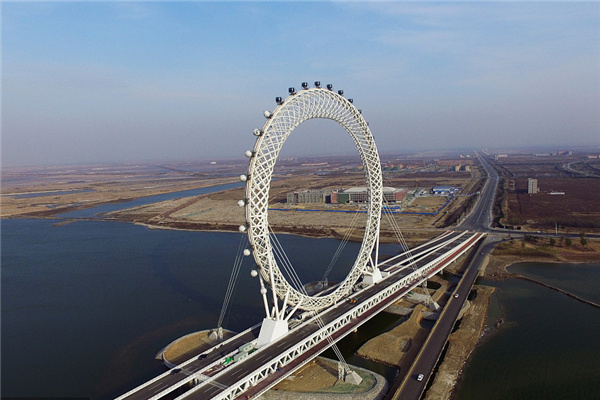 World's largest shaftless Ferris wheel built in China
 Ancient cities to be connected by Xi'an-Chengdu high-speed railway
 Snow turns Harbin into winter wonderland
 Reed Catkin Festival held in Wuhan
 Is it a building or a bookshelf?
 First flight
 Polar icebreaker Snow Dragon arrives in Antarctic
 Xi's vision on shared future for humanity
 UN's top environmental honors go to three in China
 German trains collide near Duesseldorf, several people injured
 China beats Germany 7-4 in men's curling Olympic qualification
 Bayern beat Paris Saint-Germain 3-1 in UEFA Champions League


Copyright 1995 - . All rights reserved. The content (including but not limited to text, photo, multimedia information, etc) published in this site belongs to China Daily Information Co (CDIC). Without written authorization from CDIC, such content shall not be republished or used in any form. Note: Browsers with 1024*768 or higher resolution are suggested for this site.
License for publishing multimedia online 0108263 Registration Number: 20100000002731